
Film review – Elysium
03 Sep 2014 Leave a comment
in constitutional political economy, development economics, economic growth, entrepreneurship, history of economic thought, law and economics, liberalism, P.T. Bauer, politics - USA, property rights, Public Choice, Rawls and Nozick, technological progress Tags: democracies, movies, rule of law, The Great Enrichment
Elysium was on TV. When I saw it on the big screen, no one told me it was a depiction of contemporary capitalism and the class war.

I read it as a contrast between third world countries lacking the rule of law and capitalist democracies.
The ships shooting up to the space station reminded me of Cubans trying to cross into the USA by boat to Florida.
Sorry, but I am just a simple country boy from the back blocks of Tasmania.
Why Bills of Rights
08 Aug 2014 Leave a comment
in constitutional political economy, law and economics Tags: Bill of Rights, democracy, Justice Robert Jackson, rule of law


In its majestic equality, the law forbids rich and poor alike to sleep under bridges, beg in the streets and steal loaves of bread?
15 Jul 2014 Leave a comment

The golden thread running through British justice
11 Jul 2014 Leave a comment
in economics of crime, law and economics, politics - New Zealand Tags: British justice, common law, presumption of innocence, rule of law


Thai Junta Revokes a Famed Academic’s Passport in Its Crackdown on Dissidents
11 Jul 2014 Leave a comment
in politics Tags: democracy, military coup, Pavin Chachavalpongpun, rule of law, Thailand

An old graduate school mate of ours from our Japan days, Pavin Chachavalpongpun, a prominent Thai political scholar and outspoken opponent of the country’s coup, has had his passport revoked as part of the Thai junta’s on-going campaign against dissent.
He is based at Japan’s Kyoto University, and is expected to seek asylum in Japan.
via The Thai Junta Revokes a Famed Academic’s Passport in Its Crackdown on Dissidents | TIME.
Freedom of religion and equality before the law in a democracy
04 Jul 2014 4 Comments
in liberalism, politics - Australia, war and peace Tags: democracy, democratic equality, Freedom of religion, freedom of speech, rule of law

An individual’s religious beliefs does not excuse him from compliance with an otherwise valid law of general application prohibiting conduct that governments are free to regulate.
Allowing exceptions to every law or regulation that directly or indirectly affects religion would open the prospect of constitutionally required exemptions from legal obligations of almost every conceivable kind. Examples are compulsory military service, payment of taxes, polygamy, vaccination requirements, and child-neglect laws. some parliaments do provide exemptions and accommodations but that does not say they must.
Justice Frankfurter wrote in 1940:
conscientious scruples have not in the course of the long struggle for religious toleration relieved the individual from obedience to a general law not aimed at the promotion or restriction of religious beliefs.
The mere possession of religious convictions which contradict the relevant concerns of political society does not relieve the citizen from the discharge of political responsibilities
Religious freedom bars laws that prohibit:
- the holding of a religious belief,
- the right to communicate those beliefs to others, and
- the right of parents to direct the education of their children.
This approach also has the advantage of not placing courts into the position of having to determine the importance of a particular belief in a religion or the plausibility of a religious claim when weighing it against other government interests and the objectives of the disputed law.
It might be said that there should be a compelling government interest before a religious objection can be overridden. Deciding what is a compelling government interest raises questions of public policy.
Men and women decide what is more or less important in the course of making legislation goes to the very heart of democratic decision-making. This clash of opinions and visions of the good society and what laws should be passed or not are all resolved peacefully through the ballot box and free speech even in the most desperate times.

This is not to say that a parliament may if it wishes exempt people from certain obligations on the basis of religious objections or making other accommodations. What it does require is that religions take their chances in democratic politics like the rest of us when seeking exemptions from a law.


Minorities with strong feelings about an issue regularly prevail in legislative battles because they are willing to vote as a block on one issue and trade their block support with other groups in the society to assemble the necessary majority for what they want.

Indeed, a major discontent with contemporary democratic politics is minorities and special interests have too much say, not too little.

It is up to the political process to decide whether to disadvantage those religious practices that are not widely engaged in, but that unavoidable consequence of democratic government must be preferred to a system in which each conscience is a law unto itself. To quote Frankfurter again:
Its essence is freedom from conformity to religious dogma, not freedom from conformity to law because of religious dogma.
Religious loyalties may be exercised without hindrance from the state, not the state may not exercise that which except by leave of religious loyalties is within the domain of temporal power. Otherwise each individual could set up his own censor against obedience to laws conscientiously deemed for the public good by those whose business it is to make laws…
The validity of secular laws cannot be measured by their conformity to religious doctrines. It is only in a theocratic state that ecclesiastical doctrines measure legal right or wrong
James Buchanan and a non-discriminatory democracy?
17 Jun 2014 Leave a comment
in constitutional political economy, F.A. Hayek, James Buchanan, liberalism Tags: non-discriminatory democracy, rule of law, veil of ignorance
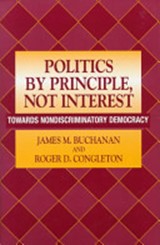
Under Buchanan’s generality norm, governments impose uniform regulation and use flat rate taxes on uniform tax bases to fund an equal-per-head demogrant (or a guaranteed minimum income) to replace all existing government cash transfers. Such a government would account for a large share of GDP. That did not bother him:
It seems to me that far too much of our politics is favourable treatment or unfavourable treatment for particularised groups. If we could somehow introduce into politics the requirement that would be analogous to the rule of law, that is, don’t treat one group differently from another group.
That has a lot of implications. That would not necessarily mean we’d have much smaller politics or government. It would mean there’d be a quite different characteristic of government…
The normative thrust of my current work is to try to push the generalization principle to the maximum extent possible, that is, so you don’t have particularised exemptions. One person gets it, everybody gets it. It cuts in favour of something like a flat tax. It cuts against means testing.
Buchanan has said that all successful welfare states (such as Sweden) apply a generality norm in some form or another.
For Buchanan, the very logic of majority rule implies unequal treatment or discrimination. If left unconstrained, majority coalitions will promote the interests of their own members at the expense of others.
Buchanan proposed a non-discriminatory democracy through the principle of generality:
- If extended to any single industry, tariff or quota protection also be extended and on equal terms to all industries.
- Tax structures would necessarily become simple, since the same tax rate would have to apply across-the-board on all sources or uses of tax base. Flat rate or proportional taxes on all incomes would broadly meet the generality norm.
- On the transfer side of the budget account, payments would have to be made in demogrants, equally available to all persons.
This is equivalent to Rawls’ veil of ignorance: choices must be without knowing where you lie in society so you make choices that are to the benefit of all.
Buchanan argued that if politics generates undesirable results, it is better to examine the rules than to argue about different policies or to elect different representatives. He build on Hayek who called a constitutional amendment that should read:
Congress shall make no law authorizing government to take any discriminatory measures of coercion.
Hayek went on say that, with such an amendment, all of the other rights would be unnecessary. In a non-discriminatory democracy, government choices are limited to those that benefit all.
Why Does 1% of History Have 99% of the Wealth? | Learn Liberty – YouTube
04 May 2014 Leave a comment
in constitutional political economy, development economics, entrepreneurship, liberalism, market efficiency, technological progress Tags: Deirdre McCloskey, industrial revolution, Rise of the Western World, rule of law, The Bourgeois Virtues, The Great Fact
Throughout the history of the world, the average person on earth has been extremely poor: subsisting on the modern equivalent of $3 per day.
This was true until 1800, at which point average wages—and standards of living—began to rise dramatically.
Prof. Deirdre McCloskey explains how this tremendous increase in wealth came about.
In the past 30 years alone, the number of people in the world living on less than $3 per day has been halved.
The cause of the economic growth we have witnessed in the past 200 years may surprise you.
It’s not exploitation, or investment. Innovation—new ideas, new inventions, materials, machinery, organizational structures—has fueled this economic boom.
Prof. McCloskey explains how changes in Holland and England in the 1600s and 1700s opened the door for innovation to take off—starting the growth that continues to benefit us today.
via Why Does 1% of History Have 99% of the Wealth? | Learn Liberty – YouTube.
Why call my blog Utopia – you are standing in it?
12 Mar 2014 2 Comments
in economics, liberalism, politics Tags: capitalism, Joan Robinson, liberalism, rule of law, technological progress, utopia
Welcome to my blog.
My blog reflects where I came from and how I think the world works for better and for worse.
Yes, my background is as a trained economist, but this blog’s title is more to do with how the over-weaning conceit of youth was replaced by an increasingly unreliable memory, a bad back and the odd dose of wisdom.
My mum and dad grew up between the two world wars. Their and my upbringing seem to be light years apart in terms of quality of life.
Longer and healthier life expectancies are obvious. Less obvious are the day to day risks of crippling diseases.
"Today, children in sub-Saharan Africa are more likely…"—Prof. Angus Deaton, @Princeton
Data: buff.ly/1K2tELk http://t.co/lrTdiLi3F7—
HumanProgress.org (@humanprogress) July 12, 2015
My brother told me a story about how my father, who was a doctor, used to give my older brothers and sisters the once-over with his eye each morning at breakfast looking for initial signs of polio and the other endemic childhood illnesses of the 1950s. These days, you show your age if you know of these endemic diseases. I was born a few years after mass immunisations of babies started. Was it just lucky me?
I am also old enough to remember when going to an airport was exciting because you were going somewhere. Devonport (in Tasmania) to Melbourne was a big trip when I was a kid. A luxury back then. Now airports are a boring wait that we must endure.
My sister traveled the world a lot. She started in about 1973 when an airfare from Sydney to London was $2,000. That was maybe a year’s income back then for her. For some reason, I kept note of that price. That airfare never increased despite 40 years of inflation.
I first visited Asia in 1993. Lived in Japan from 1995 to 1997.
Although of average height for an Australian, I was tall in Asia back then. Looking over the top of the crowd is really great. There were so few obese Japanese of any age that it really was a cause for comment when you saw one.
No more, no longer. Last time I visited Hong Kong, I was looking up at the young Chinese men serving behind the counters at McDonalds. Each generation is head and shoulders taller than their parents in Asia.
When I first visited my parents-in-law in the Philippines, that part of Leyte had no sealed roads and no phones. The next time I visited, the road was being sealed and mobile reception was better if you had an arial on the roof. After a five year gap in visiting, not only was mobile reception good, there was cable TV if you wanted it. When I visited in 2012, there was wireless internet if you had outside arial. Last Christmas, we hot spotted off my sister-in-law’s mobile.
These revolutionary improvements in my life in a rich country and in lives in developing countries must have a cause.
This blog will champion the spread of capitalism and the rule of law as the cause of the flourishing of humanity in the 20th century and beyond.
I call this a utopia because it is the heaven on earth that led so many to fall for the siren call of socialism and progressive politics. They did not notice that they were already in paradise.
Joan Robinson noted in her 1942 book An Essay on Marxism that when the Communist Manifesto was published in 1848, its battle cry, which would have had some currency, was:
‘Rise up ye workers, rise up, for you have nothing to lose but your chains.’
The industrial revolution was still in its infancy in 1848.
Alas, 90 years later, Joan Robinson suggested that this battle cry at the barricades would have to be amended to:
‘Rise up ye workers, rise up, for you have nothing to lose but your suburban home and your motor car.’
This optimism was in the middle of a world war and after the Great Depression. (Joan Robinson was one of the first writers to take Marx seriously as an economist).
These days the battle tweet of the progressive Left would have to be:
‘Rise up ye workers, rise up, for you have nothing to lose but your iPad and your air miles’.
 Utopia, you are standing in it!
Recent Comments