Far Left Mana Movement admits it’s really cheap to feed the kids

 Joe Trinder, the Mana News editor, today blogged about the great expense of feeding the kids for ordinary families. In the course of doing so, he showed how extremely cheap it was for parents to make their children breakfast. The Far Left has inadvertently capitulated on school breakfast programmes been outside the reach of ordinary families.


I completely agree with Joe. A 1 kg box of Weet-Bix costs $7 and a 2 L bottle of milk costs $5.55. I buy the cheaper brands of Weet-Bix than this myself.
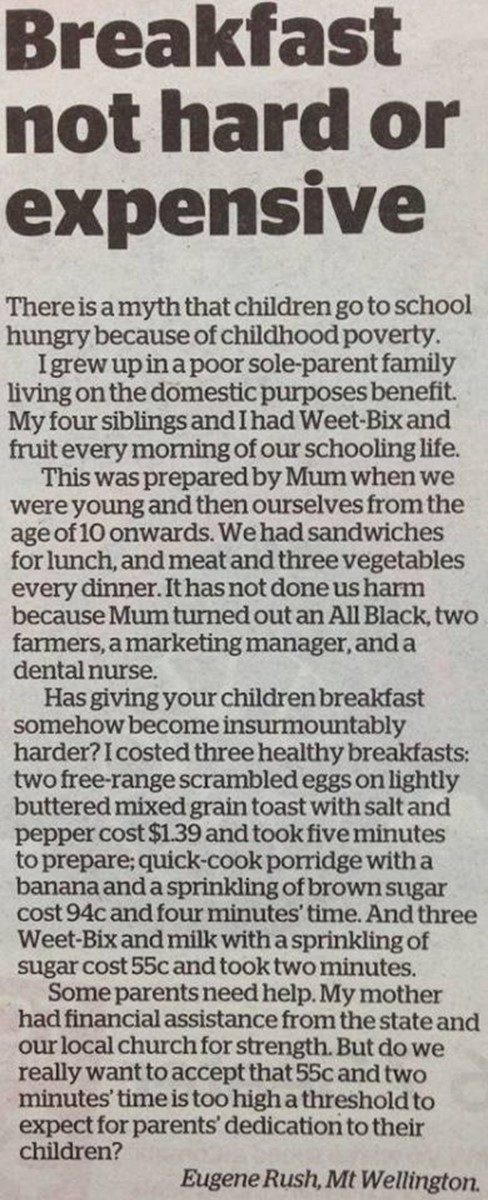
1 kg box of Weet-Bix will last maybe two weeks. 2 L of milk will last not much less than that if you pour the milk on Weet-Bix to the extent I do. Two weeks breakfast will cost much less than one dollar per breakfast as argued by Eugene Rush in her letter to the editor a few months ago.

If a family can’t find $.55 to make their children breakfast, they need targeted specific intervention from Work and Income New Zealand to see what additional financial assistance they need, including budget advice, and from the child protection agency, Child, Youth and Families.

  • Providing a hungry child with breakfast at school through a Feed the Kids Bill is parliamentary grandstanding that doesn’t strike at the root of the problem.
  • These hungry children are not provided with breakfast either at the weekend or during the school holidays. They are abandoned by the process set up under the Feed the Kids Bill championed by the hard left.
  • Worst of all, what about the parents? No good parent would have breakfast while their child goes hungry.

No provision is made by the hard left in its Feed the Kids Bill to feed the parents of these hungry children who also go hungry every morning. There is no other charitable explanation as to why their children were not given breakfast. No one in the house can afford breakfast both during school days, at the weekend and in school holidays.
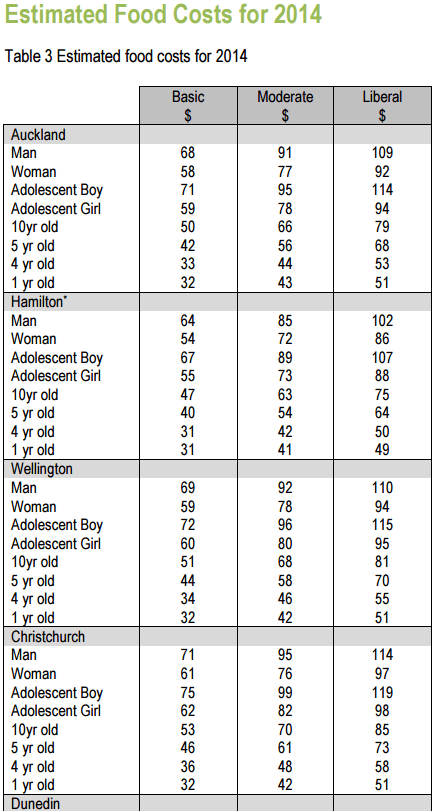
As shown from the screenshot above, the Otago University’s annual Food Cost Survey suggests that to meet basic needs, a family must spend $44 per week for a five-year-old and $34 per week for a four-year-old in Wellington, which is where I live. That is, it costs about five or six dollars per day per child to feed them. A liberal diet for a small child for a day costs not much more than a cup of coffee at a cafe where I’m going shortly. The real issue is the income of parents.

The best solution to poverty is to move people into a job. Simon Chapple is quite clear in his book in the middle of last year with Jonathan Boston that a sole parent in full-time work, and a two parent family with one earner with one full-time and one part-time worker, even at low wages, will earn enough to lift their children above most poverty thresholds.

Sustained full-time employment of sole parents and the fulltime and part-time employment of two parents, even at low wages, are sufficient to pull the majority of children above most poverty lines, given the various existing tax credits and family supports.

The best available analysis, the most credible analysis, the most independent analysis in New Zealand or anywhere else in the world that having a job and marrying the father of your child is the secret to escaping poverty is recently by the Living Wage movement in New Zealand.

According to the calculations of the Living Wage movement, earning only $18.80 per hour with a second earner working only 20 hours per week affords their two children, including a teenager, Sky TV, pets, international travel, video games and 10 hours childcare. This analysis of the Living Wage movement shows that finishing school so your job pays something reasonable and marrying the father of your child affords a comfortable family life.
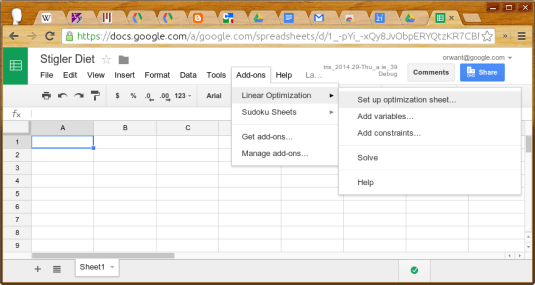
The Stigler diet is still as cheap as can be

The always excellent Matthew Kahn reminded me today of the Stigler diet: George Stigler’s famous 1945 journal article The Cost of Subsistence in the Journal of Farm Economics. Stigler posed this problem:

For a moderately active man (economist) weighing 154 pounds, how much of each of 77 foods should be eaten on a daily basis so that the man’s intake of nine nutrients (including calories) will be at least equal to the recommended dietary allowances suggested by the National Research Council in 1943, with the cost of the diet being minimal.

Stigler managed to find a nearly optimal daily diet of:

  • 1.6 pounds of wheat flour,
  • 0.3 pounds of cabbage,
  • 0.6 ounces of spinach,
  • 0.4 pounds of pancake flour,
  • 1.1 ounces of pork liver.

All of this food necessary to sustain health and weight of a moderately active man amounted to $0.16 per day in 1944, which is an annual cost of $39.93, not including leap years. A recent update for inflation put the annual cost of the Stigler diet at $561.43 in 2005. Not more than two dollars a day .

Stigler later concluded that the main issue about food consumption is a preference for a variety rather than a nutritional diet which could be obtained very low cost if you like cabbage, spinach, flour and a little bit of pork liver. For many years, pork liver was not available in my local supermarkets in Australia and New Zealand until recently when Asian buyers started to buy again.

photo

When various claims made about child poverty and children going without food, and adults too, the purpose of the Stigler diet in the calculations of the cost of subsistence is to show that it is actually extremely cheap to get the necessities of life in a capitalist society. Something more than either a lack of income in a modern welfare state or far from high prices of this extremely cheap, but spartan diet must be playing a role.

Is it really too hard for people to bother to feed their kids? – Whale Oil Beef Hooked

photo

via Is it really too hard for people to bother to feed their kids? – Whale Oil Beef Hooked | Whaleoil Media.

The Feed the Kids Bill still leaves their parents to go hungry!

The Feed the Kids Bill that has been reintroduced into the new New Zealand Parliament still contains no provision to feed the parents who are too poor to make their children breakfast.

Why are these hungry parents not invited for breakfast as well? No parent would have breakfast if their children was to go hungry. Both the parent and child must have gone hungry that morning, perhaps morning after morning. There is no other charitable explanation.

The Bill aims to set up government funded breakfast and lunch programmes in all decile 1-2 schools. The cost is $100 million a year – including food, staffing, administration, monitoring and evaluation.

Lindsay Mitchell was on the money when she wrote:

Even parents reliant on a benefit are paid enough to provide some fruit and modest sandwiches daily.

An inability to do so is a symptom of a greater problem requiring scrutiny – for the sake of their child.

“The ‘income management’ regime provides a response to genuinely hungry children.

It may interest you that even Labour advocated for extended income management in its election manifesto.

Their 2014 ‘Social Development’ policy paper proposed, “…allow[ing] income management to be used as a tool by social agencies where there are known child protection issues and it is considered in the best interests of the child, especially where there are gambling, drug and alcohol issues involved.”

Hungry children is a child protection issue. Parents who fail to feed their children should come to the attention of the child protection authorities. Those on the benefit should be subject to income management  because they clearly are spending their money elsewhere.

On the Left, there is a refusal to discuss the role of addiction and incompetent parenting in child poverty. The 2014 election manifesto of the Labour Party is a welcome departure from that tradition of denial.

Offsetting behaviour alert: school breakfast programmes

When children arrive at school without breakfast, being the dismal economist I am, the question I ask is not why they didn’t have breakfast – I ask whether their parents had breakfast.

If these children are getting a free breakfast because their parents are too poor to buy them breakfast food, why aren’t their parents invited to school to have a free breakfast as well. How do these parents eat at all? Any good parent would give up their breakfast for their children.

Diane Whitmore Schanzenbach and Mary Zaki in their just released Expanding the School Breakfast Program: Impacts on Children’s Consumption, Nutrition and Health look at the school lunch program is nearly universally available in U.S. public schools.

They use experimental data collected by the US Department of Agriculture to measure the impact of two policy innovations aimed at increasing access to the school breakfast program.

The first, universal free school breakfast, provides a hot breakfast before school (typically served in the school’s cafeteria) to all students regardless of their income eligibility for free or reduced-price meals.

The second is the Breakfast in the Classroom program that provides free school breakfast to all children to be eaten in the classroom during the first few minutes of the school day.

The study grouped schools into treated groups (school decided between breakfast in class and cafeteria-based) and control (had normal meal tested before school breakfast  which serves free or reduced-price (maximum price of 30 cents) breakfast to those that are income-eligible and can be purchased at full price for those ineligible for a meal subsidy).

The study showed that breakfast in the classroom substantially increased participation in the school breakfast program and the likelihood a child eats a high-quality breakfast. However, there was no evidence for positive impacts on other outcomes, including: overall dietary quality, health, attendance rates, and test scores.

Both policies increase the take-up rate of school breakfast, though much of this reflects shifting breakfast consumption from home to school or the consumption of multiple breakfasts and relatively little of the increase is from students gaining access to breakfast.

Eating in breakfast at home when I was kid was a good chance to talk to my mum and dad and brothers and sisters, but I wasn’t much of a morning person, so I might be understating the benefits of having breakfast at home. I was always running late, so I would always say to mum on the way out to the car to go to school

Feed the cat

.

Bassett, Brash & Hide

Celebrating humanity's flourishing through the spread of capitalism and the rule of law

Truth on the Market

Scholarly commentary on law, economics, and more

The Undercover Historian

Beatrice Cherrier's blog

Matua Kahurangi

Celebrating humanity's flourishing through the spread of capitalism and the rule of law

Temple of Sociology

Celebrating humanity's flourishing through the spread of capitalism and the rule of law

Velvet Glove, Iron Fist

Celebrating humanity's flourishing through the spread of capitalism and the rule of law

Why Evolution Is True

Why Evolution is True is a blog written by Jerry Coyne, centered on evolution and biology but also dealing with diverse topics like politics, culture, and cats.

Down to Earth Kiwi

Celebrating humanity's flourishing through the spread of capitalism and the rule of law

NoTricksZone

Celebrating humanity's flourishing through the spread of capitalism and the rule of law

Homepaddock

A rural perspective with a blue tint by Ele Ludemann

Kiwiblog

DPF's Kiwiblog - Fomenting Happy Mischief since 2003

The Dangerous Economist

Celebrating humanity's flourishing through the spread of capitalism and the rule of law

Watts Up With That?

The world's most viewed site on global warming and climate change

The Logical Place

Tim Harding's writings on rationality, informal logic and skepticism

Doc's Books

A window into Doc Freiberger's library

The Risk-Monger

Let's examine hard decisions!

Uneasy Money

Commentary on monetary policy in the spirit of R. G. Hawtrey

Barrie Saunders

Thoughts on public policy and the media

Liberty Scott

Celebrating humanity's flourishing through the spread of capitalism and the rule of law

Point of Order

Politics and the economy

James Bowden's Blog

A blog (primarily) on Canadian and Commonwealth political history and institutions

Science Matters

Reading between the lines, and underneath the hype.

Peter Winsley

Economics, and such stuff as dreams are made on

A Venerable Puzzle

"The British constitution has always been puzzling, and always will be." --Queen Elizabeth II

The Antiplanner

Celebrating humanity's flourishing through the spread of capitalism and the rule of law

Bet On It

Celebrating humanity's flourishing through the spread of capitalism and the rule of law

History of Sorts

WORLD WAR II, MUSIC, HISTORY, HOLOCAUST

Roger Pielke Jr.

Undisciplined scholar, recovering academic

Offsetting Behaviour

Celebrating humanity's flourishing through the spread of capitalism and the rule of law

JONATHAN TURLEY

Res ipsa loquitur - The thing itself speaks

Conversable Economist

Celebrating humanity's flourishing through the spread of capitalism and the rule of law

The Victorian Commons

Researching the House of Commons, 1832-1868

The History of Parliament

Articles and research from the History of Parliament Trust

Books & Boots

Reflections on books and art

Legal History Miscellany

Posts on the History of Law, Crime, and Justice

Sex, Drugs and Economics

Celebrating humanity's flourishing through the spread of capitalism and the rule of law

European Royal History

Exploring the Monarchs of Europe

Tallbloke's Talkshop

Cutting edge science you can dice with

Marginal REVOLUTION

Small Steps Toward A Much Better World

NOT A LOT OF PEOPLE KNOW THAT

“We do not believe any group of men adequate enough or wise enough to operate without scrutiny or without criticism. We know that the only way to avoid error is to detect it, that the only way to detect it is to be free to inquire. We know that in secrecy error undetected will flourish and subvert”. - J Robert Oppenheimer.

STOP THESE THINGS

The truth about the great wind power fraud - we're not here to debate the wind industry, we're here to destroy it.

Lindsay Mitchell

Celebrating humanity's flourishing through the spread of capitalism and the rule of law

Alt-M

Celebrating humanity's flourishing through the spread of capitalism and the rule of law

croaking cassandra

Economics, public policy, monetary policy, financial regulation, with a New Zealand perspective

The Grumpy Economist

Celebrating humanity's flourishing through the spread of capitalism and the rule of law

International Liberty

Restraining Government in America and Around the World