
via Forget momentum for renewables. Five of the G7 nations increased their coal use « JoNova.
Celebrating humanity's flourishing through the spread of capitalism and the rule of law
11 Jun 2015 Leave a comment
in development economics, energy economics, environmental economics, environmentalism, global warming, growth disasters, growth miracles Tags: renewable energy, solar power
10 Jun 2015 Leave a comment
in energy economics, environmental economics, global warming, politics - USA Tags: expressive voting, geothermal power, hydroelectric power, rational ignorance, rational irrationality, renewable energy, solar power, tidal power, wind power
22 Apr 2015 Leave a comment
in energy economics, environmental economics, global warming Tags: Big Solar, Big Wind, power prices, renewable energy, solar power, wind power
Compare #electricity prices across the #OECD area and learn more here: bit.ly/1xitg8T @IEA http://t.co/MGCtTlv1v8—
(@OECD) March 26, 2015
21 Apr 2015 Leave a comment
in energy economics, environmental economics Tags: Big Solar, Big Wind, green rent seeking, land supply, solar power
07 Apr 2015 Leave a comment
in energy economics, environmental economics, global warming Tags: land supply, renewable energy, solar power, wind power
18 Mar 2015 Leave a comment
in environmental economics, global warming, technological progress, transport economics Tags: carbon footprint, climate alarmism, expressive voting, global warming, solar flight, solar power
16 Mar 2015 Leave a comment
in energy economics, environmental economics, politics - Australia, politics - New Zealand, politics - USA Tags: Big Solar, Big Wind, climate alarmists, green rentseeking, solar power, wind power


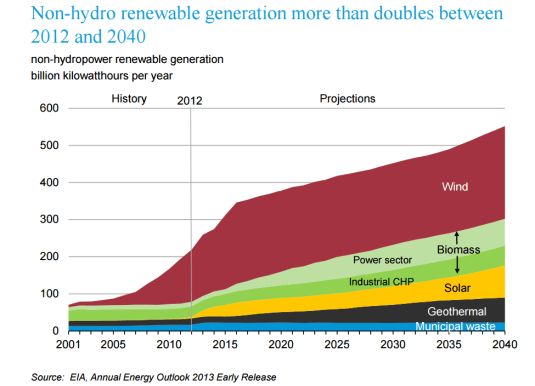
via eia.gov
The relationship between energy use & GDP
Technology is getting much more efficient
(Source bit.ly/1Anl8AJ) http://t.co/7zYDhXv2lu—
Max Roser (@MaxCRoser) March 15, 2015
13 Mar 2015 Leave a comment
in energy economics, environmental economics, global warming Tags: climate alarmism, creative destruction, global warming, killer green technologies, solar power

Unsubsidized rooftop solar electricity costs anywhere between $0.13 and $0.23/kWh today, well below retail price of electricity in many markets globally.
The economics of solar have improved significantly due to the reduction in solar panel costs, financing costs and balance of system costs. We expect solar system costs to decrease 5-15% annually over the next 3+ years which could result in grid parity within ~50% of the target markets.
If global electricity prices were to increase at 3% per year and cost reduction occurred at 5-15% CAGR, solar would achieve grid parity in an additional ~30% of target markets globally. We believe the cumulative incremental total available market for solar is currently around ~140GW/year and could potentially increase to ~260GW/year over the next 5 years as solar achieves grid parity in more markets globally and electric capacity needs increase…
solar system costs have declined at ~15% CAGR over the past 8 years and we expect 40% cost reduction over the next 4-5 years as a solar module costs continue to decline, panel efficiencies gradually improve, balance of system costs decline due to scale and competition, global financing costs decline due to development of new business models and customer acquisition costs decline as a result of increasing customer awareness and more seamless technology adoption enabled by storage solutions…
oil represents only about 5% of global electricity production and in some of the important solar markets such as US, China, oil based electricity generation is less than 5% of the total. Moreover, the cost of oil based electricity generation even at $50 oil prices is the 7-9c/kWh range and as shown in the note, the marginal cost is higher than solar in many regions worldwide. Bottom line is that oil prices do not have a material impact on solar demand.

About the only losers from this creative destruction in energy production, aside from the tens of thousands of public officials, academics and NGO employees who jobs and research grants depend up climate alarmism, are the birds that happen to fly past these solar power stations and are incinerated.

via Deutsche Bank’s 2015 solar outlook: accelerating investment and cost competitiveness – Deutsche Bank Responsibility and Deutsche Bank report: Solar grid parity in a low oil price era – Deutsche Bank Responsibility.
10 Mar 2015 Leave a comment
in energy economics Tags: Oil prices, solar power
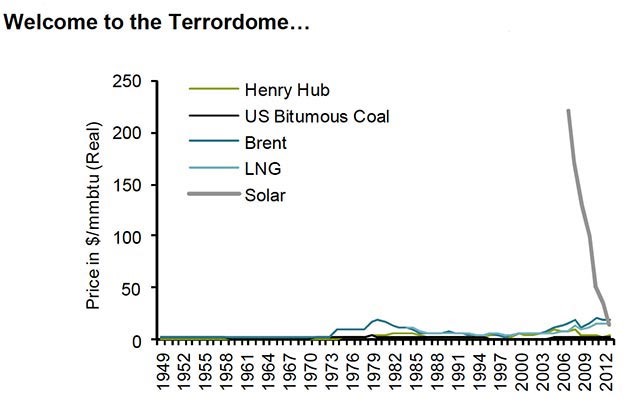
HT: Bloomberg.com
30 Jan 2015 Leave a comment
in energy economics Tags: renewable energy, solar power

HT: alexepstein
12 Sep 2014 Leave a comment
in environmental economics, environmentalism Tags: green hypocrisy, killer green technologies, solar power, wind farms

Exxon Mobil agreed to pay $600,000 in penalties after 85 migratory birds died of exposure to hydrocarbons at its natural gas facilities.
A common sight above the world’s largest solar thermal power plant is a streamer: a small plume of smoke that occurs without warning. The source is a bird that has inadvertently strayed into the white-hot heat above the plant’s many reflecting mirrors. No fines for the 28,000 birds killed in this way.

More than 573,000 birds are killed by U.S. wind farms each year. No fine.
the Obama administration issued an exemption in 2013 to allow wind power companies to kill or injure eagles without the fear of prosecution for up to three decades. The new rule is designed to address environmental consequences that stand in the way of the nation’s wind energy rush.
Celebrating humanity's flourishing through the spread of capitalism and the rule of law
Celebrating humanity's flourishing through the spread of capitalism and the rule of law
Celebrating humanity's flourishing through the spread of capitalism and the rule of law
Celebrating humanity's flourishing through the spread of capitalism and the rule of law
Celebrating humanity's flourishing through the spread of capitalism and the rule of law
Celebrating humanity's flourishing through the spread of capitalism and the rule of law
Celebrating humanity's flourishing through the spread of capitalism and the rule of law
A History of the Alt-Right
Econ Prof at George Mason University, Economic Historian, Québécois
Celebrating humanity's flourishing through the spread of capitalism and the rule of law
Scholarly commentary on law, economics, and more
Beatrice Cherrier's blog
Celebrating humanity's flourishing through the spread of capitalism and the rule of law
Celebrating humanity's flourishing through the spread of capitalism and the rule of law
Celebrating humanity's flourishing through the spread of capitalism and the rule of law
Why Evolution is True is a blog written by Jerry Coyne, centered on evolution and biology but also dealing with diverse topics like politics, culture, and cats.
Celebrating humanity's flourishing through the spread of capitalism and the rule of law
A rural perspective with a blue tint by Ele Ludemann
DPF's Kiwiblog - Fomenting Happy Mischief since 2003
Celebrating humanity's flourishing through the spread of capitalism and the rule of law
The world's most viewed site on global warming and climate change
Tim Harding's writings on rationality, informal logic and skepticism
A window into Doc Freiberger's library
Let's examine hard decisions!
Commentary on monetary policy in the spirit of R. G. Hawtrey
Thoughts on public policy and the media
Celebrating humanity's flourishing through the spread of capitalism and the rule of law
Politics and the economy
A blog (primarily) on Canadian and Commonwealth political history and institutions
Reading between the lines, and underneath the hype.
Economics, and such stuff as dreams are made on
"The British constitution has always been puzzling, and always will be." --Queen Elizabeth II
Celebrating humanity's flourishing through the spread of capitalism and the rule of law
Celebrating humanity's flourishing through the spread of capitalism and the rule of law
WORLD WAR II, MUSIC, HISTORY, HOLOCAUST
Undisciplined scholar, recovering academic
Celebrating humanity's flourishing through the spread of capitalism and the rule of law
Res ipsa loquitur - The thing itself speaks
In Hume’s spirit, I will attempt to serve as an ambassador from my world of economics, and help in “finding topics of conversation fit for the entertainment of rational creatures.”
Researching the House of Commons, 1832-1868
Articles and research from the History of Parliament Trust
Reflections on books and art
Posts on the History of Law, Crime, and Justice
Celebrating humanity's flourishing through the spread of capitalism and the rule of law
Exploring the Monarchs of Europe
Cutting edge science you can dice with
/cdn0.vox-cdn.com/uploads/chorus_asset/file/3768834/jacobson-us-renewables-2015.png)



Recent Comments