Earth Hour in North Korea
29 Mar 2015 Leave a comment
in development economics, growth disasters, growth miracles, Marxist economics Tags: Earth Hour, North Korea, South Korea
Great satellite photo of the Korean peninsula by night
14 Jan 2015 Leave a comment
in Marxist economics, war and peace Tags: North Korea, South Korea, workers paradise
Korean Peninsula from the International Space Station http://t.co/wMP6xT3yan—
Max Roser (@MaxCRoser) January 06, 2015
The World Bank wrote South Korea off in the 1960s
20 Jun 2014 3 Comments
in development economics, growth miracles Tags: East Asian Tigers, South Korea
The World Bank (2002) mentions South Korea and Botswana as long term success stories. The first World Bank mission to Korea in the early 1960s described Korea’s development program as ludicrously optimistic:
There can be no doubt that this development program GDP growth of 7.1 per cent exceeds the potential of the Korean economy. . .
It is inconceivable that exports will rise as much as projected.
Korean economic growth turned out to be 7.3 per cent in the forecasted period. In 1960, South Korea was one of the poorest countries in the world, with an income per head on a par with the poorest parts of Africa.
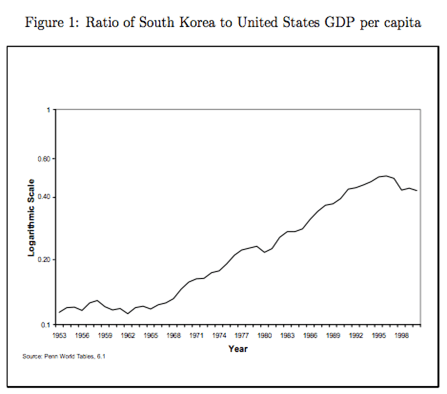
Unfortunately, a study for the World Bank’s Operations Evaluation Department found that Korea’s growth accelerated only after the decline in US aid, and did so by following policies contrary to the advice of US aid officials; hence, the consensus of most studies of Korea is that aid contributed little to Korea’s take-off (Fox 2000).
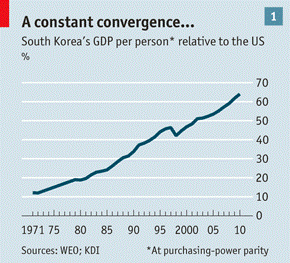
Chenery and Strout forecast in the early 1960s that growth in India and Pakistan over 1962-76 would exceed that of Korea. Rosenstein-Rodan at the same time predicted that Sri Lanka would have a higher per capita income than Taiwan or Korea by 1976. Hong Kong and Singapore, according to the same predictions, were to be left in the dust by Argentina and Colombia.
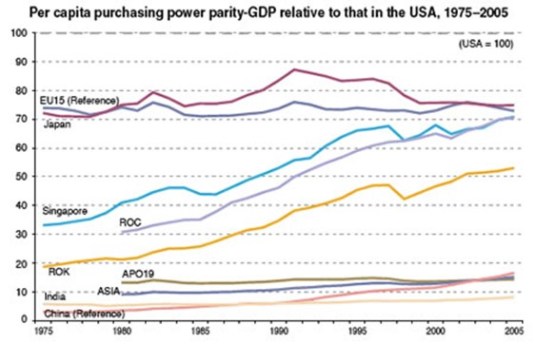
A key feature of this development miracle was an enormous increase in Korea’s international trade. In the early 1960s, Korea eliminated tariffs on imported production inputs and capital goods as long as these imports were used to produce goods for export. Beginning in the 1970s, Korea engaged in a broader, gradual reduction of tariff from about 40 per cent to 13 per cent.
Gordon Tullock is an interesting writer on South Korea saying that:
• Syngman Rhee was a socialist who knew nothing of capitalism.
• To make his country look capitalist to please the Americans, Rhee gave previously Japanese owned industries to his friends as monopolies.
• When General Park overthrew Syngman Rhee, he knew no economics, but he knew the bureaucracy was filled with Rhee’s cronies so he fired them all.
Tullock considers that South Korea became an open economy as a by-product of this political purge.
 Utopia, you are standing in it!
Recent Comments