Substitution may mean the destruction of certain #jobs but not of employment! https://t.co/j9dxIhVBGT #FutureOfWork pic.twitter.com/132fEg6wgi
— OECD Social (@OECD_Social) January 14, 2016
There is nothing new about the coming of robots
28 Jan 2016 Leave a comment
in economic history, economics of media and culture, entrepreneurship, industrial organisation, labour supply, survivor principle, technological progress Tags: automation, rational irrationality, skill bias technical change, technological unemployment
Why Are There Still so Many Jobs?
06 Dec 2015 Leave a comment
in entrepreneurship, industrial organisation, labour economics, labour supply, survivor principle Tags: creative destruction, David Autor, entrepreneurial alertness, technological unemployment
The robot revolution is overrated
22 Nov 2015 Leave a comment
in applied price theory, economic history, industrial organisation, international economics, labour supply Tags: automation, creative destruction, entrepreneurial alertness, industrial revolution, mechanisation, robots, technological unemployment
Creative destruction in British manufacturing employment
13 Nov 2015 Leave a comment
in applied price theory, applied welfare economics, economic history, industrial organisation, labour economics, labour supply, survivor principle Tags: British economy, British history, creative destruction, endogenous growth theory, labour reallocation, technological unemployment
@dsmitheconomics @thesundaytimes In mid-60s, about a third of workers were employed in manufacturing. Now 8%! http://t.co/ipmr7XvIme—
Andrew Sentance (@asentance) July 12, 2015
Factors that affect job automation
07 Jul 2015 Leave a comment
in labour economics, labour supply, technological progress Tags: creative destruction, skill bias technical change, technological unemployment
College profs face only a 3% chance their job will be automated? Nope, it's happening already.
npr.org/sections/money… http://t.co/DMPR3PWc5v—
Justin Wolfers (@JustinWolfers) May 28, 2015
More minimum wage job replacement units spotted
26 Jun 2015 Leave a comment
in industrial organisation, labour economics, labour supply, minimum wage, survivor principle, unions Tags: antimarket bias, creative destruction, expressive voting, technological unemployment
Every 20 years we worry about losing jobs to technology
17 Jun 2015 Leave a comment
in economics of education, entrepreneurship, human capital, industrial organisation, labour economics, labour supply, occupational choice, Public Choice, rentseeking, survivor principle Tags: antimarket bias, creative distraction, expressive voting, make-work bias, rational ignorance, rational irrationality, technological unemployment
Every 20 years we worry about losing jobs to tech. books.google.com/ngrams/graph?c… http://t.co/KW47Iwzsp9—
James Bessen (@JamesBessen) August 10, 2014
The robots are coming, the robots are coming – been there, done that in Japan
12 May 2015 1 Comment
in applied price theory, development economics, economic history, entrepreneurship, growth miracles, industrial organisation, labour economics, labour supply, survivor principle, unemployment Tags: creative destruction, entrepreneurial alertness, innovation, Japan, technological unemployment
When I was a kid, I used to like reading the Encyclopaedia Britannica. I read them from cover to cover.
One of the things I recalled from the Encyclopaedia Britannica was that in 1961 nearly half of the Japanese workforce worked in the agricultural sector.
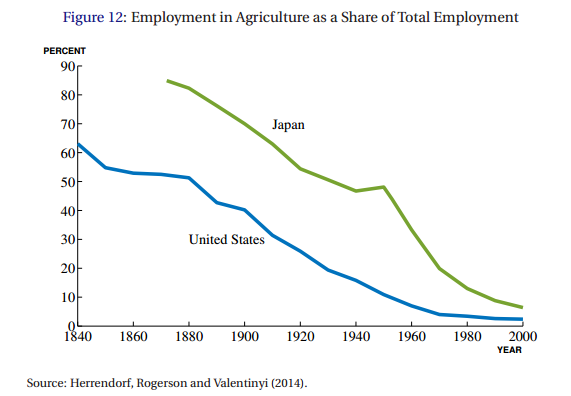
I notice that anomaly when I was reading the Encyclopaedia Britannica entry on Japan in the 1970s. Japan had undergoing an economic transformation since my Encyclopaedia Britannica’s were written in 1961. It was very much out of date.
Australian manufacturing was being outcompeted in every direction from automobiles to clothing and footwear by the Japanese manufacturing sector back when I was a teenager.
The Japanese economic miracle absorbed the Japanese agricultural labour force without anybody having time to shout "the robots are coming, the robots are coming".

There is a lesson in there somewhere for the current breathless journalism, with far too many academic fellow travellers about "the robots are coming, the robots are coming".
When I was a student at graduate school in Japan, I visited a Japanese factory in 1996 that was completely automated bar one function. Only once did a human hand actually touch the electrical goods they were making. Naturally, at the Q&A session at the end of our visit, I asked when was his job going to be automated.

The robots are coming, the robots are coming – creative destruction in time telling
04 May 2015 Leave a comment
in entrepreneurship, industrial organisation, survivor principle Tags: creative destruction, entrepreneurial alertness, technological unemployment
Before alarm clocks were affordable, 'knocker-ups' were used to wake people early in the morning. UK, around 1900 http://t.co/wD24qR85Jg—
History Pics (@HistoryPixs) January 20, 2014
The robots are coming, the robots are coming, but is it for my current job?
29 Apr 2015 1 Comment
in entrepreneurship, labour economics, labour supply, occupational choice Tags: creative destruction, entrepreneurial alertness, innovation, skill biased technical change, technological unemployment

What happened when the robots took all the agricultural jobs?
18 Apr 2015 Leave a comment
in entrepreneurship, industrial organisation, survivor principle Tags: agricultural economics, creative destruction, technological unemployment
around 1910, about a third of all US workers were in agriculture. It's now about 2%. conversableeconomist.blogspot.com/2015/03/snapsh… http://t.co/wUd8tbk0n6—
Catherine Rampell (@crampell) March 09, 2015
Another job that was replaced by a robot
25 Mar 2015 Leave a comment
in applied welfare economics, labour economics, labour supply, occupational choice, technological progress Tags: automation, creative destruction, technological unemployment
Bryan Caplan on the economics of Star Trek replicators (that is, artificial intelligence)
03 Mar 2015 Leave a comment
in labour economics, labour supply, technological progress, unemployment Tags: artificial intelligence, Bryan Caplan, creative destruction, demand for labour, star trek, Star Trek replicators, supply of labour, technological unemployment

Bryan Caplan wrote a blog a few years ago, explaining the labour economics of artificial intelligence, using an exam question he poses to his graduate students:
Suppose artificial intelligence researchers produce and patent a perfect substitute for human labour at zero MC.
Use general equilibrium theory to predict the overall economic effects on human welfare before AND after the Artificial Intelligence software patent expires.
He then gave the answer about a week later:
While the patent lasts, the patent-holder will produce a monopoly quantity of AIs. As a result, the effective labour supply increases, and wages for human beings fall – but not to 0 because the patent-holder keeps P>MC.
The overall effect on human welfare, however, is still positive! Since the AIs produce more stuff, and only humans get to consume, GDP per human goes up. How is this possible if wages fall?
Simple: Earnings for NON-labour assets (land, capital, patents, etc.) must go up. Humans who only own labour are worse off, but anyone who owns a home, stocks, etc. experiences offsetting gains.
When the patent expires, this effect becomes even more extreme. With 0 fixed costs, wages fall to MC=0, but total output – and GDP per human – skyrockets.
Human owners of land, capital, and other non-labour assets capture 100% of all output. Humans who only have labour to sell, however, will starve without charity or tax-funded redistribution.
His logic is quite good. Caplan drew attention in the responses to his blog of Capt J Parker and Alex Godofsky in the comments section of his blog.

My comments at the time were as follows:
- An artificially intelligent robot that was a perfect substitute for human labour sounds like the replicators on star trek?
- Who operates the machines? who tells them what to do? what not to do?
- After the patent expired, would anyone care if the poor stole/copied the AI machines and made them for for themselves. who cares if a free good is stolen?
- Is it a crime to steal a replicator on star trek?
Will robots take my job as a blogger?
12 Feb 2015 Leave a comment
in economics of media and culture, technological progress Tags: blogging, creative destruction, mechanisation, skill biased technical change, technological unemployment

It will be a slow train coming before they invent an angry paranoid blogger with every possible political view, conspiracy theory, taste in movies and humour, passionate scepticism and distain for anti-intellectualism depending on which menu button you click.
Every 20 years we worry about losing jobs to technology
26 Jan 2015 Leave a comment
in politics - Australia, politics - New Zealand, politics - USA, technological progress Tags: creative destruction, search and matching, technological unemployment

Every generation has its moral panic about technological change in creative destruction.
For young people, it’s that overweening conceit about the problems they are attempting to solve are new.
For the middle-aged and older, rather than suggest that they are policy hustlers, it’s more like you they simply forgot that these debates were had 20 years ago and the scaremongers lost the same reason they lost 20 years before that, and so on.
HT: https://twitter.com/JamesBessen/status/498435714322014208
 Utopia, you are standing in it!
Recent Comments