In 1959, Volvo invented the 3-point seat belt, then gave free license to all other car manufacturers to use it. pic.twitter.com/pUu9H5wsBt
— History In Facts (@HistoryInFacts) January 5, 2015
The slow diffusion of modern human resource management
19 Dec 2014 Leave a comment
in entrepreneurship, human capital, industrial organisation, managerial economics, market efficiency, organisational economics, personnel economics, survivor principle Tags: firm size, modern human resource management, technology diffusion, The meaning of competition
Modern human resource management gained ground in the 1980s, slowly replaced the centralising of people management in personnel departments that was widespread by the 1960s.

Modern human resource management stressed rigorous selection and recruitment, more training at induction and on-the-job, more teamwork and multi-skilling, better management-worker communication, the use of quality circles, and encouraging employee suggestions and innovation.
The aim is a highly committed and capable workforce that pulls toward common goals. This drive for employer-employee unity is in contrast to the old days of detachment and formality with managers directing and controlling workers.
Modern human resource management replaced compliance with rules with genuine employee commitment and a unified corporate culture.
Modern human resource management is a technology and there is a long lag on the widespread adoption of any new technology.
The lag on the intra-industry diffusion of new technologies from 10% to 90% of users is 15 to 30 years long (Hall 2003; Grubler 1991). The literature on technology transfer is full of examples of the slow and costly diffusion of new technologies even with the on-site help of the original innovator and experienced consultants (Boldrin and Levine 2008).

New management practices are often complex and they are often slow and costly to introduce successfully without the assistance of consultants with prior experience with the new practices (Bloom and Van Reenen 2007, 2010).
Managerial innovations such as Taylor’s scientific management, Ford’s mass production, Sloan’s M-form corporations, Deming’s quality movement and Toyota’s lean manufacturing diffused slowly over decades. These technologies required large investments in learning, retraining, reorganisation, trial and error and adaptation and there were many failures (Bloom and Van Reenen 2010).
Bryson, Gomez, Kretschmer and Willman (2007) found that workplace voice and modern, high-commitment human resource management practices diffused unevenly across British workplaces. More employees, larger multi-establishment networks, public or for-profit ownership and network effects all increased the rates of diffusion of the new practices.
Large firms may invest more in skills because they are the early adopters of new management practices. Large firms are organisationally complex and they require more structured, explicit management practices to survive. Higher levels of worker skills have been linked with firms having better management practices (Bloom and Van Reenen 2007, 2010).
Employers who pay higher wages lose more if they mismanage or under-utilise well-paid workers. Large firms pay more, on average, so they lose more if they do not adopt good management practices in a timely fashion.
There are fixed costs to adopting new technologies and management practices, so large firms may be the first to find them profitable (Hall 2003). Later adopters may follow this lead when the new practices are more proven and, through experience and adaptation, cheaper to adopt.
The organisational disruption from switching to any new technology can reduce production and profits for several years and the new way of doing business may fail perhaps at a great cost (Holmes, Levine, and Schmitz 2012; Atkeson and Kehoe 2007; Roberts 2004).
These costs and uncertainties slow technology diffusion and explain why smaller firms use seemly out-of-date management practices. The new ways are not yet profitable for them. The pace of adoption of new technologies is driven by changes in the profitability of using the new technology as compared to the old (Karshenas and Stoneman 1993).
Firms of different sizes will invest in skills development and new management practices to the extent that is profitable to their circumstances.
On some occasions, large firms will find it profitable to invest in more skills development because this is part of the costs of investing in more capital per worker. On other occasions, skills development is necessary to reduce the costs of a growing corporate hierarchy.
No firm cannot invest in more skills development unless this growth is buoyed by market demand. Precipitate investments in skills development are fraught with risks.
Is everything getting worse? Household technology adoption rates 1997-2010s
09 Dec 2014 Leave a comment
in politics - USA, technological progress Tags: technology diffusion, technology usage rates, The Great Enrichment, The Great Fact

HT: infodocket.com
Early Adoption of Technologies since 1750 till 2012
08 Dec 2014 Leave a comment
in applied welfare economics, economic growth, economic history, entrepreneurship Tags: 10-90 lag, international technology diffusion, technology diffusion, technology usage lags
Deigo Comin has been doing excellent work documenting both the length of 10-90 technology lags even for major technologies we now take for granted, and the contribution of these technology usage lags to international differences in living standards and post-war growth rates.
The East Asian Tigers all coincided with a catch-up in the range of technologies used with respect to industrialized countries. These development miracles all involved a substantial reduction of their technology adoption lags relative to (other) OECD countries
15 to 30 years is a common technology usage lag even within the United States for the 10-90 technology lag. The 10-90 lag is how long it takes between when 10% of industry is using a technology, and 90% of an industry is using that technology.


There is a plenty of research carried out about how important early adoption of technology is. I’ve recently skimmed a couple of researches on this topic. In my opinion there are two authors that made a better job than others. Their names are Diego Comin and Bart Hobijn.
They performed a cross-country analysis called Cross-country Historical Adoption of Technology (CHAT). This research dataset covers the diffusion of 104 technologies in 161 countries during the last 200 years. The data is available for download.
I just want to share with you the results of their report which could help better understand what’s happening in today’s world of innovations and entrepreneurship and what expect from future.
Finding # 1. “On average, countries adopted a new technology 45 years after its invention.”
Finding # 2. “Variation in adoption rates is larger than you might expect and accounts for 25% of differences…
View original post 95 more words

Who wins from the perennial gale of creative destruction
04 Aug 2014 Leave a comment
in technological progress Tags: creative destruction, Schumpeter, technology diffusion, The Great Enrichment, the withering away of the proletariat

- In 1900, <10% of families owned a stove, or had access to electricity or phones
- In 1915, <10% of families owned a car
- In 1930, <10% of families owned a refrigerator or clothes washer
- In 1945, <10% of families owned a clothes dryer or air-conditioning
- In 1960, <10% of families owned a dishwasher or colour TV
- In 1975, <10% of families owned a microwave
- In 1990, <10% of families had a cell phone or access to the Internet
HT: The Atlantic
Technology Adoption Among Senior Citizens
02 Jun 2014 Leave a comment
in applied price theory, technological progress Tags: technology diffusion, technology usage by age
Seniors use Tablets and Kindles as often as do teenagers. Seniors use what is useful to them. Their lower usage rates of other gadgets has little to do with been old fuddy-duddies and more to do with having more interesting things to do with their time.


via priceonomics.com
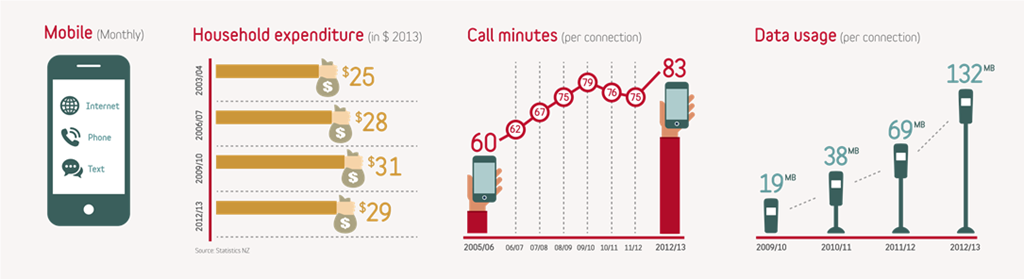
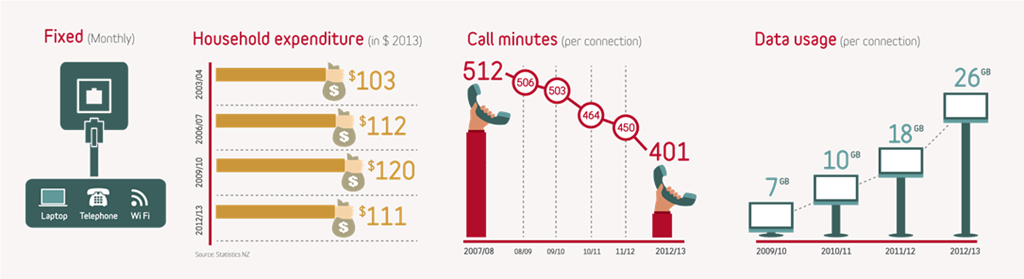
ICT is changing our lives
23 May 2014 Leave a comment
in technological progress Tags: ICT, technology diffusion, technology usage, The Great Fact
Source: Commerce Commission
 Utopia, you are standing in it!
Recent Comments