Energy use versus pollution levels
06 Mar 2015 Leave a comment
in development economics, economic history, energy economics, environmental economics, growth miracles Tags: air pollution, capitalism and freedom, The Great Escape
The Great Escape (from mortality inequality).
27 Feb 2015 Leave a comment
in health economics, Sam Peltzman Tags: capitalism and freedom, industrial revolution, infant mortality, The Great Escape, The Great Fact
Sam Peltzman in "Mortality Inequality" used the Lorenz curve to measure mortality inequality. The top figure below is based on data for 1852; the bottom figure on data for 2002. A straight line in the figure below at a 45-degree angle shows perfect equality of mortality: that is, 20% of the population lives 20% of the total life-years at this time; 40% of the population lives 40% of the life-years for this group, and so on.
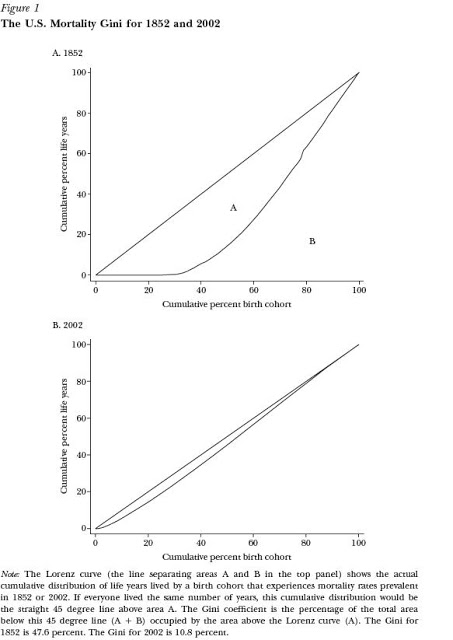
The curved line is the data In 1852 in the USA and in 2002. It shows that with high infant mortality, the bottom 30% of the distribution lived close to 0% of the life years in 1852.


How Often People in Various Countries Shower – Atlantic Mobile
18 Feb 2015 Leave a comment
in cricket, health economics Tags: The Great Escape

The greatest achievement in human history
15 Feb 2015 Leave a comment
in development economics, economic history, growth disasters, growth miracles Tags: The Great Enrichment, The Great Escape, The Great Fact

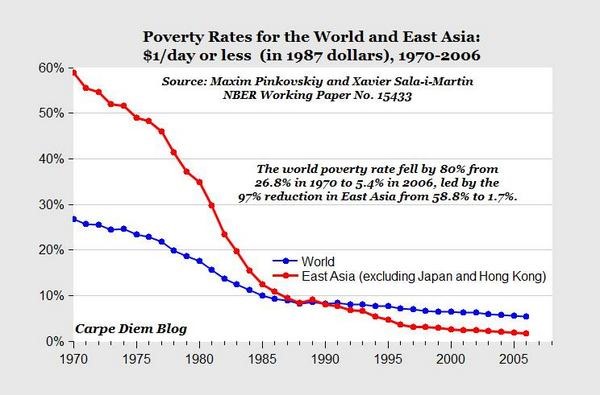
The World Bank reported on Oct. 9 that the share of the world population living in extreme poverty had fallen to 15% in 2011 from 36% in 1990. Earlier this year, the International Labor Office reported that the number of workers in the world earning less than $1.25 a day has fallen to 375 million 2013 from 811 million in 1991.
Such stunning news seems to have escaped public notice, but it means something extraordinary: The past 25 years have witnessed the greatest reduction in global poverty in the history of the world.
To what should this be attributed? Official organizations noting the trend have tended to waffle, but let’s be blunt: The credit goes to the spread of capitalism. Over the past few decades, developing countries have embraced economic-policy reforms that have cleared the way for private enterprise.
The reduction in world poverty has attracted little attention because it runs against the narrative pushed by those hostile to capitalism. The Michael Moores of the world portray capitalism as a degrading system in which the rich get richer and the poor get poorer. Yet thanks to growth in the developing world, world-wide income inequality—measured across countries and individual people—is falling, not rising, as Branco Milanovic of City University of New York and other researchers have shown.
Capitalism’s bad rap grew out of a false analogy that linked the term with “exploitation.” Marxists thought the old economic system in which landlords exploited peasants (feudalism) was being replaced by a new economic system in which capital owners exploited industrial workers (capitalism). But Adam Smith had earlier provided a more accurate description of the economy: a “commercial society.” The poorest parts of the world are precisely those that are cut off from the world of markets and commerce, often because of government policies.
Douglas Irwin
Recent life expectancy improvements across Europe
13 Feb 2015 Leave a comment
in applied welfare economics, health economics, technological progress Tags: life expectancy, The Great Escape, The Great Fact
This is how herd immunity works
11 Feb 2015 Leave a comment
in health economics Tags: anti-vaccination movement, herd immunity, The Great Escape, vaccinations
Timelines of vaccine preventable illnesses
09 Feb 2015 Leave a comment
in health economics Tags: anti-vaccination movement, The Great Escape, vaccines


A Report Card for Humanity: 1900-2050
06 Feb 2015 Leave a comment
in applied welfare economics, economic growth, health economics, technological progress Tags: The Great Enrichment, The Great Escape, The Great Fact


Everything is just getting better and better in the developing world
05 Feb 2015 Leave a comment
in development economics, growth disasters, growth miracles, health economics Tags: infant mortality, life expectancy, The Great Escape

HT: Alex Epstein

Some demographics of the anti-vaccination movement
03 Feb 2015 Leave a comment
in health economics, politics - USA Tags: anti-vaccination movement, The Great Escape, vaccinations, vaccines


The average American household was poorer in 2013 than it was in 1983 – Vox
31 Jan 2015 1 Comment
in applied welfare economics, population economics, poverty and inequality, technological progress Tags: Brad De Long, The Great Enrichment, The Great Escape, The Great Fact, time machines
/cdn0.vox-cdn.com/uploads/chorus_asset/file/3351202/vox-chart_net-worth-change-v2_1024.0.png)
US net worth rose considerably over that period, which is what you would expect to see.
Technology has improved and productivity increased, so society has a greater capacity for wealth building. America was also quite a bit older on average in 2013 than it was in 1983, so average wealth should have gone up.
But all of these gains went to the top 20 percent of the population. It’s worse than that, actually.
Over 100 percent of the gains went to the top 20 percent, because the bottom 60 percent of the population got poorer.
What does this claim by Matthew Yglesias exactly mean? He writes frequently on economics, so his editor must think he knows something about it.
http://t.co/0hEAL8X1kS—
EPI Chart Bot (@epichartbot) July 04, 2015
If 60% of the population got poorer as compared to 1983, they would be better off stepping into a time machine to go back to 1983. That is the only logical interpretation of this claim about 60% of the population. I owe this time machine thought experiment to Brad De Long.

Of course, going back to 1983, would involve giving up all products and services invented since then, and all product upgrades since then.
https://twitter.com/classicepics/status/561432237976322048
More importantly, for a good proportion of the population, they have become very sick or die immediately when they stepped out side of the Time Machine. This is because of shorter life expectancies in 1983 and the unavailability of a whole range of lifesaving medicines.

Am I just pedantic because I want access to crucial diabetic and other medications unavailable 30 years ago? No Internet, no cable, no international travel and no mobile phones.

In his original thought experiment, De Long asks how much you would want in additional income to agree to go back in time to a specific year. De Long was an economic historian examining the differences in living standards as compared to 1890 and 1990 and how that gap is greatly underestimated in economic statistics. De Long would have refused to go into the time machine to return to 1890 unless he could pack a very large bag to take with him:
I would want, first, health insurance: the ability to go to the doctor and be treated with late-twentieth-century medicines.
Franklin Delano Roosevelt was crippled by polio. Without antibiotic and adrenaline shots I would now be dead of childhood pneumonia.
The second thing I would want would be utility hookups–electricity and gas, central heating, and consumer appliances.
The third thing I want to buy is access to information–audio and video broadcasts, recorded music, computing power, and access to databases.
None of these were available at any price back in 1890.
 Utopia, you are standing in it!
Recent Comments