Incredible Decrease in Child Mortality Worldwide in Last 50 Years
18 Mar 2015 Leave a comment
in development economics, growth disasters, growth miracles, health economics, liberalism Tags: child mortality, The Great Escape, The Great Fact
Capitalism and the abolition of extreme poverty – mobile phones addition
07 Mar 2015 Leave a comment
The Great Escape (from mortality inequality).
27 Feb 2015 Leave a comment
in health economics, Sam Peltzman Tags: capitalism and freedom, industrial revolution, infant mortality, The Great Escape, The Great Fact
Sam Peltzman in "Mortality Inequality" used the Lorenz curve to measure mortality inequality. The top figure below is based on data for 1852; the bottom figure on data for 2002. A straight line in the figure below at a 45-degree angle shows perfect equality of mortality: that is, 20% of the population lives 20% of the total life-years at this time; 40% of the population lives 40% of the life-years for this group, and so on.
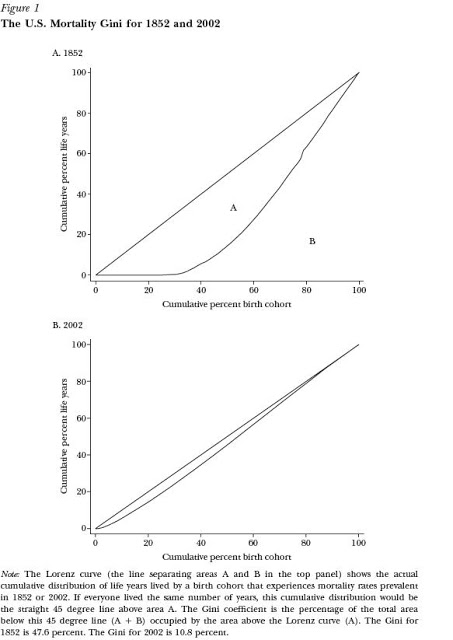
The curved line is the data In 1852 in the USA and in 2002. It shows that with high infant mortality, the bottom 30% of the distribution lived close to 0% of the life years in 1852.
Everybody is seriously richer because of post-war capitalism
22 Feb 2015 Leave a comment
in economic growth, economic history, liberalism Tags: capitalism and freedom, The Great Enrichment, The Great Fact
Figure 1: Growth in real average income for the bottom 90%

Source: voxeu.org
By the way, in the countries where growth in real average incomes appears to have flattened out, is it seriously suggested that middle-class families cannot buy a basket of goods of superior quality and quantity than they could 30 or 40 years ago?

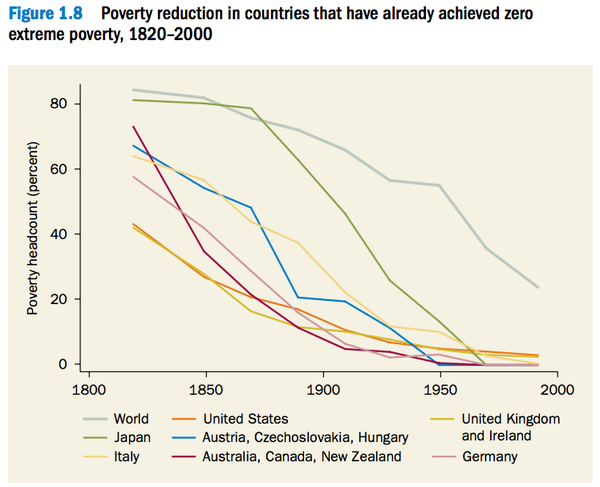
Yes it is possible to end poverty
17 Feb 2015 Leave a comment
Economics as Incredulity : Working conditions during the Industrial Revolution
16 Feb 2015 Leave a comment

The greatest achievement in human history
15 Feb 2015 Leave a comment
in development economics, economic history, growth disasters, growth miracles Tags: The Great Enrichment, The Great Escape, The Great Fact

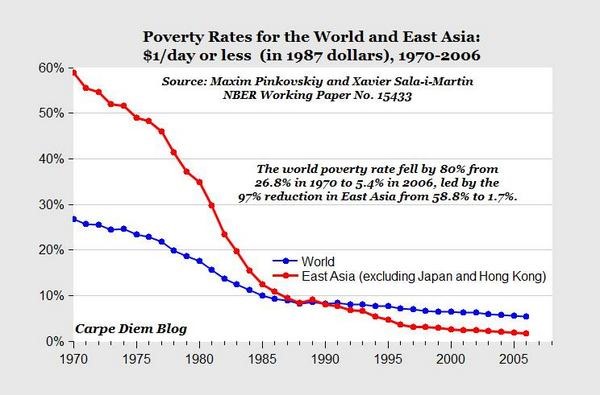
The World Bank reported on Oct. 9 that the share of the world population living in extreme poverty had fallen to 15% in 2011 from 36% in 1990. Earlier this year, the International Labor Office reported that the number of workers in the world earning less than $1.25 a day has fallen to 375 million 2013 from 811 million in 1991.
Such stunning news seems to have escaped public notice, but it means something extraordinary: The past 25 years have witnessed the greatest reduction in global poverty in the history of the world.
To what should this be attributed? Official organizations noting the trend have tended to waffle, but let’s be blunt: The credit goes to the spread of capitalism. Over the past few decades, developing countries have embraced economic-policy reforms that have cleared the way for private enterprise.
The reduction in world poverty has attracted little attention because it runs against the narrative pushed by those hostile to capitalism. The Michael Moores of the world portray capitalism as a degrading system in which the rich get richer and the poor get poorer. Yet thanks to growth in the developing world, world-wide income inequality—measured across countries and individual people—is falling, not rising, as Branco Milanovic of City University of New York and other researchers have shown.
Capitalism’s bad rap grew out of a false analogy that linked the term with “exploitation.” Marxists thought the old economic system in which landlords exploited peasants (feudalism) was being replaced by a new economic system in which capital owners exploited industrial workers (capitalism). But Adam Smith had earlier provided a more accurate description of the economy: a “commercial society.” The poorest parts of the world are precisely those that are cut off from the world of markets and commerce, often because of government policies.
Douglas Irwin
Recent life expectancy improvements across Europe
13 Feb 2015 Leave a comment
in applied welfare economics, health economics, technological progress Tags: life expectancy, The Great Escape, The Great Fact
A Report Card for Humanity: 1900-2050
06 Feb 2015 Leave a comment
in applied welfare economics, economic growth, health economics, technological progress Tags: The Great Enrichment, The Great Escape, The Great Fact


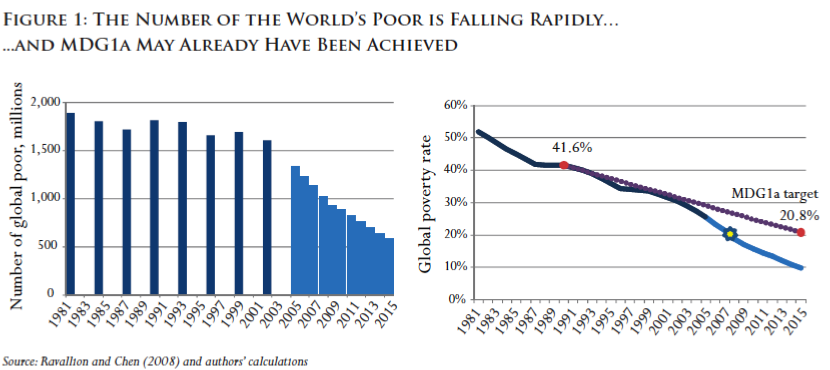
Too easy: halving between 1990 and 2015 the proportion of people living on less than $1.25 a day – Millennium Development Goal 1a
03 Feb 2015 Leave a comment
in development economics, growth miracles Tags: capitalism and freedom, millennium development goals, The Age of Milton Friedman, The Great Fact
 Utopia, you are standing in it!
Recent Comments