The Treason Of The Clerisy: Capitalism And The Intellectuals After 1848

Deirdre McCloskey is of the view that the “the clerisy” has been, with notable exceptions, hostile to capitalism and downright contemptuous of the morals and attitudes of the middle class that has flourished under capitalism:

The Germans called it the Clerisei or later the Bildungsbürgertum, the cultivated and reading as against the commercial and bettering bourgeoisie. In the eighteenth century the members of the clerisy such as Voltaire and Tom Paine had courageously advocated our liberties.

But in the 1830s and 1840s a much enlarged clerisy, mostly the sons of bourgeois fathers, commenced sneering at the liberties the fathers exercised so vigorously in the market and the factory.

On the right the clerisy under the influence of Romance looked back with nostalgia to an imagined medieval time without markets, in which stasis and hierarchy ruled…

On the left, meanwhile, the clerisy, likewise influenced by Romance, and then by historical materialism, developed the illiberal idea that ideas do not matter.

What matters to progress, they declared, is the unstoppable tide of history, aided (they declared further, contradicting themselves) by protests or strikes or even violent revolutions directed at the thieving bourgeoisie, movements to be led of course by the clerisy.

Later, in European socialism and American progressivism, the left proposed to defeat bourgeois monopoly of markets by gathering under regulation or central planning or ownership of the means of production all the monopolies into one big monopoly of violence called the state.

Yet the commercial bourgeoisie so despised by the clerisy left and right made the Great Enrichment and the modern world.

The Enrichment gigantically improved our lives, showing that both social Darwinism and economic Marxism were mistaken. The genetically inferior races and classes and ethnicities proved not to be so. The exploited proletariat was not immiserised but enriched.

and

Forcing in an illiberal way the French style of equality of outcome, cutting down the tall poppies, treating people as sad children to be engineered by the experts of the clerisy, we have found, has often had a high cost in damaging liberty and slowing betterment. Not always, but often.

On the other hand, introducing the Scottish style of equality of liberty and dignity, as in Hong Kong and Norway and France itself, has regularly led to an astounding betterment and to a real equality of outcome—with even the poor acquiring automobiles and plumbing denied in earlier times even to the rich, and acquiring political rights and social dignity denied in earlier times to everyone except the rich

The average American household was poorer in 2013 than it was in 1983 – Vox

US net worth rose considerably over that period, which is what you would expect to see.

Technology has improved and productivity increased, so society has a greater capacity for wealth building. America was also quite a bit older on average in 2013 than it was in 1983, so average wealth should have gone up.

But all of these gains went to the top 20 percent of the population. It’s worse than that, actually.

Over 100 percent of the gains went to the top 20 percent, because the bottom 60 percent of the population got poorer.

What does this claim by Matthew Yglesias exactly mean? He writes frequently on economics, so his editor must think he knows something about it.

If 60% of the population got poorer as compared to 1983, they would be better off stepping into a time machine to go back to 1983. That is the only logical interpretation of this claim about 60% of the population. I owe this time machine thought experiment to Brad De Long.

Of course, going back to 1983, would involve giving up all products and services invented since then, and all product upgrades since then.

https://twitter.com/classicepics/status/561432237976322048

More importantly, for a good proportion of the population, they have become very sick or die immediately when they stepped out side of the Time Machine. This is because of shorter life expectancies in 1983 and the unavailability of a whole range of lifesaving medicines.

Am I just pedantic because I want access to crucial diabetic and other medications unavailable 30 years ago? No Internet, no cable, no international travel and no mobile phones.

In his original thought experiment, De Long asks how much you would want in additional income to agree to go back in time to a specific year. De Long was an economic historian examining the differences in living standards as compared to 1890 and 1990 and how that gap is greatly underestimated in economic statistics. De Long would have refused to go into the time machine to return to 1890 unless he could pack a very large bag to take with him:

I would want, first, health insurance: the ability to go to the doctor and be treated with late-twentieth-century medicines.

Franklin Delano Roosevelt was crippled by polio. Without antibiotic and adrenaline shots I would now be dead of childhood pneumonia.

The second thing I would want would be utility hookups–electricity and gas, central heating, and consumer appliances.

The third thing I want to buy is access to information–audio and video broadcasts, recorded music, computing power, and access to databases.

None of these were available at any price back in 1890.

HT: http://www.vox.com/2015/1/28/7929939/net-worth-decline

The first fridge for a family and whole village

The world’s poverty – in 50 seconds from BBC

The Human Development Index is rising in every world region.

https://twitter.com/MaxCRoser/status/560368719390851072

Image

Google maps circa 1963

Image

Thanks to capitalism the world’s poor are getting richer

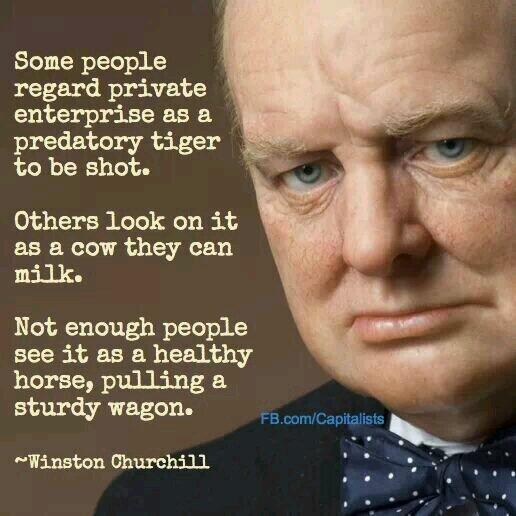
Winston Churchill on Piketty

Embedded image permalink

Image

How is global poverty going?

image

Image

Global Warming Was Worth It

graph (6)

  • Higher incomes that allow people to make livings that afford them more than merely survival or avoiding starvation.
  • A low poverty rate.
  • High quality and diversity of employment opportunities. Rather than the choice of being a farmer or being a blacksmith, the average citizen should have an  array of careers to choose from, and the ability to be industrious and take risks for profit.
  • The availability of housing. On an average night in the United States, a country with a population of somewhere around 350 million, fewer than one million people are homeless.
  • Consistent GDP growth.
  • Access to quality health care.
  • The availability of quality education. (I suppose we could quibble over the word “quality,” but certainly there is widespread free education availability.)
  • High life expectancy. Worldwide life expectancy has more than doubled from 1750 to 2007.
  • Low frequency of deadly disease.
  • Affordable goods and services.
  • Infrastructure that bolsters economic growth.
  • Political stability.
  • Air conditioning.
  • Freedom from slavery, torture and discrimination.
  • Freedom of movement, religion and thought.
  • The presumption of innocence under the law.
  • Equality under the law regardless of gender or race.
  • The right to have a family – as large as one can support. Maybe even larger.
  • The right to enjoy the fruits of labor without government – or anyone else – stealing it.

via Global Warming Was Worth It.

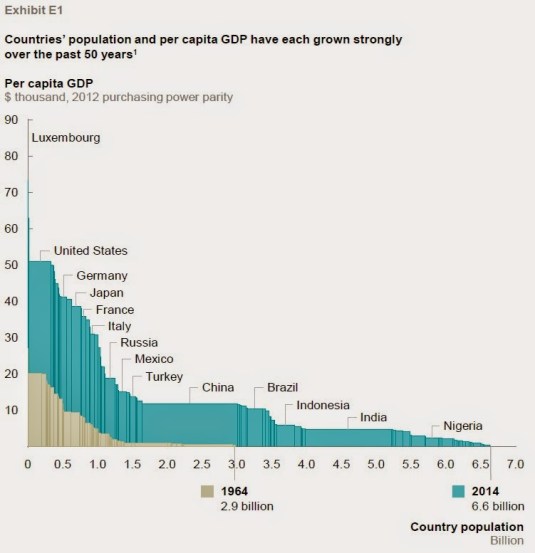
The Great Fact in one chart

HT: CONVERSABLE ECONOMIST: Global Economic Growth: All Productivity, All the Time.

GDP at PPP by population shares

https://twitter.com/MaxCRoser/status/557451764199620609

Image

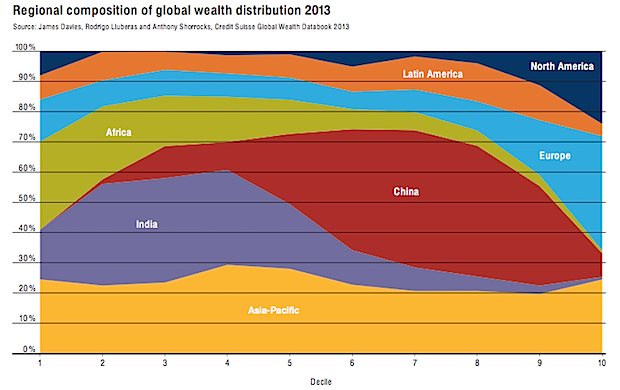
The regional composition of global wealth

image

HT: http://blogs.reuters.com/felix-salmon/2014/04/04/stop-adding-up-the-wealth-of-the-poor/

What Oxfam doesn’t want you to know: global capitalism means there’s less poverty than ever » Spectator Blogs

Screen Shot 2015-01-19 at 08.29.48

War on Disease

We are, right now, living through the golden age of poverty reduction.  

Anyone serious about tackling global poverty (and I’m afraid we have to exclude Oxfam from this category) has to accept that whatever we’re doing now, it’s working – so we should keep doing it.

We are literally on the road to an incredible goal: the abolition of poverty, as we know it, within our lifetime. 

Those who care more about helping the poor than hurting the rich will celebrate the fact – and make sure free trade and global capitalism keep spreading so as to finish the job.

via What Oxfam doesn’t want you to know: global capitalism means there’s less poverty than ever » Spectator Blogs.

Thomas Babington Macaulay on the early days of The Great Fact

If any person had told the Parliament which met in terror and perplexity after the crash of 1720 that in 1830 the wealth of England would surpass all their wildest dreams, that the annual revenue would equal the principal of that debt which they considered an intolerable burden, that for one man of £10,000 then living there would be five men- of £50,000, that London would be twice as large and twice as populous, and that nevertheless the mortality would have diminished to one-half what it then was, — that the post-office would bring more into the exchequer than the excise and customs had brought in together under Charles II.  - Thomas B. Macaulay

Image

Previous Older Entries Next Newer Entries

Bassett, Brash & Hide

Celebrating humanity's flourishing through the spread of capitalism and the rule of law

Truth on the Market

Scholarly commentary on law, economics, and more

The Undercover Historian

Beatrice Cherrier's blog

Matua Kahurangi

Celebrating humanity's flourishing through the spread of capitalism and the rule of law

Temple of Sociology

Celebrating humanity's flourishing through the spread of capitalism and the rule of law

Velvet Glove, Iron Fist

Celebrating humanity's flourishing through the spread of capitalism and the rule of law

Why Evolution Is True

Why Evolution is True is a blog written by Jerry Coyne, centered on evolution and biology but also dealing with diverse topics like politics, culture, and cats.

Down to Earth Kiwi

Celebrating humanity's flourishing through the spread of capitalism and the rule of law

NoTricksZone

Celebrating humanity's flourishing through the spread of capitalism and the rule of law

Homepaddock

A rural perspective with a blue tint by Ele Ludemann

Kiwiblog

DPF's Kiwiblog - Fomenting Happy Mischief since 2003

The Dangerous Economist

Celebrating humanity's flourishing through the spread of capitalism and the rule of law

Watts Up With That?

The world's most viewed site on global warming and climate change

The Logical Place

Tim Harding's writings on rationality, informal logic and skepticism

Doc's Books

A window into Doc Freiberger's library

The Risk-Monger

Let's examine hard decisions!

Uneasy Money

Commentary on monetary policy in the spirit of R. G. Hawtrey

Barrie Saunders

Thoughts on public policy and the media

Liberty Scott

Celebrating humanity's flourishing through the spread of capitalism and the rule of law

Point of Order

Politics and the economy

James Bowden's Blog

A blog (primarily) on Canadian and Commonwealth political history and institutions

Science Matters

Reading between the lines, and underneath the hype.

Peter Winsley

Economics, and such stuff as dreams are made on

A Venerable Puzzle

"The British constitution has always been puzzling, and always will be." --Queen Elizabeth II

The Antiplanner

Celebrating humanity's flourishing through the spread of capitalism and the rule of law

Bet On It

Celebrating humanity's flourishing through the spread of capitalism and the rule of law

History of Sorts

WORLD WAR II, MUSIC, HISTORY, HOLOCAUST

Roger Pielke Jr.

Undisciplined scholar, recovering academic

Offsetting Behaviour

Celebrating humanity's flourishing through the spread of capitalism and the rule of law

JONATHAN TURLEY

Res ipsa loquitur - The thing itself speaks

Conversable Economist

Celebrating humanity's flourishing through the spread of capitalism and the rule of law

The Victorian Commons

Researching the House of Commons, 1832-1868

The History of Parliament

Articles and research from the History of Parliament Trust

Books & Boots

Reflections on books and art

Legal History Miscellany

Posts on the History of Law, Crime, and Justice

Sex, Drugs and Economics

Celebrating humanity's flourishing through the spread of capitalism and the rule of law

European Royal History

Exploring the Monarchs of Europe

Tallbloke's Talkshop

Cutting edge science you can dice with

Marginal REVOLUTION

Small Steps Toward A Much Better World

NOT A LOT OF PEOPLE KNOW THAT

“We do not believe any group of men adequate enough or wise enough to operate without scrutiny or without criticism. We know that the only way to avoid error is to detect it, that the only way to detect it is to be free to inquire. We know that in secrecy error undetected will flourish and subvert”. - J Robert Oppenheimer.

STOP THESE THINGS

The truth about the great wind power fraud - we're not here to debate the wind industry, we're here to destroy it.

Lindsay Mitchell

Celebrating humanity's flourishing through the spread of capitalism and the rule of law

Alt-M

Celebrating humanity's flourishing through the spread of capitalism and the rule of law

croaking cassandra

Economics, public policy, monetary policy, financial regulation, with a New Zealand perspective

The Grumpy Economist

Celebrating humanity's flourishing through the spread of capitalism and the rule of law

International Liberty

Restraining Government in America and Around the World