
35 sci-fi predictions that came true
26 May 2014 Leave a comment
in technological progress Tags: sci-fi, The Great Fact
Why Life Expectancy Is Misleading
25 May 2014 Leave a comment
in technological progress Tags: life expectancy, The Great Escape, The Great Fact
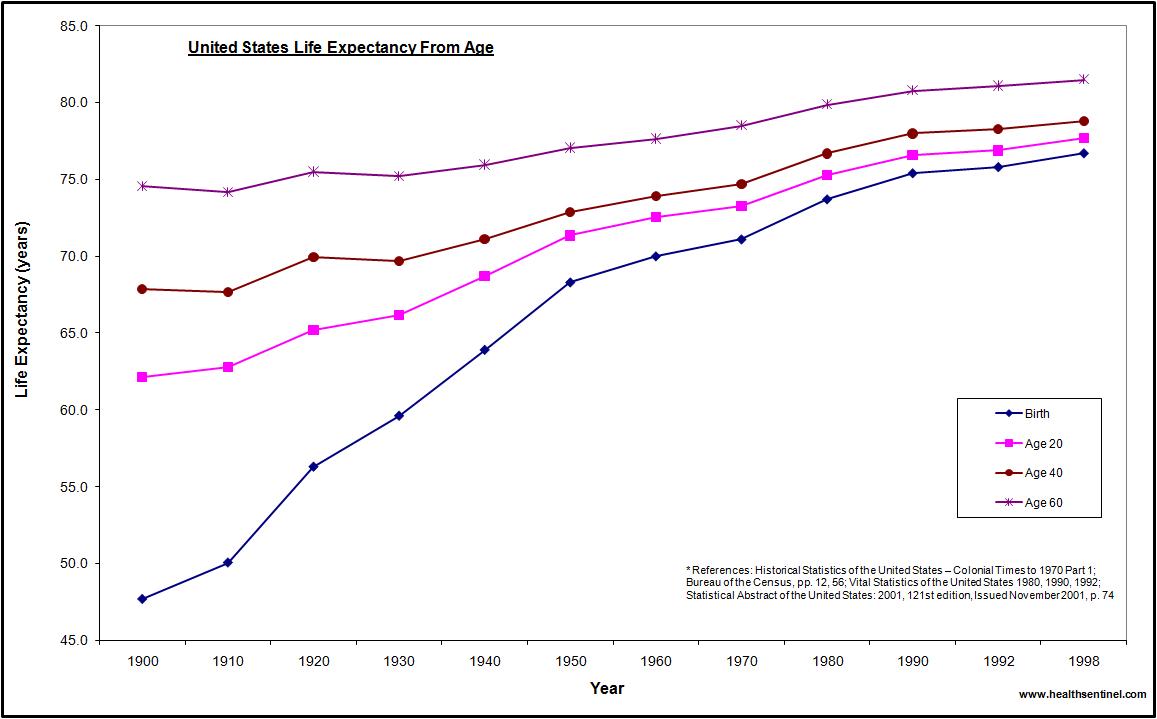
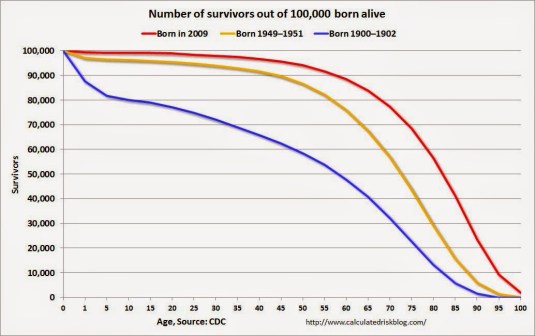
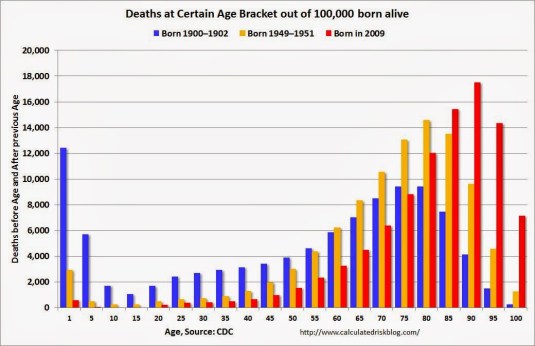
From 1900 to 1998, life expectancy from birth for Americans rose from 47 to 75, an increase of 28 years.
A good deal of that increase in life span had to do with increases in the chances of surviving birth and childhood.
via priceonomics
ICT is changing our lives
23 May 2014 Leave a comment
in technological progress Tags: ICT, technology diffusion, technology usage, The Great Fact
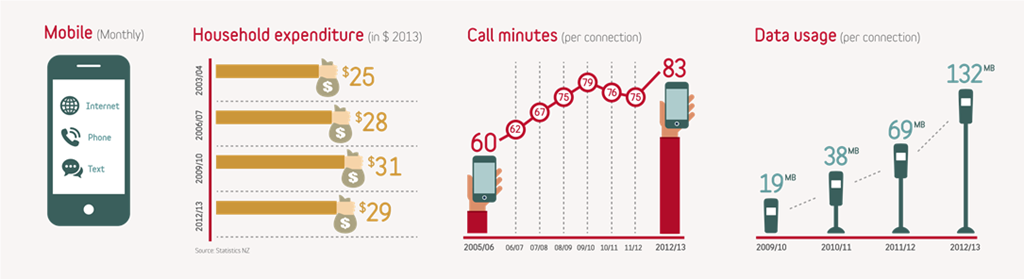
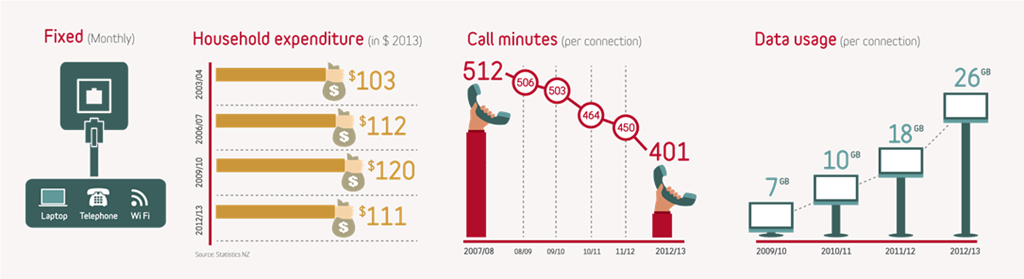
Source: Commerce Commission
How much would an IPhone cost in 1991? | Techpolicy Daily
12 May 2014 Leave a comment
in entrepreneurship, technological progress Tags: mobile phones, standards of living, The Great Fact
In the beginning, mobile phones were just a walkie-talkie. iPhones have the same capabilities of 13 distinct electronics gadgets worth more than $3,000 in a 1991.

An iPhone incorporates a computer, CD player, phone, and video camera, among other items.
In 1991, a gigabyte of hard disk storage cost around $10,000. Today, it costs around four cents.
Back in 1991, a gigabyte of flash memory, which is what the iPhone uses, would have cost something like $45,000, or more. (Today, it’s around 55 cents ($0.55).)
The mid-level iPhone 5S has 32 GB of flash memory. Thirty-two GB, multiplied by $45,000, equals $1.44 million.
The iPhone used 20,500 millions of instructions per second which in 1991 would have cost around $620,000.
In 1991, a mobile phone used the AMPS analog wireless network to deliver kilobit voice connections.
A 1.44 megabit T1 line from the telephone company cost around $1,000 per month.
Today’s LTE mobile network is delivering speeds in the 15 Mbps range.
Safe to say, the iPhone’s communication capacity is at least 10,000 times that of a 1991 mobile phone.
The 1991 cost of mobile communication was something like $100 per kilobit per second.
Fifteen thousand Kbps (15 Mbps), multiplied by $100, is $1.5 million.
Considering only memory, processing, and broadband communications power, duplicating the iPhone back in 1991 would have (very roughly) cost: $1.44 million + $620,000 + $1.5 million = $3.56 million.
This doesn’t even account for the MEMS motion detectors, the camera, the iOS operating system, the brilliant display, or the endless worlds of the Internet and apps to which the iPhone connects us.
via Techpolicy Daily and Cafe Hayek
The Projected Improvement in Life Expectancy
11 May 2014 Leave a comment
in technological progress Tags: life expectancy, The Great Escape, The Great Fact
Why Does 1% of History Have 99% of the Wealth? | Learn Liberty – YouTube
04 May 2014 Leave a comment
in constitutional political economy, development economics, entrepreneurship, liberalism, market efficiency, technological progress Tags: Deirdre McCloskey, industrial revolution, Rise of the Western World, rule of law, The Bourgeois Virtues, The Great Fact
Throughout the history of the world, the average person on earth has been extremely poor: subsisting on the modern equivalent of $3 per day.
This was true until 1800, at which point average wages—and standards of living—began to rise dramatically.
Prof. Deirdre McCloskey explains how this tremendous increase in wealth came about.
In the past 30 years alone, the number of people in the world living on less than $3 per day has been halved.
The cause of the economic growth we have witnessed in the past 200 years may surprise you.
It’s not exploitation, or investment. Innovation—new ideas, new inventions, materials, machinery, organizational structures—has fueled this economic boom.
Prof. McCloskey explains how changes in Holland and England in the 1600s and 1700s opened the door for innovation to take off—starting the growth that continues to benefit us today.
via Why Does 1% of History Have 99% of the Wealth? | Learn Liberty – YouTube.
 Utopia, you are standing in it!
Recent Comments