Australian policymakers from at least 1971 viewed inflation as not a consequence of their monetary policy decisions. There were repeated references by them to wage-price spirals and both unsuccessful (1977) and successful attempts (1981) at wage freezes.
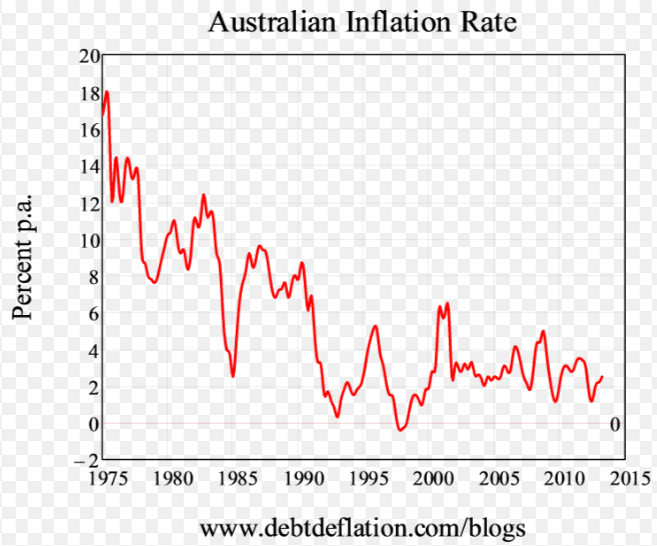
The prices and incomes accord from 1983 onwards was just another 1970s wage tax trade-off. An Incomes policy attributes inflation to non-monetary factors, as did Fraser and Lynch regularly.
• It was not until 1980 that the Fraser government’s monetary policy became genuinely anti-inflationary. With a lag, these changes halved inflation to the mid-single digits by 1983. The implementation lag on the 1975 Monday conference programme must have been long and variable and lasted for a three year window!? Three years out of 20 is hardly a monetarist hegemony!
• Australia had lower CPI inflation in the 1980s than the 1970s, but this was marred by rebounds in 1985–86 and 1988–90 to near 9%.
The monetary policy regime change in the late 1980s was triggered by factors besides rising inflation: a demonic view of currant account.
After several years of high interest rates, the budget papers forecasted a moderate slowing:
• The budget GDP forecast for 1990-91 was 2% with an actual of minus 0.4%; for inflation the actual and forecast were 5.3% versus 6.5%; 1989-90 inflation rate was 8% with GDP growth of 3.3%.
• In 1991-92, the budget GDP forecast was 1.5% with an actual of 2.1%; for inflation the actual and forecast were 1.9% versus 3.8%.
• In 1992-93, the budget papers forecast for inflation 3% for an actual of 1%.
• In 1993-94, the budget forecast for inflation 3.5% for an actual of 1.8%.
The monetarists in the Treasury, entranced as they were by Friedman’s 1975 visit, still had not clicked to the link between a tight monetary policy and low inflation as late as 1993. Australia pursued a stop-go monetary policy from 1971 to the early 1990s.
I worked in the next desk to the monetary policy section in the Prime Minister’s Department in the 1980s. They were determined that market set interest rates, not monetary policy.
I suggest you read the biography of keating by john edwards(?) – his economic advisor in the late 1980s.
Edwards quotes from numerous Treasury briefings to Keating. the Treasury remembered their Keynesian educations well, as did those at DPMC. the prices and incomes accord was very Keynesian: inflation as a non-monetary phenomenon
Mentioning Friedman’s name in the 1980s at job interviews would have been extremely career limiting. Not much better in the early 1990s. Back in the late 1980s, Friedman was graduating from ‘a wild man in the wings’ to just a suspicious character in policy circles.
If you name dropped Hayek in the 1980s and 1990s, any sign of name recognition would have indicated that you were been interviewed by people who were very widely read.
 Utopia, you are standing in it!
Recent Comments