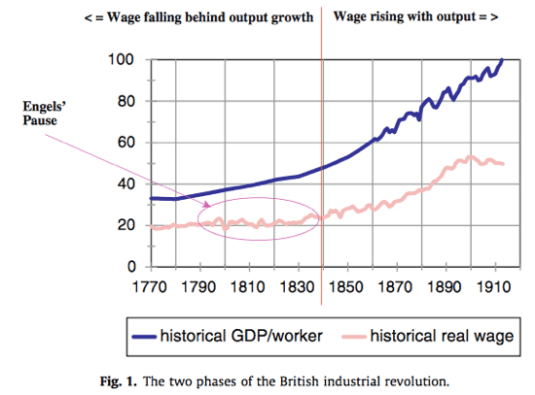
…In the first half of the 19th century, the real wage stagnated while output per worker expanded. The profit rate doubled and the share of profits in national income expanded at the expense of labour and land.
After the middle of the 19th century, real wages began to grow in line with productivity, and the profit rate and factor shares stabilized….
Technical progress was the prime mover behind the industrial revolution. Capital accumulation was a necessary complement.
The surge in inequality was intrinsic to the growth process: technical change increased the demand for capital and raised the profit rate and capital’s share. The rise in profits, in turn, sustained the industrial revolution by financing the necessary capital accumulation.
After the middle of the 19th century, accumulation had caught up with the requirements of technology and wages rose in line with productivity.
Capitalism has raised living standards worldwide by a thousand fold. Societies that respect innovation and entrepreneurship can expect more of the same.
In the space of just a couple of hundred years real incomes and living standards have risen dramatically. From peasantry to prosperity – how did it happen ?
According to McCloskey in her 2013 John Bonython lecture presented by the Centre for Independent Studies, it was ideological change, rather than saving or exploitation, that created this prosperous modern world.
McCloskey proclaims “it’s OK to be in business” and asks those critical of capitalism to re-think their opposition.
Business and enterprise, she suggests, is altruistic, cooperative and the best way to lift living standards in developing and emerging economies.
In a marvellous speech in India on the origins of economic freedom (and its subsequent fruits), Deirdre McCloskey aptly crystallizes the deeper implications of her work on bourgeois virtues and bourgeois dignity:
The leading Bollywood films changed their heroes from the 1950s to the 1980s from bureaucrats to businesspeople, and their villains from factory owners to policemen, in parallel with a similar shift in the ratio of praise for market-tested improvement and supply in the editorial pages of The Times of India…
Did the change from hatred to admiration of market-tested improvement and supply make possible the Singh Reforms after 1991?
Without some change in ideology Singh would not in a democracy have been able to liberalize the Indian economy…
…After 1991 and Singh much of the culture didn’t change, and probably won’t change much in future.
Economic growth does not need to make people European.
Unlike the British, Indians in 2030 will probably still give offerings to Lakshmi and the son of Gauri, as they did in 1947 and 1991.
Unlike the Germans, they will still play cricket, rather well.
So it’s not deep “culture.” It’s sociology, rhetoric, ethics, how people talk about each other.
Why Evolution is True is a blog written by Jerry Coyne, centered on evolution and biology but also dealing with diverse topics like politics, culture, and cats.
“We do not believe any group of men adequate enough or wise enough to operate without scrutiny or without criticism. We know that the only way to avoid error is to detect it, that the only way to detect it is to be free to inquire. We know that in secrecy error undetected will flourish and subvert”. - J Robert Oppenheimer.

 Utopia, you are standing in it!
Recent Comments