

Celebrating humanity's flourishing through the spread of capitalism and the rule of law
19 Jan 2015 Leave a comment
in discrimination, gender, human capital, labour supply, occupational choice, population economics Tags: gender wage gap, Parental leave, unintended consequences
09 Nov 2014 1 Comment
in liberalism Tags: spontaneous order, The collapse of communism, The fall of the Berlin Wall, unintended consequences

When one of the regime’s most loyal subordinates, a Stasi officer named Harald Jaeger who was working the 9 November shift at a crucial checkpoint in the Berlin wall, repeatedly phoned his superiors with accurate reports of swelling crowds, they did not trust or believe him. They called him a delusional coward.
Insulted, furious and frightened, he decided to let the crowds out [at 11:30 p.m], starting a chain reaction that swept across all the checkpoints that night.
In short, the fall of the wall came about because of the complex interplay among Soviet reforms, East Berlin’s incompetence and, crucially, rising opposition from everyday Germans.
Earlier that night, Politburo member Guenther Schabowski said — mistakenly, as it turns out — at an evening news conference on Nov. 9, 1989, that East Germans would be allowed to cross into West Germany, effective immediately.
Jaeger refused to leave East Berlin because he said he was "on duty". Stasi officers didn’t get permission to cross into the West until just before Christmas. Red tape involving his travel documents delayed the trip for another month.
06 Oct 2014 Leave a comment

01 Oct 2014 Leave a comment

20 Sep 2014 1 Comment
in environmentalism, health economics Tags: do gooders, environmental movement, killer green technologies, offsetting behaviour, recycling, reusable grocery bags, unintended consequences
Reusable grocery bags often carry raw meat and are stored for convenience in the trunk of cars that sit outside in the sun. Reusable grocery bags are friendly breeding environment for E. coli bacteria, which can cause severe illness and death.
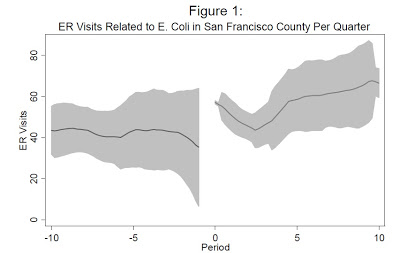
The above figure shows the number of emergency room visits in San Francisco County related to E. coli for the 10 quarters before and after the reusable grocery bags enactment of the ordinance: zero on the horizontal axis is the date the ordinance went into effect. The shaded area around the line is a 95% statistical confidence interval. There is a discontinuous jump in the number of emergency room visits immediately after the reusable grocery bags ordinance was enacted.
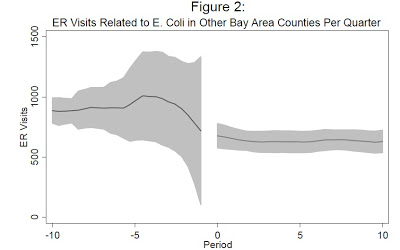
San Francisco experiences about 12 deaths per year from intestinal infections, and that the restrictions on plastic bags probably let to another 5-6 deaths per year in that city and several dozen additional hospitalisations.
03 Sep 2014 Leave a comment
in politics, politics - USA, war and peace Tags: interventionist foreign policies, Obama foreign policy, The fatal conceit, unintended consequences

HT: Helen Dale
19 Aug 2014 Leave a comment
in economics of regulation, labour economics, minimum wage, Uncategorized Tags: minimum wage, offsetting behaviour, Richard McKenzie, unintended consequences
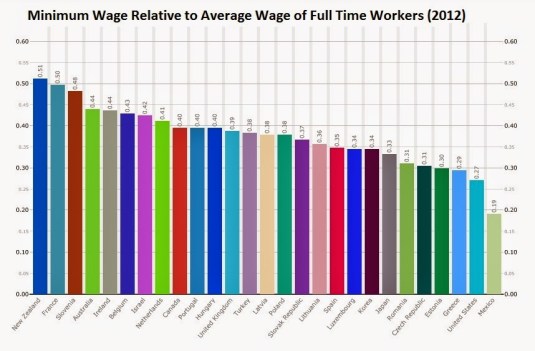
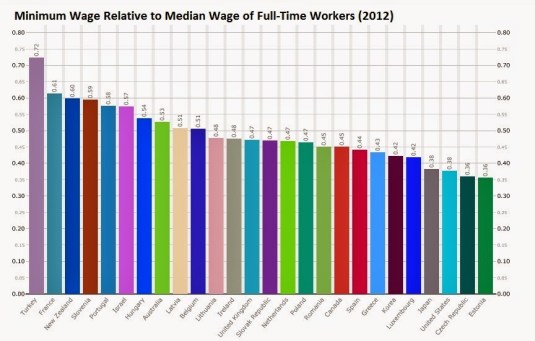
John Schmitt lists 11 margins along which a minimum wage might cause changes:
Richard McKenzie argues that the biggest impact of a minimum wage increase is reductions to paid and unpaid benefits for minimum wage workers, including health insurance, store discounts, free food, flexible scheduling, and job security resulting from higher-skilled workers drawn to the higher minimum wage jobs:
McKenzie also argued that if the minimum wage does not cause employers to make substantial reductions in fringe benefits and increases in work demands, then an increased minimum should cause
(1) an increase in the labour-force-participation rates of covered workers (because workers would be moving up their supply of labour curves),
(2) a reduction in the rate at which covered workers quit their jobs (because their jobs would then be more attractive), and
(3) a significant increase in prices of production processes heavily dependent on covered minimum-wage workers.
Wessels found that minimum-wage increases had exactly the opposite effect:
(1) participation rates went down,
(2) quit rates went up, and
(3) prices did not rise appreciably—which are findings consistent only with the view that minimum-wage increases make workers worse off.
McKenzie was the first economist to argue that a minimum wage increase may actually reduce the labour supply of menial workers. Employment in menial jobs may go down slightly in the face of minimum-wage increases not so much because the employers don’t want to offer the jobs, but because fewer workers want these menial jobs that are offered.
The repackaging of monetary and non-monetary benefits, greater work intensities and fewer training opportunities make these jobs less attractive relative to their other options. This reduction in labour supply by low skilled workers is why the voluntary quit rate among low-wage workers goes up, not down, after a minimum wage increase. As McKenzie explains
Economists almost uniformly argue that minimum wage laws benefit some workers at the expense of other workers.
This argument is implicitly founded on the assumption that money wages are the only form of labour compensation.
Based on the more realistic assumption that labour is paid in many different ways, the analysis of this paper demonstrates that all labourers within a perfectly competitive labour market are adversely affected by minimum wages.
Although employment opportunities are reduced by such laws, affected labour markets clear. Conventional analysis of the effect of minimum wages on monopsony markets is also upset by the model developed.
McKenzie argues that not accounting for offsetting behaviour led to a fundamental misinterpretation in the empirical literature on the minimum wage. That literature shows that small increases in the minimum wages does not seem to affect employment and unemployment by that much.
…. wage income is not the only form of compensation with which employers pay their workers. Also in the mix are fringe benefits, relaxed work demands, workplace ambiance, respect, schedule flexibility, job security and hours of work.
Employers compete with one another to reduce their labour costs for unskilled workers, while unskilled workers compete for the available unskilled jobs — with an eye on the total value of the compensation package. With a minimum-wage increase, employers will move to cut labour costs by reducing fringe benefits and increasing work demands…
Proponents and opponents of minimum-wage hikes do not seem to realize that the tiny employment effects consistently found across numerous studies provide the strongest evidence available that increases in the minimum wage have been largely neutralized by cost savings on fringe benefits and increased work demands and the cost savings from the more obscure and hard-to-measure cuts in nonmoney compensation.
McKenzie is correct in arguing that the empirical literature on the minimum wage is dewy-eyed. The first assumption about any regulation is the market will offset it significantly. In the course of undoing the direct effects of the regulation, there will be unintended consequences such as the remixing of wage and nonwage components of remuneration packages of low skilled workers covered by the minimum wage.
10 Jul 2014 Leave a comment
in labour economics, macroeconomics Tags: employment protection laws, offsetting behaviour, unintended consequences

A policy designed to protect workers from unemployment, over time, will increase the duration of unemployment spells through a chilling effect on job creation. Employment protection laws are a tax on job creation. With fewer vacancies posted, the unemployed will take longer to find jobs.
Celebrating humanity's flourishing through the spread of capitalism and the rule of law
Scholarly commentary on law, economics, and more
Beatrice Cherrier's blog
Celebrating humanity's flourishing through the spread of capitalism and the rule of law
Celebrating humanity's flourishing through the spread of capitalism and the rule of law
Celebrating humanity's flourishing through the spread of capitalism and the rule of law
Why Evolution is True is a blog written by Jerry Coyne, centered on evolution and biology but also dealing with diverse topics like politics, culture, and cats.
Celebrating humanity's flourishing through the spread of capitalism and the rule of law
Celebrating humanity's flourishing through the spread of capitalism and the rule of law
A rural perspective with a blue tint by Ele Ludemann
DPF's Kiwiblog - Fomenting Happy Mischief since 2003
Celebrating humanity's flourishing through the spread of capitalism and the rule of law
The world's most viewed site on global warming and climate change
Tim Harding's writings on rationality, informal logic and skepticism
A window into Doc Freiberger's library
Let's examine hard decisions!
Commentary on monetary policy in the spirit of R. G. Hawtrey
Thoughts on public policy and the media
Celebrating humanity's flourishing through the spread of capitalism and the rule of law
Politics and the economy
A blog (primarily) on Canadian and Commonwealth political history and institutions
Reading between the lines, and underneath the hype.
Economics, and such stuff as dreams are made on
"The British constitution has always been puzzling, and always will be." --Queen Elizabeth II
Celebrating humanity's flourishing through the spread of capitalism and the rule of law
Celebrating humanity's flourishing through the spread of capitalism and the rule of law
WORLD WAR II, MUSIC, HISTORY, HOLOCAUST
Undisciplined scholar, recovering academic
Celebrating humanity's flourishing through the spread of capitalism and the rule of law
Res ipsa loquitur - The thing itself speaks
Celebrating humanity's flourishing through the spread of capitalism and the rule of law
Researching the House of Commons, 1832-1868
Articles and research from the History of Parliament Trust
Reflections on books and art
Posts on the History of Law, Crime, and Justice
Celebrating humanity's flourishing through the spread of capitalism and the rule of law
Exploring the Monarchs of Europe
Cutting edge science you can dice with
Small Steps Toward A Much Better World
“We do not believe any group of men adequate enough or wise enough to operate without scrutiny or without criticism. We know that the only way to avoid error is to detect it, that the only way to detect it is to be free to inquire. We know that in secrecy error undetected will flourish and subvert”. - J Robert Oppenheimer.
The truth about the great wind power fraud - we're not here to debate the wind industry, we're here to destroy it.
Celebrating humanity's flourishing through the spread of capitalism and the rule of law
Celebrating humanity's flourishing through the spread of capitalism and the rule of law
Economics, public policy, monetary policy, financial regulation, with a New Zealand perspective
Celebrating humanity's flourishing through the spread of capitalism and the rule of law
Restraining Government in America and Around the World




 Utopia, you are standing in it!
Recent Comments