History with David M. Rubenstein: A Conversation with Ken Burns: The Vietnam War
25 Apr 2018 Leave a comment
in defence economics, economic history, laws of war, Public Choice, television, war and peace Tags: Vietnam war
Firing Line with William F. Buckley Jr.: Vietnam and the Intellectuals
03 Apr 2018 Leave a comment
in defence economics, laws of war, politics - USA, war and peace Tags: Noam Chomsky, Vietnam war
Reagan and RFK (1967) debate Vietnam war with angry British student
05 Feb 2018 Leave a comment
in defence economics, war and peace Tags: Vietnam war
The Post was a lot better than I anticipated
20 Jan 2018 Leave a comment
in defence economics, economic history, movies, politics - USA, war and peace Tags: Vietnam war, World War II
Second movie this week on it is heroic (Darkest Hour), treasonous (The Post) to fight on in a war you can’t win against murderously evil monsters in the hope something might turn up.
Redgum – I Was Only 19 (1983)
10 Dec 2016 Leave a comment
in defence economics, Music Tags: Redgum, Vietnam war
Young people supported the Vietnam War as much as older folk
16 Dec 2015 Leave a comment
in defence economics, politics - USA, war and peace Tags: Vietnam war, votor demographics
Vietnam War tunnels
30 Oct 2015 Leave a comment
in war and peace Tags: Vietnam war
During the Vietnam War This Is How The Enemy Hid http://t.co/jYf5XoNZ0S—
War History Online (@WarHistoryOL) June 30, 2015
America’s wars
05 Jul 2015 Leave a comment
in defence economics, politics - USA, war and peace Tags: American Civil War, Korean war, Revolutionary War, Vietnam war, War of 1812, World War I, World War II
Undeclared war:
bloom.bg/17bV5nM http://t.co/xx51J6R0sA—
Bloomberg VisualData (@BBGVisualData) May 31, 2015
Do violent protests win votes for your cause?
12 May 2015 Leave a comment
in constitutional political economy, economic history, economics of crime, law and economics, politics - Australia, politics - New Zealand, politics - USA, Public Choice Tags: 1960s, activists, civil disobedience, Democratic Party, George Wallace, nonviolent protest, Richard Nixon, riots, Vietnam war, violent protests
Monkey Cage blogged on a very timely study on the impact of violent and nonviolent protests on voting behaviour. Non-violent protest in the 60s enticed sympathy and increased voter support for the Democratic Party in the 1964, 1968 to 1972 presidential elections:
Black-led nonviolent protests… exhibit a statistically significant positive relationship with county-level Democratic vote-share in the same period.
This is not surprising because nonviolent protest acknowledge fidelity to law and democratic equality. No one likes to be bullied and one of the purposes of the secret ballot is to prevent voters from being bullied because no one knows how you voted.
Indeed, there is a long history of anonymous pamphleteering, which has evolved into anonymous trolling as a way of people expressing their political views without facing backlash from both the majority and a vindictive minority.
In a democracy, it’s up to me to persuade you to change your mind – that what you took for granted for so long is not so. That’s how liberal democracies work: by trying to persuade each other and voting.
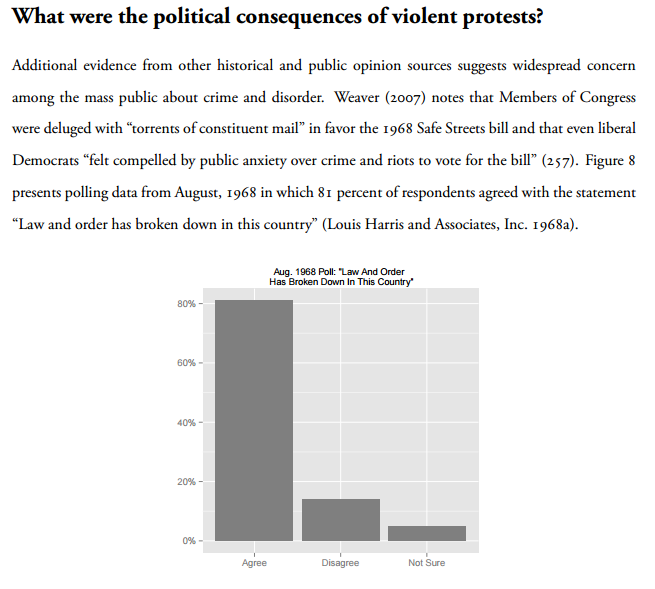
Violent protests had the exact opposite effect to peaceful protests on Democratic Party voting shares in the 1964, 1968 in 1972 presidential elections. There was a law and order backlash among voters against what were relatively widespread rioting and civil disorder:
…black-led protests in which some violence occurs are associated with a statistically significant decline in Democratic vote-share in the 1964, 1968 and 1972 presidential elections.
This is a roundabout way of saying that a Republican won the 1968 election on a law and order platform, not a Democrat on a peace platform. The country was convinced, including Liberal Democrats, that law and order had broken down and that the Democratic Party could not restore law and order.
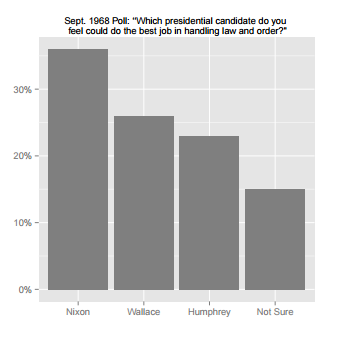
In the 1968 presidential election, there is a third party candidate, George Wallace, who won won almost ten million popular votes and 46 electoral votes, including in the electoral college on an even harsher law and order platform than Nixon.
Wallace was a racist Southern Democrat the Democratic Party would prefer us to forget and a nasty political opportunist to boot. His political rhetoric included the only words four letter words the protesters didn’t know was work and soap.
As I recall warmed over Marxism, the idea of violent protests is to provoke a law and order backlash, initially with popular support of the working class. The resulting police repression will overreach and cause the proletariat to breakthrough their false consciousness to see that capitalists for whom they are and rise up to overthrow them.

Rise up ye workers, rise up for you have nothing to lose but your chains. These days that call to the barricades would have to be rise up ye workers, rise up for you have nothing to lose what your smart phone and air points.
Noam Chomsky’s fact free world about the poor dying fighting the wars started by the rich
08 May 2015 2 Comments
in politics - Australia, politics - New Zealand, politics - USA, war and peace Tags: Noam Chomsky, Vietnam war, World War I, World War II
Noam Chomsky hit a new low with his claim that the poor die fighting the wars started by the rich. Wartime casualty rates are available on the Internet in great detail to rebut this nonsense claim.
In the Second World War, First World War and Boar War, the British, Australian and New Zealand Army had minimum fitness standards. Many from poor backgrounds were rejected because of poor health or they were too short.

12% per cent of all men mobilised in Britain between 1914 and 1918 were killed; but nearly a fifth of Oxford graduates who served did not return from the war; the figure for Cambridge was 18 per cent.
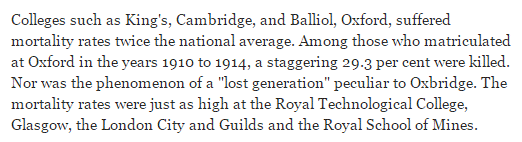
UK wartime Prime Minister Herbert Asquith lost a son; future Prime Minister Andrew Bonar Law lost two. Anthony Eden lost two brothers, another brother of his was terribly wounded, and an uncle was captured. At the end of World War II, Anthony Eden had to take a week off to grieve because he lost his son in the final days of fighting.
So much for the poor fighting the wars of the rich. Furthermore, taxes on both incomes and inheritances were very high both during and after both world wars.
Australia and New Zealand had volunteer armies in the First World War. The population of New Zealand in 1914 was approximately 1.1 million. Almost 100,000 New Zealanders served overseas in the New Zealand Expeditionary Force. From a population of fewer than five million, 416,809 Australian men signed up.
By war’s end, over 60,000 Australians were killed and 156,000 wounded, gassed, or taken prisoner. This compares with around 700,000 British, 60,000 Canadians and 16,000 New Zealanders killed.
In 1939, the New Zealand labour government went to great lengths to ensure it would declare war on Germany simultaneously with the Mother Country. As in 1914, Australia made no separate declaration of war because it regarded as automatic that it would be at war with the enemies of the Mother Country

Military service was all but indispensable to been elected to public office from much of the 20th century.

Bill Clinton’s and Michael Dukakis’s failure to serve were issues on their presidential campaigns that hurt them among their own voting base. They knew that and had to have very elaborate explanations as to why they didn’t serve.
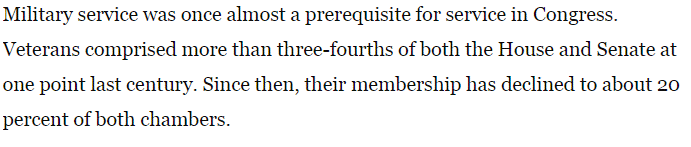
The lack of a service in the First World War of Australia’s wartime Prime Minister in the Second World War, Sir Robert Menzies, was a constant source of taunting and heckling both in Parliament and at public meetings during that war and for the rest of his life.
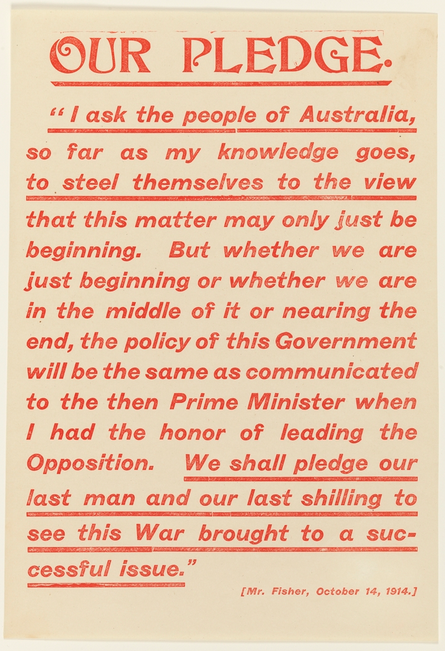
The First World War broke out during the 1914 Australian federal election. There was ample opportunity for a popular vote on the wisdom of going to war. The opposition Labour party won that election on the pledge of fighting to the last man and the last shilling.
Being an intellectual, Chomsky forgets the patriotism of the working class and the plain desire to ward off foreign domination and conquest. What is a just war? Murray Rothbard explains:
a just war exists when a people tries to ward off the threat of coercive domination by another people, or to overthrow an already-existing domination.
A war is unjust, on the other hand, when a people try to impose domination on another people, or try to retain an already existing coercive rule over them
Richard Nixon’s public choice economics of the Vietnam anti-war movement
30 Apr 2015 Leave a comment
in labour economics, labour supply, occupational choice, politics - USA Tags: conscription, peace movements, Richard Nixon, Vietnam war
The Vietnam anti-war movement were primarily the result of the draft: hell no, we won’t go and the burning of draft cards. Richard Nixon was as cunning a rat who ever occupied the Oval Office. He was elected in 1968 to end the Vietnam war and to end the draft.
Nixon had an intuitive economic understanding that the anti-war movement’s rioting in the streets and campuses was very much motivated by private gain. In particular, the threat of being drafted. The notion that revolutions and political movements are motivated by private gain is not new.
Vietnamisation changed everything. In 1969, Nixon started the process of phasing down the sending of further combat troops to Vietnam and the phasing down of the draft. US troop withdrawal started on July 1st 1969 with completion dates – December 1970, June 1971 and December 1972.
By the beginning of 1972, over 400,000 U.S. military personnel had been withdrawn, virtually all combat troops. The protests were against ending up in the jungle – not up the rear with the gear. There were 24,000 US troops in Vietnam in 1972. This compares to 560,000+ in 1969.
A Vietnam vet told me that when he returned to his U.S. campus in 1971 for graduate studies, it was very quite compared to 1969 because the spectre of the draft had gone in their minds.

The anti-war movement was really motivated by hell no, we won’t go. As soon as the prospect of going to Vietnam faded away, so did the anti-war movement.
Elections as battlefields, literally: public choice aspects of the allocation of death in battle
25 Apr 2015 Leave a comment
in Public Choice, war and peace Tags: Anzac Day, Civil War, Vietnam war
There have been studies of both elections affecting the fighting wars, and how troop deployments and furloughs are manipulated to affect elections. Regular Army and reservists from states and electorates that are hotly contested at the next election are kept away from the firing line.
Goff and Tollison (1987) studied how assignments to combat or non-combat positions wan influenced by political considerations during the Vietnam war. Casualties across U.S. states were a function of the political influence, especially in military affairs, of a state’s House and Senate delegations to Congress and the Senate.
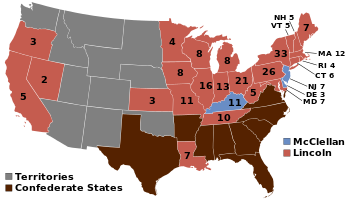
Political influence on which troops were put into combat positions was not new as shown by Anderson and Tollison’s 1991 study of the electoral college is a battlefield during the American civil war. Their primary empirical finding was that electoral votes per capita are a strong explainer of casualties across Union states, all else equal. Lincoln would dispatch and withdraw troops from the frontline on the basis of electoral considerations, including who was needed back home to vote in the 1864 presidential election:
Northern causalities [during the Civil War] were partly determined by electoral votes in 1864… Given that the Northern troops were organized by states and that President Lincoln sought to be re-elected, . . . [t]roops from close states were much less likely to suffer causalities . . . [based on the logic that] . . . dead men cannot vote
 Utopia, you are standing in it!
Recent Comments