


In search of libertarians | Pew Research Center
07 Feb 2015 Leave a comment
in liberalism, libertarianism Tags: voter demographics
The political proclivities of different occupations
30 Jan 2015 Leave a comment
in occupational choice, Public Choice Tags: academic bias, media bias, political bias, voter demographics

Voter profiles – utilitarian/instrumental, swinging and expressive | Alex White
23 Jan 2015 Leave a comment
in applied welfare economics, Public Choice Tags: expressive voting, rational ignorance, rational irrationality, voter demographics
I just came across this great blog by Alex White on the three types of voters: utilitarian/instrumental, swinging and expressive. His diagrammatic expressions of them are superb. Most enlightening.

His first diagram above shows three consumer types of engagement with a brand: utilitarian, low involvement and expressive.
- Utilitarian decision making is one that is typically high involvement, but are partly price sensitive;
- Low involvement buyers do not spend a lot of time researching the features of the product or service, beyond a cursory glance; and
- Expressive consumers are ones who make in depth purchases where there is a high engagement. Their decision to purchase precedes research. The research itself serves to rationalise the purchase decision. Often, they will feel a relationship with the brand and identify with the brand’s values.
White then overlaps these brand engagement profiles on voter profiles in the next diagram made up of utilitarian/instrumental, swinging and expressive and then fleshes out these voter types depending on whether they are rusted or swinging.

- The rusted-on utilitarian voter votes on a specific issue and are loyal to the party that represents the best fit with that issue. For example, the Greens and forestry, or Labor and education. So long as they view the party as best fitting or addressing their issue, they’ll vote for that party.
- A swinging utilitarian voter listens to announcements during campaigns, and tries to make a decision based on what is best for them. These swinging voters are susceptible to the pork barrel promises. Utilitarian voters are sensitive to their expectations being met.
- The swinging low engagement voter has no party familiarity, no interest in politics, and do not do any assessment of party policies; they make up their mind based on availability of the party on Election Day (so the presence of people handing out how-to-votes is important). They see no difference between parties; they are completely switchable, so there is no brand loyalty. A low involvement voter is really looking at the absence of negatives.
- The rusted on expressive voter votes to convey their values or beliefs, and often strongly identify with the party, or with a party leader. They are partisans who seek out research or information to justify their support for that party. The have a strong emotional connection to the party, or they may be ideologues and identify with a political philosophy rather than the party.
- The swinging expressive voter is an ideologue whose voting decision is based on their political ideology. For example, strong environmentalists who support the Greens Party because of their commitment to conservation rather than to the Party itself. The swinging expressive voter may change their vote if they feel a party ceases to represent their value set or beliefs. The expressive voter expectations align with their values or ideology. Their relationship to the party can be very committed, but also very critical. They may tolerate or forgive lapses on policy areas outside the voter’s core values — and they can be passionate advocates.
Alex White has set out a great topology of voters, and how a political party or lobby group should appeal to different types of voters based on their engagement and information needs. White is secretary of UnionsACT, the peak body for 33 unionists Unions in Canberra.
The growing libertarian vote in the USA
16 Jan 2015 Leave a comment
in liberalism, politics - USA Tags: Libertarian party, libertarians, voter demographics

HT – David_Boaz’s Tweet: https://twitter.com/David_Boaz/status/529287344151879680?s=09

Where did the anti-war movement go after Obama was elected?
28 Jul 2014 Leave a comment
in war and peace Tags: anti-war movement, peace movement, voter demographics
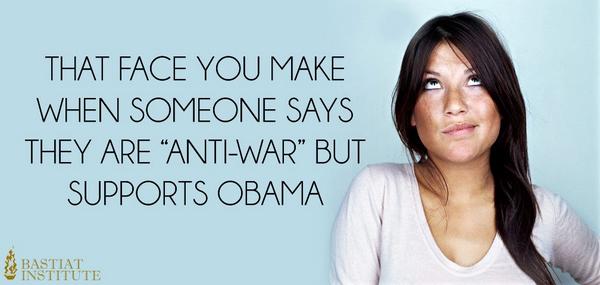
Michael T. Heaney and Fabio Rojas found that half of democratic party voters previously involved in anti-war protests under President Bush withdrew from the anti-war movement upon the election of President Obama:
The withdrawal of Democratic activists changed the character of the anti-war movement by undermining broad coalitions in the movement and encouraging the formation of smaller, more radical coalitions
Not even the loud, raucous and disruptive Code Pink stayed to its principle, and show themselves to be bunch of Democratic party hacks – Heaney and Rojas explain:
Code Pink: Women for Peace continues to speak out against war, but it has devoted a greater proportion of its energy to other issues, such as health care reform and the Israeli-Palestinian crisis.
After Obama’s election as president, their surveys of 5,400 demonstrators at 27 protests from January 2007 to December 2009 showed that Democratic party voter participation in anti-war activities plunged 37 per cent of anti-war protest this in January 2009 to 19 per cent in November 2009.
U.S. voter demographics by age
23 Jul 2014 Leave a comment
in politics - USA Tags: voter demographics

Female voting demographics and the growth of government
13 Jul 2014 1 Comment
in applied price theory, gender, income redistribution, Public Choice Tags: John Lott, The growth in government, voter demographics

The gender gap in voting dates back 2 generations or more and may now be in double digits.
A large share of all social spending is for the care of dependents – everything from children to non-working mothers and old age pensioners. Women support this spending because they benefit more from the social insurance it offers. Women both earn less and are more likely to be out of the workforce caring for children. Women also change their voting patterns more often than men as they marry and divorce or as they become single mothers.
John Lott pondered on why the government started growing precisely when it did. The federal government, aside from periods of wartime, consumed 2 to 3% of GDP up until World War I. In the 1920s, non-military federal spending began steadily climbing. FDR’s New Deal continued an earlier trend.
Lott explains the growth of government with women’s suffrage. For decades, polls have shown that women as a group vote differently than men. Without the women’s vote, Republicans would have swept every U.S. presidential race but one between 1968 and 2004.
A major gender gap issue is smaller government and lower taxes, which is a much higher priority for men. Women were more opposed to the 1996 federal welfare reforms, which mandated time limits for receiving welfare and imposed work requirements on welfare recipients.
Women are also supporters of Medicare, Social Security and educational expenditures more than men. Studies show that women are generally more risk-averse than men so they support government programs to ensure against certain risks in life.
- Women’s average incomes are also slightly lower and less likely to vary so single women prefer more progressive income taxes.
- Once women marry, they bear a greater share of taxes through their husbands’ relatively higher incomes so their support for high taxes declines.
Marriage also provides an economic explanation for why men and women prefer different policies.
Single women who believe they may marry as well as married women who most fear divorce, look for protection against possible divorce: a more progressive tax system and other government transfers of wealth from rich to poor.
Lott considers that A good way to analyse the direct effect of women’s suffrage on the growth of government is to study how each of the 48 state governments expanded after women obtained the right to vote.
- Women’s suffrage was first granted in western states seeking women migrants: Wyoming (1869), Utah (1870), Colorado (1893) and Idaho (1896).
- Women could vote in 29 states before women’s suffrage was achieved nationwide in 1920 with the adoption of the 19th Amendment to the Constitution.
The impact of granting of women’s suffrage was startling: state governments started expanding the first year after women voted and continued growing until real per capita spending more than doubled. The increase in government spending and revenue started immediately after women started voting.
There were 19 states that had not passed women’s suffrage before the approval of the 19th Amendment, nine approved the amendment, while the other 12 had suffrage imposed on them.
If some unknown third factor caused a desire for larger government and women’s suffrage, government should have only grown in states that voluntarily adopted suffrage. After approving women’s suffrage, government grew at a similar pace in both groups of states.
As more women voted and eventually voted in similar numbers as men, the size of state and federal governments expanded as women became an increasingly important part of the electorate. It took up to 30 years for women’s voting participation rate to equal that of men.
Lott also found that women’s political views on average vary more than those of men:
- Young single women are about 50 per cent more likely to vote Democratic.
- For married women, this gap is only one-third as large.
- Married women with children become more conservative still.
- Women with children who are divorced are suddenly about 75 per cent more likely to vote for Democrats than single men.
Not surprisingly, political parties pitch their platforms to women because they are more likely to change their vote over identifiable issues that are within the scope for government to change or influence
The decline of class as a factor in voting
03 Jul 2014 Leave a comment
in politics - Australia, Public Choice Tags: voter demographics

At the UK General Election of 1964, a 2% of voters with no ‘working class characteristics’ voted Labour.
People’s socio-economic characteristics are now much less significant than they used to be as indicators of how they are likely to vote, for not only do many working class people vote for parties of the right, but large swathes of the middle class now vote Labour.
Support for Labor among manual working class voters as a whole was no higher than support for the right-wing parties in the 2004 Australian election.
If lower grade white collar occupations are included as working class, the right-wing parties in Australia actually achieved a small lead over the Australian Labor Party among working class voters.
POSSUM COMITATUS asks why are the Greens strongest in the inner cities? What is the cause of Greens voters living in the inner cities?

He found that people working in the arts, education, media and technology industries are more likely to vote Green, and as a result of the distribution of workplaces for these industries having a higher density in the inner suburbs, the people living within close proximity to their workplaces naturally leads to the inner cities having higher levels of Greens voters. He concludes:
it’s just a modern evolution of class based electoral analysis – whereas the Labor vote used to correlate strongly with manufacturing and low skill, labour intensive industries – today, the Green vote correlates with new skilled services industries like arts, education, media and technology.
The Chardonnay socialists are not as left-wing as they think
08 Jun 2014 Leave a comment
in constitutional political economy, politics, Public Choice Tags: voter demographics
As people hit middle age their youthful radicalism tends to be replaced with a growing conservatism. There has been a study of the 136,000 people in the World Values Survey. The data was from 48 different countries, during five periods between 1981 and 2008:
- Participants were asked to choose whether they saw themselves as left-wing or right-wing.
- The results were then compared with their responses to more detailed questions about their views, to determine how closely the participants own perception matched their real position on the ideological spectrum.
Well-educated individuals are more likely to wrongly characterise their political positions as more left-wing than they actually are. Holding down a job and raising a family leads them to adopt a more conservative outlook.
 One reason the left-intellectuals do not realise that they have shed their youthful liberalism is that they socialise with people going through the same ideological shift to the right.
These results are no particular surprise given the growing authoritarian nature of the Left both in terms of social regulation and political correctness. Like a true conservative, the Left is a great believer in ordering their inferiors about while exempting themselves from these laws.
The US voting data shows that:
- Americans who identify as independents is inversely related to age. More than one-third of the youngest Americans identify as independents, a percentage that drops steadily as the population ages.
-
The percentage who identify as Republicans follows roughly the opposite pattern. Only around 20% of Americans below 25 identify as Republicans.
-
Democrats are quite strong among those under age 24. The percentage of Democrats stays at the one-third mark until about age 45, when it climbs slightly and remains higher through the 50s and early 60s, hovering at around the 40% point.
Why specific people change is more interesting, because as Hayek said, aggregates conceal more than they reveal.
 Utopia, you are standing in it!
Recent Comments