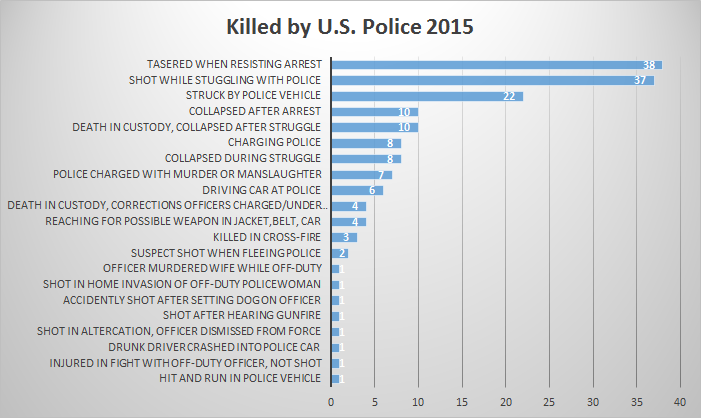
@radleybalko @thecounted How did the 169 unarmed people killed by police in 2015 die? @Mark_J_Perry updated

The Guardian is so anti-police that they included in their interactive database a drunk that drove into a police car and some poor bastard run over by the police cruiser searching for him at night.

image

Source: The Counted: people killed by police in the United States in 2015 – interactive | US news | The Guardian.

Another handy hint for an unarmed suspect is do not flee police by stealing a police cruiser with the officer dragging behind you. He may well shoot you. Police will certainly shoot an unarmed suspect if they flee arrest in a police cruiser, kidnapping the two children who happened to be in the back – their parents expect no less.

Most of the police killings of the unarmed in circumstances where better evidence would resolve doubts.

The Guardian would do a lot better by arguing that all Tasers should have cameras on them, all police cruisers should have cameras in them, and all police officers should have cameras on their lapels. These cameras are excellent for collecting evidence against criminals. There should also be plenty of cameras in police stations.

The first randomized controlled trial of police body cameras in the USA showed that cameras sharply reduce the use of force by police and the number of citizen complaints. In Seattle, the police department has set up its own YouTube channel, broadcasting a stream of blurred images to protect privacy.

https://youtu.be/h1HHx3yVcHc

Update: I recoded charging police and reaching for a possible weapon on your person or in a car into separate categories

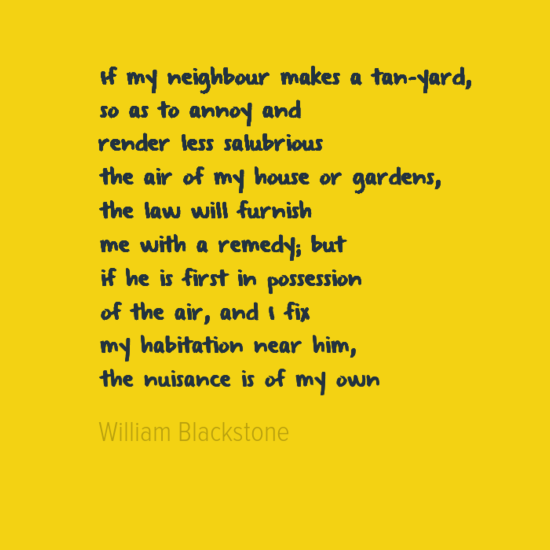
I’m worried! I’m sympathising with organic farmers over a land use conflict!

Writing this blog of sound mind and sober disposition, I still have considerable sympathy with two organic farmers over a land use conflict they have with the neighbouring gun range.

blackstone nuisance

Local land use regulations allows a gun club to set up 600 m away with competitive shooting days all day for 88 days a year. That is a voluntary self restraint. They could hold shooting competitions every day of the year. The local land use regulations allow the use of guns on rural land. The gun club used this absence of a prohibition on the use of guns in the frequency of use to set up a gun range to fire guns all day long on rural land.

Now here is the rub. There something wrong with the concept of quiet enjoyment of your land if a neighbour can fire off a large amount of noises continuously. The occasional noise, the occasional gunshot yes, but all day? I live near the airport, but I knew it was there when we bought the property and the lands  was a little cheaper because of that.

https://youtu.be/34azi8qkiRs

The organic farmers are unusually pristine and prissy about what they want by neighbours to protect the sacredness of their more expensive snob food. I’m not too sure whether they would want to grant their neighbours an equal right to unusual land uses such as opening a gun range. That said, the organic farmers do have a point about a very noisy neighbouring land use that can be heard some distance away.

The organic farmers, of course, could have negotiated with their neighbours for covenants to restrict land use that undermine there are unusually pristine requirements for quiet enjoyment of their land and their neighbours land too. Easy to do when the land is first unused, but once economic activity accumulates, not so easy in terms of  transaction costs and hold-outs.

HT: Environmental Law 101 | Hoover Institution.

William Blackstone on the Resource Management Act (RMA)

blackstone nuisance

Image

Would a referendum on euthanasia pass in New Zealand?

A New Zealand First MP along with his populist leader have proposed that the morally tricky question of euthanasia be addressed in New Zealand by a referendum rather than by a vote on a private member’s bill in Parliament.

Although about 80% of the public support euthanasia when asked about it in principle, when the 120 members in New Zealand Parliament elected by proportional representation are asked to vote on it in practice with procedures for safeguards, be last time this was tried in 2003 the Bill failed by three votes. The reason why it failed to pass was a substantial number of MPs who voted against the bill was reservations about abuse.

A badly drafted bill may offer insufficient assurances to some MPs about preventing abuse and ensuring people who are depressed are not offered options that are not in their best interests.

Others have moral or religious objections. The religious objections were summarised by Blackstone, in his Commentaries on the Laws of England, where he wrote that suicide was also a spiritual offence:

…in evading the prerogative of the Almighty, and rushing into his immediate presence uncalled for

If a referendum was to fail, that would make our morally timid MPs even more timid about ever passing a bill on euthanasia.

There is a considerable risk that a referendum on euthanasia will fail because people don’t know exactly what they are voting for. Because of that they will listen to those  who opposed euthanasia who will point to the risk of abuse. A referendum strengthens the hands of those that oppose euthanasia. They can play to the lack of detail on what exactly is to be approved.

Many people have very strong views on exactly when and when not euthanasia is permissible because of their views about the sanctity of life and the risk of abuse. The recent High Court judgement on an unsuccessful application  are an exception to the criminal law on assisted suicide said that:

The sanctity of human life principle underpins the criminal law relating to culpable homicide. It was said by Blackstone to be the first rule of English law.

When making an exception to the first rule of law, people want to know exactly what they are voting for and exactly what safeguards apply the proposed exceptions. A Referendum does not offer that indispensable option. Writing on a Bill on end of life choice is legally and morally tricky.

Many Bills have failed such as recently in the Scottish Parliament and in 2003 in the New Zealand Parliament because they were badly drafted and were considered by many  to offer insufficient protection of the vulnerable against abuse and melancholy.

Even when courts rule favourably on the matter, such as in Canada with its recent Supreme Court decision under its Bill of Rights, that court suspended its judgement upholding the right to euthanasia for 12 month so that the Canadian Parliament could work out the ever so vital details by passing a Bill. As the Supreme Court of United Kingdom recently ruled:

… unless the court can be satisfied that any exception to the subsection can be operated in such a way as to generate an acceptably small risk that assistance will be afforded to those vulnerable to pressure to seek to commit suicide, it cannot conclude that the absolute prohibition in the subsection is disproportionate to its legitimate aim.

That is the essence of reservations about end of life choice. Blackstone’s ratio applies to standards of proof in criminal proceedings: it is better that 10 guilty go free than one innocent suffer.

Those with reservations about end of life choice have the same concerns that motivated Blackstone’s ratio. Their reservations are focused on few cases of abuse not justifying the benefits of going gently into that good night by making exceptions from an absolute prohibition under the criminal law against assisted suicide for the terminally ill despite they being of sound mind and independent judgement.

Blackstone agrees with Lucas on ideas and growth

image

Image

William Blackstone’s maximum

All presumptive evidence of felony should be admitted cautiously; for the law holds, that it is better that ten guilty persons escape, than that one innocent suffer.  - William Blackstone

Image

An Englishman’s home is his castle

Image

The rights of an Englishman

Image

Bassett, Brash & Hide

Celebrating humanity's flourishing through the spread of capitalism and the rule of law

Truth on the Market

Scholarly commentary on law, economics, and more

The Undercover Historian

Beatrice Cherrier's blog

Matua Kahurangi

Celebrating humanity's flourishing through the spread of capitalism and the rule of law

Temple of Sociology

Celebrating humanity's flourishing through the spread of capitalism and the rule of law

Velvet Glove, Iron Fist

Celebrating humanity's flourishing through the spread of capitalism and the rule of law

Why Evolution Is True

Why Evolution is True is a blog written by Jerry Coyne, centered on evolution and biology but also dealing with diverse topics like politics, culture, and cats.

Down to Earth Kiwi

Celebrating humanity's flourishing through the spread of capitalism and the rule of law

NoTricksZone

Celebrating humanity's flourishing through the spread of capitalism and the rule of law

Homepaddock

A rural perspective with a blue tint by Ele Ludemann

Kiwiblog

DPF's Kiwiblog - Fomenting Happy Mischief since 2003

The Dangerous Economist

Celebrating humanity's flourishing through the spread of capitalism and the rule of law

Watts Up With That?

The world's most viewed site on global warming and climate change

The Logical Place

Tim Harding's writings on rationality, informal logic and skepticism

Doc's Books

A window into Doc Freiberger's library

The Risk-Monger

Let's examine hard decisions!

Uneasy Money

Commentary on monetary policy in the spirit of R. G. Hawtrey

Barrie Saunders

Thoughts on public policy and the media

Liberty Scott

Celebrating humanity's flourishing through the spread of capitalism and the rule of law

Point of Order

Politics and the economy

James Bowden's Blog

A blog (primarily) on Canadian and Commonwealth political history and institutions

Science Matters

Reading between the lines, and underneath the hype.

Peter Winsley

Economics, and such stuff as dreams are made on

A Venerable Puzzle

"The British constitution has always been puzzling, and always will be." --Queen Elizabeth II

The Antiplanner

Celebrating humanity's flourishing through the spread of capitalism and the rule of law

Bet On It

Celebrating humanity's flourishing through the spread of capitalism and the rule of law

History of Sorts

WORLD WAR II, MUSIC, HISTORY, HOLOCAUST

Roger Pielke Jr.

Undisciplined scholar, recovering academic

Offsetting Behaviour

Celebrating humanity's flourishing through the spread of capitalism and the rule of law

JONATHAN TURLEY

Res ipsa loquitur - The thing itself speaks

Conversable Economist

Celebrating humanity's flourishing through the spread of capitalism and the rule of law

The Victorian Commons

Researching the House of Commons, 1832-1868

The History of Parliament

Articles and research from the History of Parliament Trust

Books & Boots

Reflections on books and art

Legal History Miscellany

Posts on the History of Law, Crime, and Justice

Sex, Drugs and Economics

Celebrating humanity's flourishing through the spread of capitalism and the rule of law

European Royal History

Exploring the Monarchs of Europe

Tallbloke's Talkshop

Cutting edge science you can dice with

Marginal REVOLUTION

Small Steps Toward A Much Better World

NOT A LOT OF PEOPLE KNOW THAT

“We do not believe any group of men adequate enough or wise enough to operate without scrutiny or without criticism. We know that the only way to avoid error is to detect it, that the only way to detect it is to be free to inquire. We know that in secrecy error undetected will flourish and subvert”. - J Robert Oppenheimer.

STOP THESE THINGS

The truth about the great wind power fraud - we're not here to debate the wind industry, we're here to destroy it.

Lindsay Mitchell

Celebrating humanity's flourishing through the spread of capitalism and the rule of law

Alt-M

Celebrating humanity's flourishing through the spread of capitalism and the rule of law

croaking cassandra

Economics, public policy, monetary policy, financial regulation, with a New Zealand perspective

The Grumpy Economist

Celebrating humanity's flourishing through the spread of capitalism and the rule of law

International Liberty

Restraining Government in America and Around the World