WWI British and German soldiers exchange cigarettes, gifts, and addresses during Christmas Truce, 1914. http://t.co/8HFq1870YI—
ClassicPics (@History_Pics) April 25, 2015
Soldiers exchange cigarettes during Christmas Truce, 1914
25 Dec 2015 Leave a comment


Peace feelers in World War 1
25 Apr 2014 1 Comment
in war and peace Tags: Landsdowne peace letter, Papal Peace Note, peace feelers, Reichstag peace resolution, world war 1
There were no meaningful peace proposals by the belligerent governments until 1916.
In late 1916 a series of peace proposals were suddenly put forward, all of them without exception advocating compromises. They contained no demands for unconditional surrender or a dictated peace.
There was Reichstag peace resolution on 19 July 1917. The resolution called for no annexations, no indemnities, freedom of the seas, and international arbitration. It was ignored by the German High Command and by the Allied Powers.
Pope Benedict XV tried to mediate with his Peace Note of August 1917 calling for a return to the pre-war borders.
On November 14, 1917, Lord Landsdowne, a minister in the Asquith cabinet, put forward a letter to the Daily Telegraph on the need for peace negotiations.
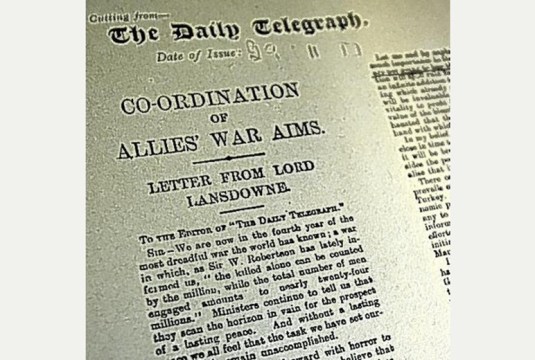
The Landsdowne memorandum titled "Coordination of Allies’ War Aims" recommended a serious investigation of the possibility of a peace and advocated that a statement be made by the British government indicating that the destruction of the German Empire was not her goal. Landsdowne said:
We are not going to lose this war, but its prolongation will spell ruin for the civilised world, and an infinite addition to the load of human suffering which already weighs upon it…
We do not desire the annihilation of Germany as a great power …
We do not seek to impose upon her people any form of government other than that of their own choice…
We have no desire to deny Germany her place among the great commercial communities of the world.
Landsdowne favoured a peace on the basis of pre-war status quo. The fall of the Asquith government and the installation of the Lloyd George Cabinet on December 16 put an end to Landsdowne’s activities.
The problem with the negotiation of the end of a war is the securing of credible assurances that the peace is lasting rather than just a chance for the other side to rebuild and come back to attack from a stronger position.
- When on the advance, the peace feelers of the advancing powers were on basis of keeping conquered territories.
- When in retreat, the peace proposals of the retreating powers were on the basis of returning to the pre-war borders.
One side will think that the other’s promise not to re-start a war is credible only if the other state would be better off by keeping its promise not to re-start a war than by breaking its promise.
France fortified its border with Germany in the 1920s because of a lack of trust that the peace would endure. Germany was disarmed after 1918 so that the day which it would be a threat again was well into the future.
Anzac Day: why did we fight at Gallipoli?
25 Apr 2014 1 Comment
in war and peace Tags: Anzac Day, Gallipoli, national security, world war 1
Australia and New Zealand were filled with first and second generation migrants happy to rally to defend their mother country:
- 12 per cent of the population of New Zealand volunteered to fight; and
- 13 per cent of the male population of Australia volunteered to fight in World War 1.
The people and governments of New Zealand and Australia of that time were British to their boot straps. The Union Jack was in their flags for a reason.
Our specific quarrel with the Ottoman Empire was it joined Germany and others to be at war with the UK, Australia and New Zealand.
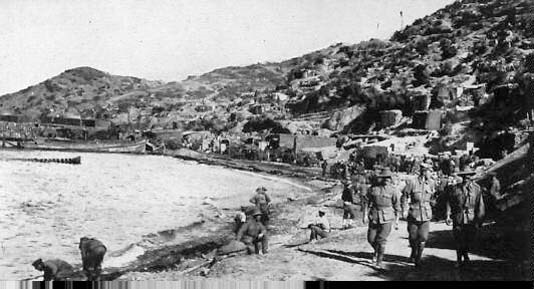
Removing the Ottoman Empire from that war would have strengthened Russia. A stronger Russia would have weakened Germany and its allies and brought the war to an earlier end.
The governments of Australian and New Zealand fell over themselves to declare war and pledge troops in 1914.
World War 1 started in the middle of an Australian election campaign in 1914.
In the September 1914 election, both opposition leader Andrew Fisher and Prime Minister Joseph Cook stressed Australia’s unflinching loyalty to Britain, and Australia’s readiness to take its place with the allied countries.
Labor Party leader Fisher’s campaign pledge was to:
stand beside the mother country to help and defend her to the last man and the last shilling.
Labor defeated the incumbent government to win majorities in both houses. Billy Hughes and his nationalist party won the 1917 election in a landslide.
New Zealanders had even a better chance to reflect on the war-making choices of their leaders in 1914.
Our election was in December of 1914. The passions of the moment had some chance to calm, and the fighting has started for real.
The will of the people was a 90 per cent vote for the war parties. New Zealanders could have voted for the Labour MPs, several of whom were later imprisoned for their anti-conscription activities or for refusing military service.
In New Zealand, after that wartime election, the Prime Minister was an Irish Protestant who formed a coalition with an Irish Catholic as his deputy.
Do you know of a superior mechanism to elections for measuring the will of the people? Are elections inadequate to the task of deciding if the people support a war and that support of the public is based on well-founded reasons?
The reasons for New Zealand and Australia fighting are the just cause of fighting militarism and territorial conquest, empire solidarity, regional security interests such as the growing number of neighbouring German colonies, and long-term national security. A victorious Germany would have imposed a harsh peace.
New Zealand and Australian national security is premised on having a great and powerful friend. That was initially Britain. When the USA arrived in 1941 as a better great and powerful friend, the British were dropped like a stone.
 Utopia, you are standing in it!
Recent Comments