

No end to hereditary peer by-elections in the House of Lords?
24 Jul 2018 Leave a comment

 The House of Lords is not entirely unelected; July saw two new peers appointed following elections involving a very small, select group of electors. In this post, former Clerk of the Parliaments David Beamish discusses the process by which hereditary peers can be elected to the Lords, how the system came to exist, and the continuing efforts to remove the remaining hereditaries altogether.
It was announced on 18 July that Lord Bethell had been elected to fill a vacancy among the 90 elected hereditary peers in the House of Lords – the 34th such vacancy to be filled by means of a by-election. The vacancy arose from the retirement of the Conservative peer Lord Glentoran (the House’s only Winter Olympic gold medallist) on 1 June. These by-elections are conducted using the alternative vote system and, despite there being 11 candidates, Lord Bethell did not need any transfers of votes, receiving…
View original post 1,836 more words
The Andrew Leigh-Sinclair Davidson company tax debate
21 Jul 2018 Leave a comment

In March, there was extensive media coverage (e.g. in the Guardian Australia) of shadow assistant treasurer Andrew Leigh’s company tax research which found companies paying lower effective company tax rates (i.e. actual tax paid/profits) did not create more jobs than those paying higher effective tax rates, and may actually create fewer jobs. The research paper was published in Economic Analysis and Policy (EAP), the online journal of the Economic Society of Australia (QLD) of which I’m Vice President, although this is a personal comment on my part, and I am not on the editorial committee of EAP.
I am very pleased that RMIT’s Sinclair Davidson has converted his critique of Andrew Leigh’s paper, originally published at Catallaxy Files, into a submission to EAP. Davidson’s paper has been published along with a reply by Andrew Leigh, which in my view doesn’t effectively counter the major criticism Davidson makes, that…
View original post 515 more words
On Energy Transitions
21 Jul 2018 Leave a comment


These days the media are full of stories about people setting targets to “decarbonize” the energy sources fueling their societies. Some are claiming (and some have failed notoriously) to achieve zero carbon electrification. We should take a deep breath, step back and rationally consider what is being discussed and proposed.
The History of Energy Transitions
Thanks to Bill Gates we have this helpful graph showing the progress of human civilization resulting from shifts in the mix of energy sources.
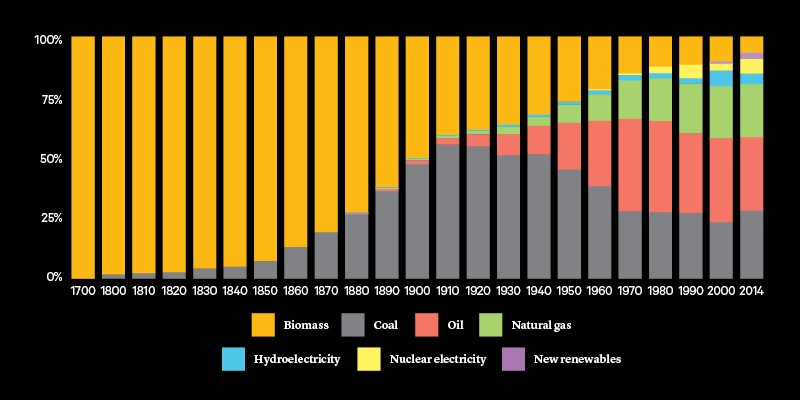
Before the 19th century, it is all biomass, especially wood. Some historians think that the Roman Empire collapsed partly because the cost of importing firewood from the far territories exceeded the benefits. More recently, the 1800’s saw the rise of coal and the industrial revolution and a remarkable social transformation, along of course with issues of mining and urban pollution. The 20th century is marked first by the discovery and use…
View original post 4,478 more words


Recent Comments