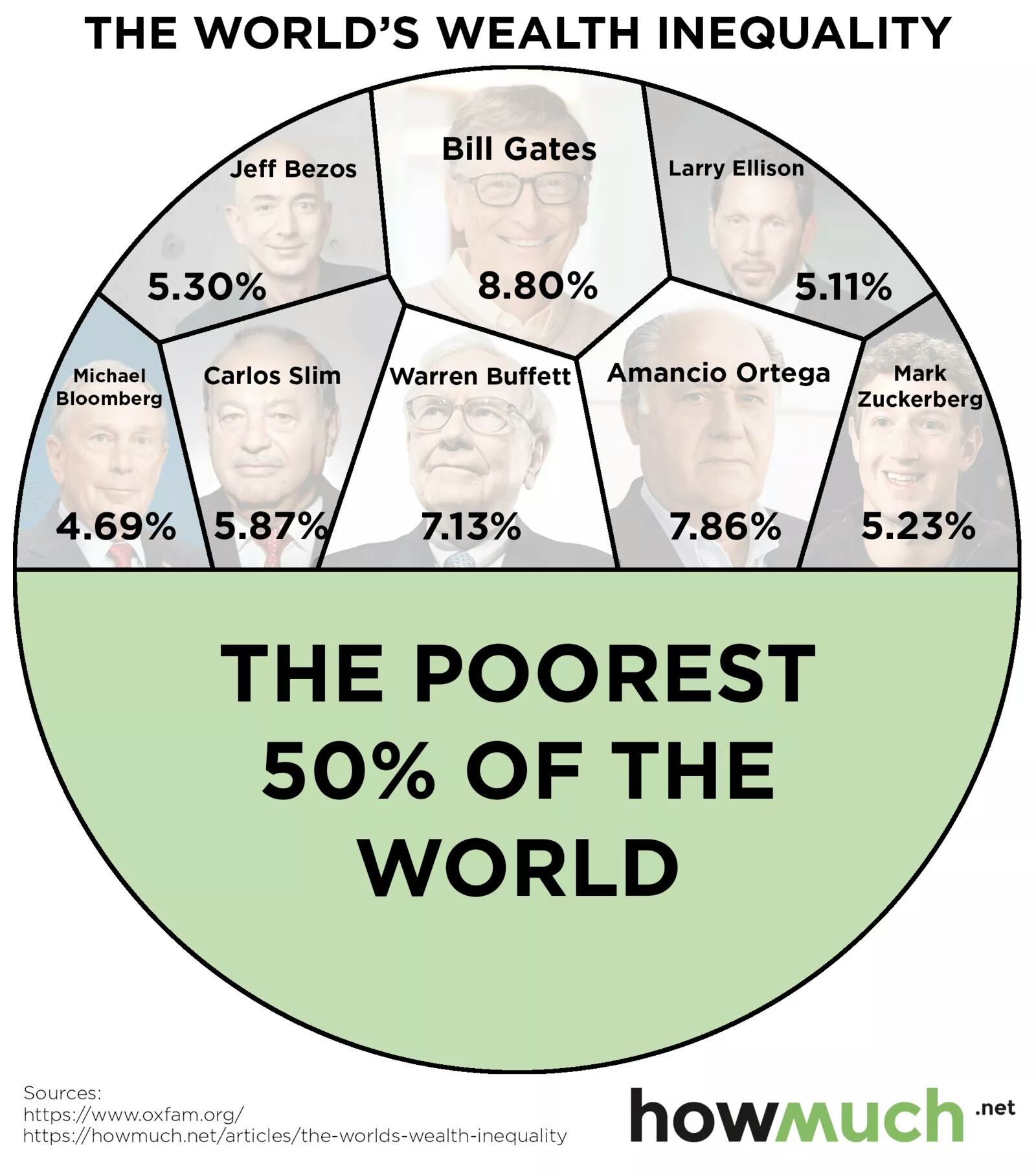
It’s "threadbare" to question @NZSuperFund’s investment strategy @TaxpayersUnion
23 Mar 2017 Leave a comment
There really is an issue on which economists are unanimous, a big issue to boot.
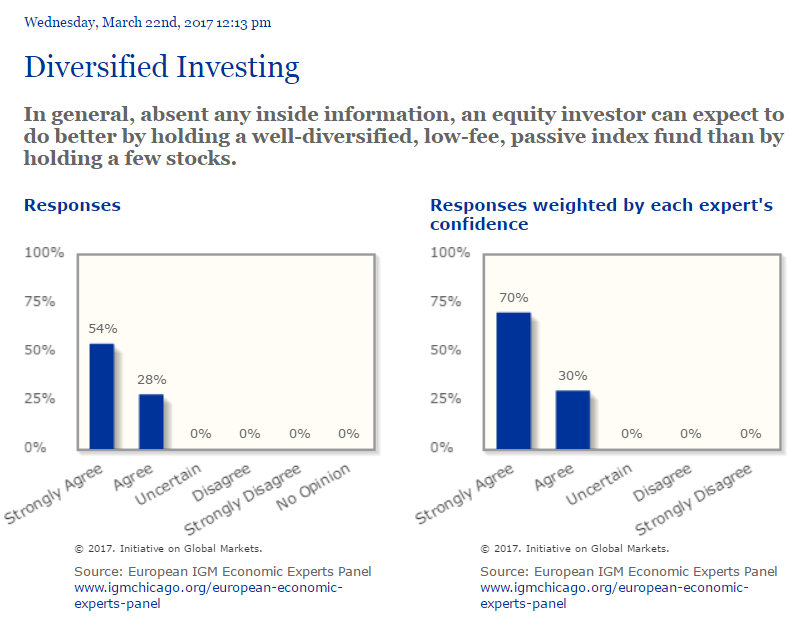
Source: Diversified Investing | IGM Forum.
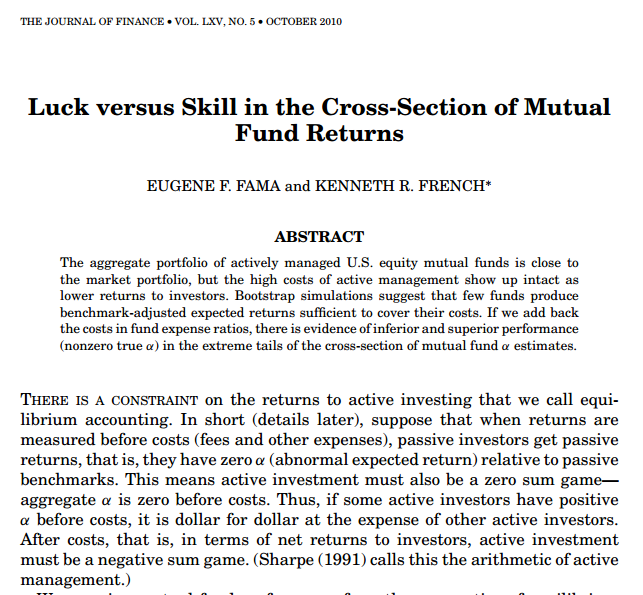
Actively-managed mutual funds cannot earn excess returns over index funds because in aggregate they earn the same as index funds, less the difference in cost. This was proposed by Sharpe in his timeless 1991 article, The Arithmetic of Active Management.
Of course, certain definitions of the key terms are necessary. First a market must be selected — the stocks in the S&P 500, for example, or a set of “small” stocks. Then each investor who holds securities from the market must be classified as either active or passive.
- A passive investor always holds every security from the market, with each represented in the same manner as in the market. Thus if security X represents 3 per cent of the value of the securities in the market, a passive investor’s portfolio will have 3 per cent of its value invested in X. Equivalently, a passive manager will hold the same percentage of the total outstanding amount of each security in the market2.
- An active investor is one who is not passive. His or her portfolio will differ from that of the passive managers at some or all times. Because active managers usually act on perceptions of mispricing, and because such misperceptions change relatively frequently, such managers tend to trade fairly frequently — hence the term “active.”
… Properly measured, the average actively-managed dollar must underperform the average passively-managed dollar, net of costs. Empirical analyses that appear to refute this principle are guilty of improper measurement.
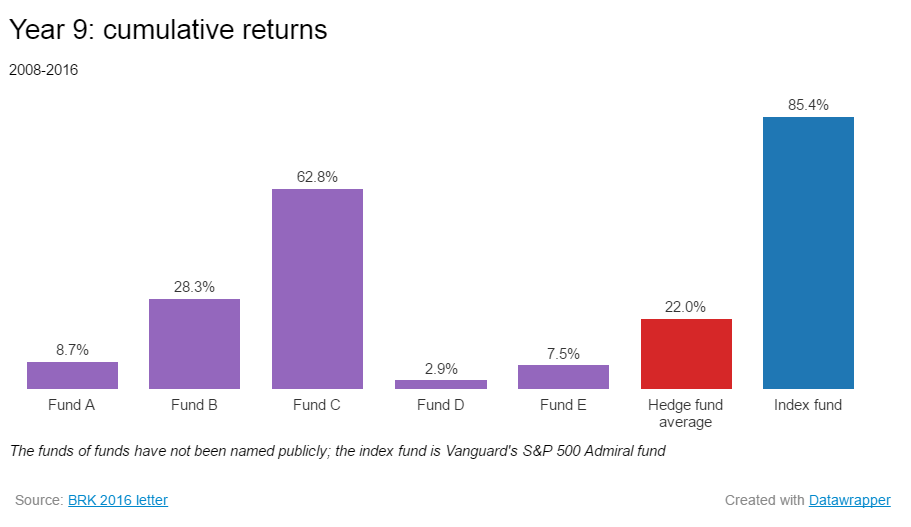
In 2008, Warren Buffett made a bet of $1 million with Protégé Partners LLC that, including fees, costs and expenses, an S&P 500 index fund would outperform a hand-picked portfolio of hedge funds over the 10 years ending December 31, 2017.


The wages of sin catching up with the Vice Fund v. S&P 500
22 Mar 2017 Leave a comment
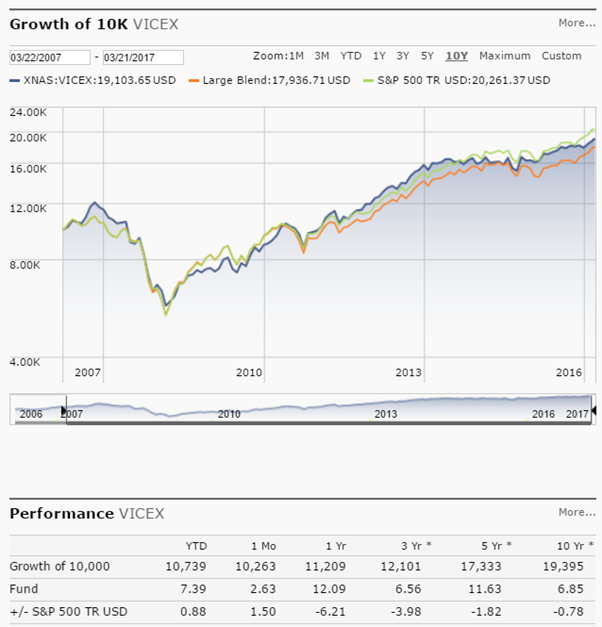
Source: VICEX USA Mutuals Barrier Investor Fund VICEX Quote Price News.
The Vice Fund is now known as the Barrier Fund because it extended out of sinful stocks into industries with high barriers to entry. Minimum Investment is $2,000.
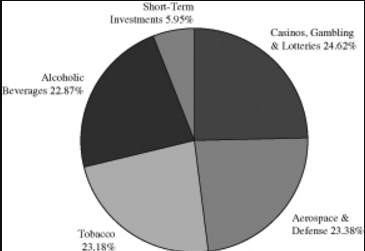 The Barrier Fund primarily invests in the following industries: Aerospace/Defense, Gaming, Tobacco and Alcoholic Beverages. These four industries were chosen because they demonstrate one or more of these compelling and distinctive investment characteristics:
- Natural barriers to new competition
- Steady demand regardless of economic condition
- Global Marketplace – not limited to the U.S. economy
- Potentially high profit margins
- Ability to generate excess cash flow and pay and increase dividends
.
Women’s choice of keeping surnames post marriages: Some economics..
20 Mar 2017 Leave a comment

I have been trying to read some non-crisis and non-macro papers these days (to remain sane).
I just came across this superb paper written in 2001 by Claudia Goldin and Maris Shim. It looks at this issue of whether women keep their maiden name or their husband surname post marriage. The paper went onto become part of ongoing project called Harvard and Beyond.
The paper looks at two datasets. Both datasets show women increasingly retain their maiden names. This is because of changes in society with women getting increasingly educated and professionally known. When women “make a name” they increasingly retain their maiden name:
View original post 282 more words
Gall-Peters projection of land masses in their correct proportions by area
20 Mar 2017 Leave a comment



Recent Comments