UN Says The US Is The Most Successful Major Country in Carbon Emissions Reduction
09 Jan 2021 Leave a comment

The UN released its global emissions and carbon report last month. The U.S. is the most successful major country at mitigating its own pollution carbon dioxide (CO2). So successful according to a Forbes posting written by Ellen Wald titled “The U.N. Says America Is Already Cutting So Much Carbon It Doesn’t Need the Paris Climate Accord”.
“According to the report,
“The United States of America emits 13 per cent of global GHG emissions.” Comparatively, “China emits more than one-quarter of global GHG emissions.” The U.S. still contributes the most greenhouse gas emissions per capita in the world, but, over the last decade, the country’s GHG emissions have been in decline (0.4 per cent per year). “Greenhouse gas emissions per capita in the U.S. are dropping precipitously while those of China, India and Russia continue to rise. With the world’s most successful economy (over $21 trillion in 2019), it is…
View original post 293 more words

Australia’s Subsidised Wind & Solar Rush Threatens Total Power Grid Collapse
08 Jan 2021 Leave a comment


Australia’s self-inflicted renewable energy calamity was as perfectly predictable as it was perfectly avoidable.
Now, amongst the myriad of energy commissars and boffins, it’s a case of avoiding responsibility for the disaster that everybody (save them) saw coming.
For years the likes of Kerry Schott – head of the inaptly named Energy Security Board – have been talking up the inevitable transition to an all wind and sun powered future. However, now, with Australia’s Eastern Grid on the brink of collapse, Schott and her fellow travellers are all crab walking away from the disaster for which they are, in large part, responsible. [Note to Ed: what’s that line about ‘failure being an orphan’?]
The Federal Government’s Large-Scale Renewable Energy Target is the principal source of subsidy for wind and large-scale solar – delivered by way of renewable energy certificates (LGCs) – the cost of which is added to all retail…
View original post 2,193 more words





For Whom The Bell Tolls
06 Dec 2020 Leave a comment

For Whom The Bell Tolls (1943) Director: Sam Wood
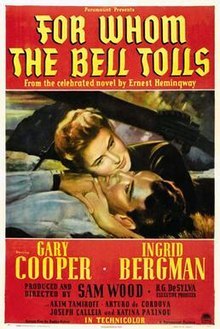
★★★★☆
For Whom The Bell Tolls is a beautiful technicolor film version of Ernest Hemingway’s famous novel of the same name. It is impossible to successfully compare the film version to Hemingway’s classic novel, as so much is lost without the modernist reflections of the complex protagonist, Robert Jordan, however Sam Wood’s production does a fabulous job of capturing the main narrative, despite the film being nearly three hours long. The Hays Code, active in Hollywood in the 1940s, blocked certain romantic scenes from being shown onscreen, scenes which are quite scandalous even in the novel. Hemingway was apparently involved in the production. He hand-selected both Gary Cooper and Ingrid Bergman for their respective roles in the film. The film was nominated for nine Academy Awards, winning one well-deserved award: Best Supporting Actress for Greek actress, Katina Paxinou who played the…
View original post 269 more words
Alison L Young: The Draft Fixed-term Parliaments Act 2011 (Repeal) Bill: Turning Back the Clock?
05 Dec 2020 Leave a comment

 Things were different in 2010. If schools closed and households found themselves stuck indoors, or unable to travel abroad, it was due to snowstorms and erupting Icelandic volcanoes, not because of a pandemic. Moreover, if the then Prime Minister wished to dissolve Parliament, he did not need to adhere to the requirements of the Fixed-term Parliaments Act 2011, which fixed parliamentary terms to five years, allowing for early parliamentary general elections either following a vote of two-thirds of the House of Commons in favour of an early parliamentary general election, or following a vote of no confidence. Instead, so the draft Fixed-term Parliaments Act 2011 (Repeal) Bill would have us believe, the Prime Minister could dissolve Parliament and instigate a new general election by use of a prerogative power, at a date of his choosing unchecked by the courts, subject only to ensuring Parliament did not exceed its maximum…
View original post 4,227 more words
 Utopia, you are standing in it!
Recent Comments