

U.S. Antitrust Enforcement and Error Costs: The Supreme Court and the Obama Administration
22 Sep 2015 Leave a comment
Stigler on economics as a big tent @RusselNorman @NZGreens @GreenpeaceNZ @Mark_J_Perry
21 Sep 2015 1 Comment

Was Moynihan, right? The role of prospective success in assortative mating in family poverty
20 Sep 2015 Leave a comment
The American upper middle class: married brook.gs/1POkEv2 http://t.co/lLdEBA0mHX—
Richard V. Reeves (@RichardvReeves) September 03, 2015


Albert Shanker on Charters: 1988
17 Sep 2015 Leave a comment

In the hagiography of the charter school movement, we often hear that Albert Shanker was one of the original proponents of the idea. Shanker was president of the American Federation of Teachers, and his imprimatur is supposed to persuade people that charters have a progressive patina.
This is ironic, because 90% of the nation’s 6,000 charters are non-union and oppose collective bargaining. Some charters have even insisted in federal court and to the National Labor Relations Board that they are private schools to avoid complying with state labor laws that would allow teachers to join a union.
Shanker never intended that charters would be non-union, nor that they would compete with public schools. He thought they would be formed by teachers to create a “school within a school,” and eventually autonomous schools whose purpose was to enroll the students who were bored or disengaged in regular school. He thought that…
View original post 110 more words
Can Nudges Improve Government?
17 Sep 2015 Leave a comment

Behavioral “nudges” can increase college enrollment by low-income students, boost health insurance take up, encourage federal workers to save for retirement, cut delinquencies on student loans, reduce vendor fraud, and save paper, according to the first annual report of the White House’s “nudge” unit.
President Obama established the unit—officially known as the Social and Behavioral Sciences Team (SBST)—to use insights from psychology, behavioral economics, and other decision sciences to improve federal programs and operations. Those social sciences increasingly appreciate what regular folks have long known: people are imperfect. We procrastinate. We avoid making choices. We get confused and discouraged by complex forms. We forget to do things. We sometimes lack the energy to weigh decisions thoroughly, so we act based on what we think our peers do or how choices are framed. And we sometimes cut corners when we think no one is looking.
Changing how people engage with the…
View original post 575 more words
America’s Unfortunate Loss of Economic Liberty in the 21st Century
16 Sep 2015 Leave a comment

Last month, I cited data from Economic Freedom of the World to explain that the United States was becoming less competitive because of creeping protectionism and reductions in the rule of law and property rights.
Now I have more bad news to share.
Last year, the United States ranked #12 for economic liberty.
But according to the new rankings released yesterday, the United States now has dropped to #16. Here are the new rankings (based on a 0-10 scale), with Hong Kong and Singapore once again leading the pack.
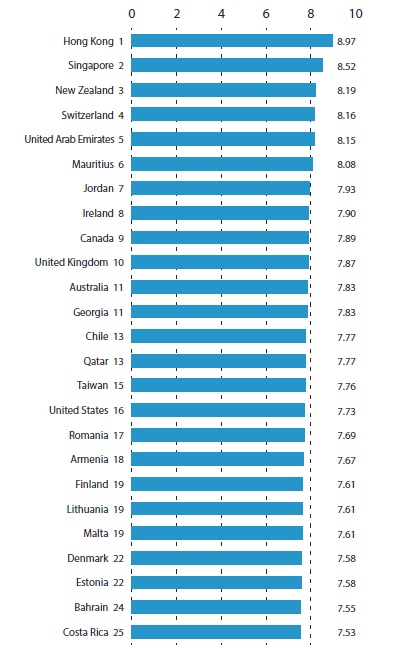
Why did the United States drop? In part, because our score fell from 7.81 to 7.73, but also because of what happened to the scores of other nations.
The bottom line is that Georgia, Taiwan, Qatar, Ireland, and the United Kingdom jumped ahead of the United States, while Finland fell behind America.
Now let’s get more depressed.
If you dig through…
View original post 318 more words

I Love You, You Love Me, We’ve Probably Never Said That To More Than Three | FiveThirtyEight
11 Sep 2015 Leave a comment


via I Love You, You Love Me, We’ve Probably Never Said That To More Than Three | FiveThirtyEight
A Comparison of the Tax Burden on Labor in the OECD
10 Sep 2015 Leave a comment
How high is the US #tax burden on labor? Here's an OECD comparison tax.foundation/1LNpE4W by @samcjordan_ @kpomerleau http://t.co/unaxWM1BgH—
Tax Foundation (@taxfoundation) July 27, 2015
Payroll taxes make up a large portion of a worker's #tax bill: tax.foundation/1g1nd1w by @samcjordan_ @kpomerleau http://t.co/yHx4kQTmr6—
Tax Foundation (@taxfoundation) July 21, 2015
via A Comparison of the Tax Burden on Labor in the OECD | Tax Foundation.


Recent Comments