I unsuccessfully tried to get a list of all the drugs that had a stronger case for funding than Keytruda. The Labor Party wants that to be given priority – jump the queue.
I asked for the cost of each drug that is above Keytruda and the cut-off point for PHARMAC funding of drugs in the last four years. The first part about the cost of drugs was refused on commercial in confidence grounds.
My inquiries about a list of drugs queued up for funding that will get funding as soon as money becomes available lead to an intriguing answer by Pharmac in their response to my Official Information Act request:
For the second part of your request, PHARMAC makes its funding decisions based on its legislative objective, ‘to secure…the best health outcomes that can reasonably be achieved from pharmaceutical treatment and from within the amount of funding. Therefore, there is no cut-off value, threshold or other criteria relating to a fixed point.
This lack of a queue or cut-off point lead me to ponder how funding is allocated between life-saving and other medications, between painkillers and routine medications that are not about relieving suffering.

Source: Pharmac Making Funding Decisions factsheet.
So at the bottom of it all a certain amount of funding is available for different types of drugs ranging for miracle drugs to routine medications. Cost benefit analysis cannot really help you with that because all would tell you is to spend all your money on the life-saving drugs but we live our lives out in pain as few other drugs are available to us. At bottom, someone must play God and say that a certain amount of the budget is available to save lives.
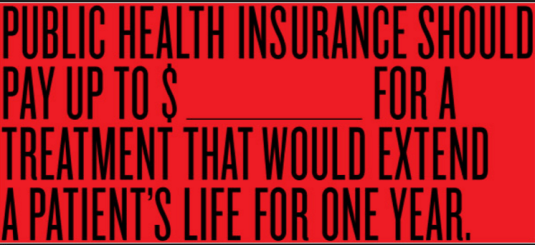
That philosopher God King must first decide how big the health budget is and then how big the Pharmac budget is. Within the Pharmac budget, certain rather arbitrary decisions must be made as to how much is spent on life-saving drugs. Peter Singer had one of his good days when he said:
Governments implicitly place a dollar value on a human life when they decide how much is to be spent on health care programs and how much on other public goods that are not directed toward saving lives.
The task of health care bureaucrats is then to get the best value for the resources they have been allocated. It is the familiar comparative exercise of getting the most bang for your buck. Sometimes that can be relatively easy to decide. If two drugs offer the same benefits and have similar risks of side effects, but one is much more expensive than the other, only the cheaper one should be provided by the public health care program. That the benefits and the risks of side effects are similar is a scientific matter for experts to decide after calling for submissions and examining them. That is the bread-and-butter work of units like NICE.
But the benefits may vary in ways that defy straightforward comparison. We need a common unit for measuring the goods achieved by health care. Since we are talking about comparing different goods, the choice of unit is not merely a scientific or economic question but an ethical one.
Singer then goes on to talk about quality adjusted life years as the measure economists use. Still very subjective because people have enough trouble working out the value of a life saved – the value of the statistical life.

Quantifying the quality of life is even bigger leap for bureaucrats. That is not to belittle their effort. At least it is an attempt to be upfront about making difficult choices in medical rationing.
Health care does more than save lives: it also reduces pain and suffering. Tragic choices must be made as only so much spending is on saving lives; the rest will be spent on relieving pain and suffering.
We should be upfront about that so we are not captured by the identifiable victim effect. Giving money to an identifiable victim is money taken from many other health budget purposes that also save lives and relieve suffering.
 Utopia, you are standing in it!
Mar 05, 2016 @ 22:40:57
Reblogged this on Utopia – you are standing in it! and commented:
20+ treatments have a higher priority than Keytruda. I was declined access to that information when I requested it under the Official Information Act.
LikeLike