The French and Korean president every election or so pardons all minor traffic offences. The accident rate goes up on the eve of this pardon.
Despite the obvious incentive effect of safer cars on risk taking, I have argued with people until they were black and blue where they were denying that accident rates respond to incentives and risks. My interlocutor even denied that his driving habits would change if seat belts were banned. Oddly enough, he did believe that people acted on better information about risks. I do not know why he thought they had an incentive to act on new information.
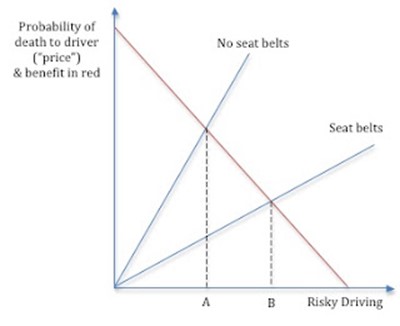
I mentioned this French pardon in another conversation. He mentioned that when he lived in Paris, he would save up his traffic and parking tickets in anticipation of the pardon.
Armen Alchian’s famous solution to speeding was to put a jagged spike in car wheels to make sure the driver died if he had an accident. This would ensure that everyone drives very carefully, assuming that anyone every got into a car ever again.
 |
 |
People have considerable control over the risk of accidents. When Sweden changed from driving on the left to driving on the right, motor insurance claims fell 40% for six weeks; fatalities took two years to return fully to previous levels.
The Peltzman effect was named after Sam Peltzman’s findings in “The Effects of Automobile Safety Regulation”, Journal of Political Economy August 1975 about the impact of mandatory safety devices on the accident rates for passengers and pedestrians.
Peltzman found that enough extra pedestrians were mowed down by drivers who were driving faster because they were safer that the increase in these deaths offset the fewer number of drivers and passengers dying in accidents.
Peltzman never said that the behavioural offset to greater safety and reduced risk would always be complete in all cases. Many subsequent studies found at least a partial offsetting effect of greater safety on risk taking, including an increased risk of accidents for others.
Sports economists even found the Peltzman effect in NASCAR racing. A major new safety rule led to more on-track accidents and an increased risk to both spectators and pit crew members. Greg Mankiw pointed to an Australian news report that 4WD drivers were almost four times more likely than other drivers to be using a mobile phone. Maybe they fell safer in accidents. I drive a Toyota Corolla.
The Peltzman effect is a simple point that many still resist. The whole point of safety equipment is to allow us to undertake riskier activities. When more safety equipment becomes available or is mandated, people will undertake more of the risky activity because it is now safer to do so.
HT: http://correctionspageone.blogspot.co.nz/2010/09/seatbelts-are-lifesavers-in-your-car.html for graphics
 Utopia, you are standing in it!
Nov 04, 2015 @ 11:46:53
Reblogged this on Utopia – you are standing in it! and commented:
LikeLike