Old macroeconomic fallacies never die, they just wait for the next recession

Thomas Kuhn’s Structure of Scientific Revolutions showed that sciences do not march onwards and upwards towards the light. Kuhn found that once a central paradigm is selected, there is no testing or sifting, and tests of basic assumptions only take place after accumulated failures and anomalies in the ruling paradigm plunge the science into a crisis.

Scientists do not give up the failing paradigm until a new paradigm arrives, which resolves the failures and anomalies that caused the crisis. It takes a theory to beat a theory.

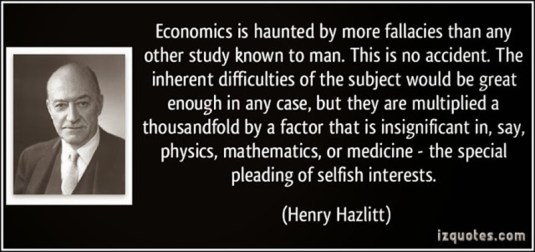
Murray Rothbard, when discussing Kuhn, pointed to economics is an example of a science which moves in a zigzag fashion, with old fallacies sometimes elbowing aside earlier but sounder paradigms.
Thomas Humphrey wrote an excellent 250-year long literature surveys of both the rules versus discretion debate and the cost-push theories of inflation in the 1998 and 1999 Richmond Fed Quarterly.

Humphrey wrote the reviews to see if economics was a progressive science in the sense that superior new ideas relentlessly supplant inferior old ones.

Humphrey showed that policy rules were popular in good times to contain inflation, and when unemployment was rising, discretionary policies returned to vogue. The policy debate keeps recycling because

  1. people forget the lessons of the past; and
  2. For better or worse, politicians and the public have tended to believe that central banks, the focus of his studies, have the power to boost output, employment, and growth permanently.

Mercantilists, with their fears of hoarding and scarcity of money together with their prescription of cheap (low interest rates) and plentiful cash as a stimulus to real activity, tend to gain the upper hand when unemployment is the dominant problem.

Classicals, chanting their mantra that inflation is always and everywhere a monetary phenomenon, tend to prevail when price stability is the chief policy concern.

Cost-push fallacies about inflation were even more resilient against repeated refutations.

There is nothing new under the sun in macroeconomics. The same issues that divided twentieth-century monetarists and non-monetarists as well as current macroeconomists were discussed by everyone from David Hume (1752) to Knut Wicksell (1898) and in the Bullionist-Anti-Bullionist and the Currency School-Banking School controversies:

  • rules v. discretion,
  • inflation as a monetary v. real cost push phenomenon,
  • direct v. inverse money-to-price causality,
  • central bank-determined v. market demand-determined money stocks,
  • exogenous v. endogenous money, and
  • backing v. supply-and-demand theories of money’s value

Current macroeconomists and monetary economists often unaware of the eighteenth and nineteenth-century origins of the ideas they employ.

Barro (1989) “New Classicals and New Keynesians, or the Good Guys and the Bad Guys”, made the point that Keynesian macroeconomics does not seek out new theoretical results for testing; rather the aim is to provide respectability for the basic viewpoints and policy stances of the old Keynesian models.

Bellante (1992) likewise, noted that the search in Keynesian economics for microeconomic foundations is to blunt criticism, rather than because it is otherwise useful. The analytical apparatus may change, but the policy conclusions remain the same.

Bassett, Brash & Hide

Celebrating humanity's flourishing through the spread of capitalism and the rule of law

Truth on the Market

Scholarly commentary on law, economics, and more

The Undercover Historian

Beatrice Cherrier's blog

Matua Kahurangi

Celebrating humanity's flourishing through the spread of capitalism and the rule of law

Temple of Sociology

Celebrating humanity's flourishing through the spread of capitalism and the rule of law

Velvet Glove, Iron Fist

Celebrating humanity's flourishing through the spread of capitalism and the rule of law

Why Evolution Is True

Why Evolution is True is a blog written by Jerry Coyne, centered on evolution and biology but also dealing with diverse topics like politics, culture, and cats.

Down to Earth Kiwi

Celebrating humanity's flourishing through the spread of capitalism and the rule of law

NoTricksZone

Celebrating humanity's flourishing through the spread of capitalism and the rule of law

Homepaddock

A rural perspective with a blue tint by Ele Ludemann

Kiwiblog

DPF's Kiwiblog - Fomenting Happy Mischief since 2003

The Dangerous Economist

Celebrating humanity's flourishing through the spread of capitalism and the rule of law

Watts Up With That?

The world's most viewed site on global warming and climate change

The Logical Place

Tim Harding's writings on rationality, informal logic and skepticism

Doc's Books

A window into Doc Freiberger's library

The Risk-Monger

Let's examine hard decisions!

Uneasy Money

Commentary on monetary policy in the spirit of R. G. Hawtrey

Barrie Saunders

Thoughts on public policy and the media

Liberty Scott

Celebrating humanity's flourishing through the spread of capitalism and the rule of law

Point of Order

Politics and the economy

James Bowden's Blog

A blog (primarily) on Canadian and Commonwealth political history and institutions

Science Matters

Reading between the lines, and underneath the hype.

Peter Winsley

Economics, and such stuff as dreams are made on

A Venerable Puzzle

"The British constitution has always been puzzling, and always will be." --Queen Elizabeth II

The Antiplanner

Celebrating humanity's flourishing through the spread of capitalism and the rule of law

Bet On It

Celebrating humanity's flourishing through the spread of capitalism and the rule of law

History of Sorts

WORLD WAR II, MUSIC, HISTORY, HOLOCAUST

Roger Pielke Jr.

Undisciplined scholar, recovering academic

Offsetting Behaviour

Celebrating humanity's flourishing through the spread of capitalism and the rule of law

JONATHAN TURLEY

Res ipsa loquitur - The thing itself speaks

Conversable Economist

Celebrating humanity's flourishing through the spread of capitalism and the rule of law

The Victorian Commons

Researching the House of Commons, 1832-1868

The History of Parliament

Articles and research from the History of Parliament Trust

Books & Boots

Reflections on books and art

Legal History Miscellany

Posts on the History of Law, Crime, and Justice

Sex, Drugs and Economics

Celebrating humanity's flourishing through the spread of capitalism and the rule of law

European Royal History

Exploring the Monarchs of Europe

Tallbloke's Talkshop

Cutting edge science you can dice with

Marginal REVOLUTION

Small Steps Toward A Much Better World

NOT A LOT OF PEOPLE KNOW THAT

“We do not believe any group of men adequate enough or wise enough to operate without scrutiny or without criticism. We know that the only way to avoid error is to detect it, that the only way to detect it is to be free to inquire. We know that in secrecy error undetected will flourish and subvert”. - J Robert Oppenheimer.

STOP THESE THINGS

The truth about the great wind power fraud - we're not here to debate the wind industry, we're here to destroy it.

Lindsay Mitchell

Celebrating humanity's flourishing through the spread of capitalism and the rule of law

Alt-M

Celebrating humanity's flourishing through the spread of capitalism and the rule of law

croaking cassandra

Economics, public policy, monetary policy, financial regulation, with a New Zealand perspective

The Grumpy Economist

Celebrating humanity's flourishing through the spread of capitalism and the rule of law

International Liberty

Restraining Government in America and Around the World