
Celebrating humanity's flourishing through the spread of capitalism and the rule of law
21 May 2014 1 Comment
in applied welfare economics, economics of climate change Tags: global warming
20 May 2014 Leave a comment
in Music Tags: favourite songs
20 May 2014 Leave a comment
in applied welfare economics, industrial organisation, Public Choice, rentseeking, survivor principle Tags: corporate welfare, farm welfare, middle-class welfare
The term corporate welfare was coined by Ralph Nader in 1956. Corporate welfare is subsidies, tax breaks, or other favourable treatment for business and implies that business are much less needy of such treatment than the poor.
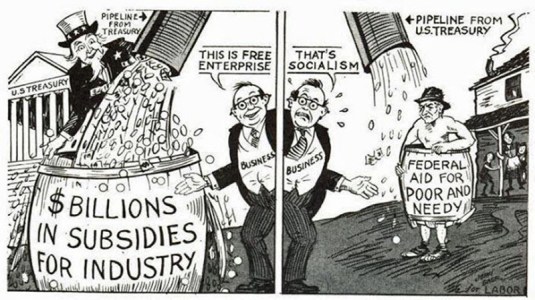 The Right talks of the deserving and undeserving poor. The Left countered with payments to business.
Supporters of corporate welfare often justify them as remedying some sort of purported market failure.
Businesses, big and small, see market failure everywhere under balance sheets that are in the red.
The notion behind corporate welfare is profits should be private while losses should be a reason for a taxpayer bailout.
 Both direct and indirect subsidies to businesses are classified as corporate welfare. The reason is businesses as supposed to make a profit or go out of business.
If a business is losing money, they should try better or do something different or just go out of business.
Losses are not a reason for a taxpayer bailout. No business project should be premised on government subsidies.
The purpose of the capital market is to direct investment to projects that have a future and take support away from failing projects.
The capital market is picking winners and losers every day because that’s its job. That’s what it’s good at.
The participants in the capital market who are not good at picking winners and avoiding losers will themselves will go soon out of business.
Corporate welfare is increasingly used interchangeably with crony capitalism.
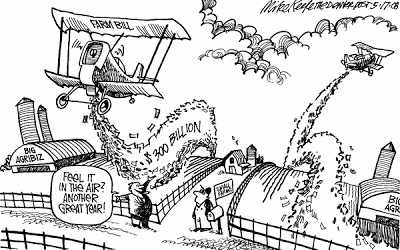 A kissing cousin of corporate welfare is farm welfare. These are the countless subsidies that farmers get in Europe and America, and in the past, in New Zealand.
Middle-class welfare is cash payments by the government to the non-poor. These payments to the middle-class can be for having children such as in Working for Families, for early-childhood education or for childcare. Middle-class welfare also can be tax breaks and subsidies for retirement savings of the nonpoor.
 It is pointless to tax the middle-class and then give them their money pretty much straight back as a cash payment for a particular purpose be it child care or for their retirement. Middle-class welfare covers at least in part expenses the middle-class could have covered themselves but for the taxes.
20 May 2014 Leave a comment
in Thomas Schelling, war and peace Tags: arms control, disarmament

We cannot abolish conventional wars for the same reason:

While I have your attention, imagine if all nuclear weapons were abolished:

Compare the sleepy world we have now with one where the first country to reacquire one nuclear weapon would be dominant. Some practice a variation of this with nuclear weapons now.
Because latent capacity to develop nuclear weapons is not prescribed by the Nuclear Non-Proliferation Treaty, as a work-around of the treaty, this is sometimes called the “Japan Option”. Japan is a clear case of a significant advanced country with the complete technical prowess and nuclear materials to develop a nuclear weapon quickly.
A country does not need to test weapons nor declare its latent nuclear potential. Yet just keep the resources for a latent nuclear potential on hand for a crash programme.
19 May 2014 Leave a comment
in Austrian economics, F.A. Hayek, macroeconomics, Milton Friedman Tags: credibility, gradualism, Margaret Thatcher, neoliberalism, Thomas Sargent
Thatcher read Hayek’s Road to Serfdom as an undergraduate at Oxford. She took away two key lessons for her life: you cannot compromise with socialism, even the mild social democratic forms; and she saw her own party was doing just that, which put her deeply at odds with its leadership.

After she became Leader of the Opposition, Thatcher cut short a leftish member of her own Conservative Party Research Department by showing him a copy of The Constitution of Liberty, slamming it down on the table declaring “this is what I believe”.
Thatcher’s relationship with Milton Friedman was different to that of Hayek and not as long standing. Friedman met Thatcher for the first time at a dinner in 1978.
After Thatcher came to office in 1979, Friedman was a critic of the monetary regime of the Thatcher government, questioning her monetary policy targets, questioning the raising of the value added tax to finance income tax cuts, and urging deeper spending cuts in the 1979 budget. Friedman was also a strong critic of the monetary policies of the Fed at that time as well, arguing that they lacked credibility, transparency and were very erratic.
In a letter to the Times on 3 March 1980 Friedman stated that he opposed “fine-tuning” and strongly preferred:
a steady monetary and fiscal policy announced long in advance and strictly adhered to
Hayek disagreed with Friedman about the role of gradualism in a letter to the Times on 26 March 1980:
The chief practical issue today is how fast inflation can be and ought to be stopped.
On this, I am afraid, my difference from Friedman makes me take an even more radical position.
The reason is that I believe that the artificial stimulus which inflation gives to business and employment lasts only so long as inflation accelerates, that is, so long as prices turn out to be higher than expected.
Inflation clearly cannot accelerate indefinitely, but as soon as it ceases to accelerate, all the windfalls due to prices turning out higher than expected, which kept unprofitable businesses and employment going, disappear.
Every slowing down of inflation must therefore produce temporary conditions of extensive failures and unemployment.
No inflation has yet been terminated without a “stabilization crisis”.
To advocate that inflation should be slowed down gradually over a period of years is to advocate a long period of protracted misery. No government could stand such a course.
Milton Friedman’s general views on Britain when Thatcher first came to office were clear-cut and were also stated in his letter to the Times on 3 March 1980:
…while monetary restraint is a sufficient condition for controlling inflation, it is a necessary but not sufficient condition for improving Britain’s productivity – the fundamental requirement for restoring Britain to full economic health.
That requires measures on a broader front to restore and improve incentives, promote productive investment, and give a greater scope for private enterprise and initiative.
Both Hayek and Friedman wrote privately about the Thatcher policies of the early 1980s, decrying them as gradualism. So much for the retired professors as the ring masters of neo-liberalism and Thatcher as their pawn.
Friedman and Hayek disagreed with each other, in important respects, about both gradualism in monetary policy and macroeconomics in general.
Thatcher did not follow their conflicting policy advice to her. At best, Thatcher was a wayward disciple of squabbling prophets.
Friedman was a strong critic of Austrian macroeconomics and its supposed role in the 1930s policy response or lack of a response to the Great Depression:
I think the Austrian business-cycle theory has done the world a great deal of harm.
If you go back to the 1930s, which is a key point, here you had the Austrians sitting in London, Hayek and Lionel Robbins, and saying you just have to let the bottom drop out of the world.
You’ve just got to let it cure itself. You can’t do anything about it. You will only make it worse. You have Rothbard saying it was a great mistake not to let the whole banking system collapse.
I think by encouraging that kind of do-nothing policy both in Britain and in the United States, they did harm.
Hayek was equally critical of the macroeconomics of Milton Friedman and his methodology in general:
I do indeed regard the abandonment of the whole macroeconomics nonsense as very important, but it is for me a very delicate matter and I have for some time avoided stating my views too bluntly and would not have time to state them adequately.
The source of the difficulty is the constant danger that the Mont Pelerin society might split into a Friedmanite and a Hayekian wing.
I have long regretted my failure to take time to criticise Friedman’s Positive Economics almost as much as my failure to return to the critique of Keynes General Theory after I had dealt with his Treatiese.
It still seems to me paradoxical that Keynes, who was rather contemptuous of econometrics, should have become the main source of the revival of macroeconomics – which incidentally was also the reason why Milton was for a time a Keynesian.
I believe a good and detailed critical analysis of macroeconomics would be very desirable.
Brad Delong pointed out in 2000 that the New Keynesian macroeconomic research program was developed in the 20th century monetarist tradition mostly in the work of Milton Friedman.
Tom Sargent argued in 1981 that Thatcher’s medium term economic strategy was gradualism, and the sustained budget deficits would result in unpleasant monetarist arithmetic:
…In order that the current British plan be viewed as credible it is necessary that the large prospective government deficits over the next several years be counterbalanced by prospective surpluses further down the line.
It is difficult to point to much either in current legislation, or equally importantly, in the general British political climate that could objectively support such an outlook.
…Gradualism invites speculation about future reversals with U-turns in policy.
Large contemporary government deficits unaccompanied by concrete prospects for future government surpluses promote realistic doubts about whether monetary restraint must be abandoned sooner or later to help finance the deficits.
Such doubts not only call into question the likelihood that the plan can successfully permanently reduce inflation, but also can induce high real cost in terms of depressed industry and lengthened unemployment in response to what may be viewed as only temporary downward movements in nominal aggregate demand that the monetary restraint induces.
What did Thatcher actually do?
by discrediting socialism so thoroughly, she prompted in due course the adoption by the Labour Party of free market economics, and so, as she wryly confessed in later years, “helped to make it electable”.
The archives of the Margaret Thatcher foundation has released extensive correspondence and other documents about Thatcher, Hayek and Friedman.
19 May 2014 1 Comment
in Alfred Marshall, applied welfare economics, David Friedman, labour economics, minimum wage Tags: David Card, interpersonal comparision of utility, Milton Friedman, minimum wage, offsetting behaviour, The fatal conceit, The pretense to knowledge
Raising the minimum wage by a substantial amount would price working poor people out of the job market.
A far better way to help them would be to subsidize their wages or – better yet – help them acquire the skills needed to earn more on their own…
Raise the legal minimum price of labour above the productivity of the least skilled workers and fewer will be hired.
If a higher minimum means fewer jobs, why does it remain on the agenda of some liberals?
A higher minimum would undoubtedly raise the living standard of the majority of low-wage workers who could keep their jobs. That gain, it is argued, would justify the sacrifice of the minority who became unemployable.
The argument isn’t convincing. Those at greatest risk from a higher minimum would be young, poor workers, who already face formidable barriers to getting and keeping jobs. Indeed, President Reagan has proposed a lower minimum wage just to improve their chances of finding work.
What does the New York Times say in 2014?
The minimum wage is specifically intended to take aim at the inherent imbalance in power between employers and low-wage workers that can push wages down to poverty levels.…
The weight of the evidence shows that increases in the minimum wage have lifted pay without hurting employment
Both the White House and the New York Times are not the best of Bayesian updaters because the author of the one study on which they are very much hang their hats for their policy conclusions about no job losses from a minimum wage increase interprets his results with very much less zeal than they do:
I think careful research on the topic has found that for this range of minimum wage increase, the almost unmistakable conclusion is that there will be little in the way of job losses, while the wages of low-end workers will get a boost (his underlining).
The claims of the White House and the New York Times that the minimum wage can be lifted without hurting employment are a long bow from what Andrajit Dube said about small changes in the minimum wage having small adverse effects on unemployment:
What Andrajit Dube said s not much different from everyone else on the minimum wage – Nuemark is an example:
a 10 per cent increase in the minimum wage could reduce young adult employment by up to 2 per cent
David Card was always very careful amount about how his pioneering research was about how small increases in the minimum wage not reducing employment in the presence of search and matching costs:
From the perspective of a search paradigm, these policies make sense, but they also mean that each employer has a tiny bit of monopoly power over his or her workforce.
As a result, if you raise the minimum wage a little—not a huge amount, but a little—you won’t necessarily cause a big employment reduction. In some cases you could get an employment increase.
There is always offsetting behaviour: Barry Hirsch found that when the federal minimum wage went up in 2007, businesses just made their employees work harder to justify the expense.
I am always surprised that people might think that the minimum wage will have anywhere near its intended effects after market participants have had time to act to counter its effects as Peltzman explains:
Regulation creates incentives for behaviour to offset some or even all of the intended effect of the regulation…
Regulation seldom changes the forces that produces the particular results the regulators seek to change. So we need to ask whether the regulation really changes result or only the form in which the market forces assert themselves.
Is a minimum wage increase a Pareto improvement – a policy action done in an economy that harms no one and helps at least one person?

Obviously there are winners and losers from a minimum wage increase and these wins and loses must be summed up in some way as they are for all public policy changes.

When there are winners and losers from deregulation, the only thing seems to matter to many of those who support a minimum wage increase are the losses to the incumbent industry and its often well-paid workers rather than the gains to consumers, rich or poor.
For there to be a Marshall improvement, the sum of all of the gains and losses must sum to a positive.
A Marshall improvement from a minimum wage or any other change is measured by adding utilities as if everyone receives the same utility from a dollar. A dollar is a dollar to everyone as David Friedman explains:
A net improvement in the sense used by Marshall–what I have elsewhere called a Marshall improvement–is a change whose net value is positive, meaning that the total value to those who benefit, measured as the sum of the number of dollars they would each, if necessary, pay to get the change, is larger than the total cost to those who lose, measured similarly.
The advantage of the Marshall improvement criterion is we commonly observe people’s values of different things by seeing how much they are willing to pay for it.
Alfred Marshall was aware that treating people as if they all had the same utility for a dollar was a stretch but this was considered less relevant for policy changes that affect large and diverse groups of people. Individual differences could be expected to cancel out over a broad suite of policies in a well-functioning democracy so that most people gain in net terms through time. David Friedman explains:
I prefer to use the Marshallian approach, which makes the interpersonal comparison explicit, instead of hiding it in the ‘could be made but isn’t’ compensating payment…
a change that benefits a millionaire by $10 and costs a pauper $9 is a potential Pareto improvement, since if combined with a payment of $9.50 from the millionaire to the pauper it would benefit both. If the payment is not made, however, the change is not an actual Pareto improvement.
The ‘potential Paretian’ approach reaches the same conclusion as the Marshallian approach and has the same faults; it simply hides them better. That is why I prefer Marshall…
It is worth noting that although a Marshall improvement is usually not a Pareto improvement, the adoption of a general policy of ‘Wherever possible, make Marshall improvements’ may come very close to being a Pareto improvement…
Add up all the effects and, unless one individual or group is consistently on the losing side, everyone, or almost everyone, is likely to benefit.
This is the latest review of the minimum wage research from David Neumark:
The potential benefits of higher minimum wages come from the higher wages for affected workers, some of whom are in poor or low-income families.
The potential downside is that a higher minimum wage may discourage employers from using the low-wage, low-skill workers that minimum wages are intended to help.
If minimum wages reduce employment of low-skill workers, then minimum wages are not a “free lunch” with which to help poor and low-income families, but instead pose a trade-off of benefits for some versus costs for others.
Research findings are not unanimous, but evidence from many countries suggests that minimum wages reduce the jobs available to low-skill workers.
George Stigler set-out the conditions for a minimum wage to achieve its purported objectives in 1946, which have not been bettered:
If an employer has a significant degree of control over the wage rate he pays for a given quality of labour, a skilfully-set minimum wage may increase his employment and wage rate and, because the wage is brought closer to the value of the marginal product, at the same time increase aggregate output…
This arithmetic is quite valid but it is not very relevant to the question of a national minimum wage. The minimum wage which achieves these desirable ends has several requisites:
1. It must be chosen correctly… the optimum minimum wage can be set only if the demand and supply schedules are known over a considerable range…
2. The optimum wage varies with occupation (and, within an occupation, with the quality of worker).
3. The optimum wage varies among firms (and plants).
4. The optimum wage varies, often rapidly, through time.
A uniform national minimum wage, infrequently changed, is wholly unsuited to these diversities of conditions.
The case for a minimum wage was therefore hung, drawn and quartered in 1946 by Stigler. Not every cause and effect is open to policy manipulation because of the lack of the necessary knowledge about the relationship and insufficiently deft policy tools to exploit that knowledge in a timely fashion and as circumstances change. This information and organisational burden is such that the process of setting minimum wage increases is an example of public policy making that is groping about in the dark. Success can be neither appraised in advance nor later retrospectively determined.
19 May 2014 Leave a comment
in labour economics, taxation Tags: labour supply, taxes
Most economists believe male labour supply elasticities are small, but a sizable minority of studies have large values. There is no clear consensus on this point.
The key factor driving these tensions is the failure of most studies to account for human capital returns to work experience.
In a model that includes human capital, even modest elasticities—as conventionally measured—can be consistent with large efficiency costs of taxation.
Conventional estimates of male labour supply elasticities have a severe downward bias because of their failure to include human capital accumulation. The opportunity cost of time includes their after tax wage and present value of increased earnings in all future years.
The return to work experience is high so working more has large long-term payoffs for younger male workers. Wages start low for young grow and then peak in 40s. When adjusted for the return for work experience, a large part of compensation when younger is human capital, and this peters away by the 40s.

Estimates where wages grow with work experience, with the accumulation of human capital, yield large male labour supply elasticities, as high as 3.8 rather than close to zero (Keane 2010, 2011). That is a profound difference.
Women have high labour supply elasticities, especially on the labour force participation margin, as most agree.
Estimates of long-run female labour supply elasticities—estimates that allow for dynamic effects of wages on fertility, marriage, education and work experience—are generally quite high.
18 May 2014 Leave a comment
in development economics Tags: China
18 May 2014 Leave a comment
in George Stigler, history of economic thought Tags: textual exegesis
There are cottage industries of academics living of the questions such as what did Marx actually say, or what did Keynes really mean? A sign that you have really made it is people squabbling over what you really said.
Stigler’s law of textual exegesis (1965) is that because even the great and the good are human enough to contradict themselves, change their minds, and even write in vague terms from time to time and are misheard, rely on their own summaries of their own work to work out what they really think rather than hand-picked quotation. You can then check if their analytical system supports their summaries of their main work:
Let us recognize the fact that the interpretation of a man’s position –– especially if the man has a complex and subtle mind –– is a problem in inference, not to be solved by the choice of quotations.
As for why we ponder over the great texts, our goal should not be to understand what an author really believed, instead it is
…to maximize the value of a theory to the science… The man’s central theoretical position is isolated and stated in a strong form capable of contradictions by facts. The net scientific contribution, if any, of a man’s work is thus identified, amended if necessary, and rendered capable of evaluation and possible acceptance.
17 May 2014 Leave a comment
in economics
via Funeral Blues – Four Weddings and a Funeral – YouTube.
Funeral Blues
WH Auden
Stop all the clocks, cut off the telephone,
Prevent the dog from barking with a juicy bone,
Silence the pianos and with muffled drum
Bring out the coffin, let the mourners come.
Let aeroplanes circle moaning overhead
Scribbling on the sky the message He is Dead.
Put crepe bows round the white necks of the public doves,
Let the traffic policemen wear black cotton gloves.
He was my North, my South, my East and West,
My working week and my Sunday rest,
My noon, my midnight, my talk, my song;
I thought that love would last forever: I was wrong.
The stars are not wanted now; put out every one,
Pack up the moon and dismantle the sun,
Pour away the ocean and sweep up the woods;
For nothing now can ever come to any good.
Read by Matthew, as played by John Hanna
17 May 2014 Leave a comment
in applied welfare economics, Edward Prescott, labour economics Tags: labour supply, taxes
Americans now work 50 per cent more than do the Germans, French, and Italians. This was not the case in the early 1970s, when the Western Europeans worked more than Americans.
Edward Prescott found that taxes accounted for these differences in labour supply across time and across countries; in particular, the effective marginal tax rate on labour income. The population of countries considered is the G-7 countries, which are major advanced industrial countries. Prescott concluded that
virtually all of the large differences between U.S. labour supply and those of Germany and France are due to differences in tax systems.
Prescott and many that followed him were truly puzzled by the lack of a role for employment mandates, employment protections and product market regulation in Europe’s poor economic performance
Richard Rogerson is a very sharp fellow who built on Prescott’s work. Most anything Rogerson writes is worth a look.

A non-technical note by Rogerson made these key points:
Dramatic differences in the overall change in hours worked per person aged 16 to 64 across countries between 1960 and 2000;
at one extreme the U.S., with an increase of 10 per cent between these two dates;
At the other extreme are Germany and France, with declines of more than 30 per cent;
For the U.S. and France, the difference is staggering—more than 45 per cent;
Richard Freeman and Ronald Schettkat (2001) studied time allocation by married couples in Germany and the United States.
Their striking finding is about total time devoted to work (i.e., market work plus home production) turns out in the two countries is virtually the same.
In The Impact of Labor Taxes on Labor Supply: An International Perspective (AEI Press, 2010) Rogerson finds that:
• a 10 percentage point increase in the tax rate on labour leads to a 10 to 15 per cent decrease in hours of work.
• Even a 5 per cent decrease in hours worked would mean a decline in labour output equating to a serious recession.
• While recessions are temporary, permanent changes in government spending patterns have long-lasting repercussions.
• Although government spending provides citizens with important benefits, such benefits must be weighed against the disincentive effects of increased labour taxes.
• Policymakers who fail to account for the decrease in labour output risk expanding government programs beyond their optimal scale.
16 May 2014 Leave a comment
in economic growth, great recession Tags: Obamanomics, trend growth rate of the USA
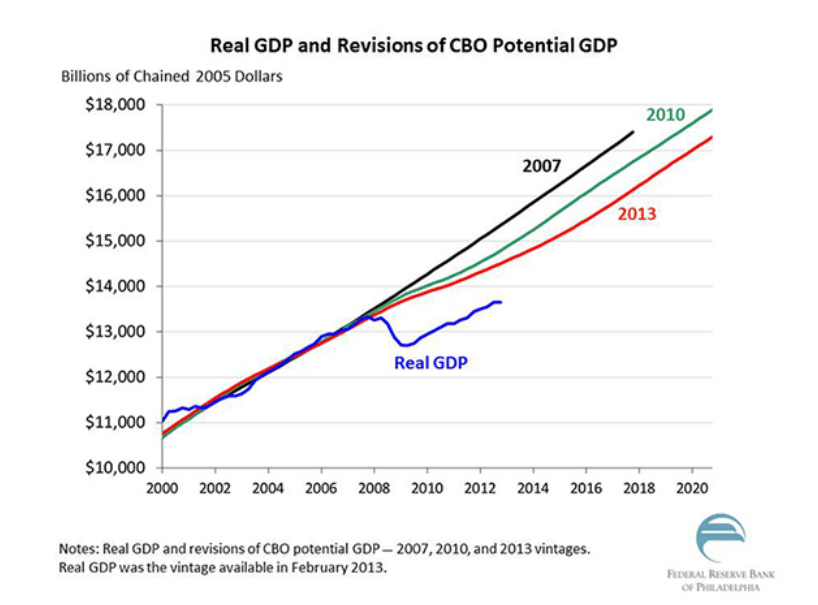
Philadelphia Fed President Charles Plosser made this nice graph on official views of potential GDP and trends in actual GDP.
16 May 2014 Leave a comment
in labour economics Tags: moral hazard
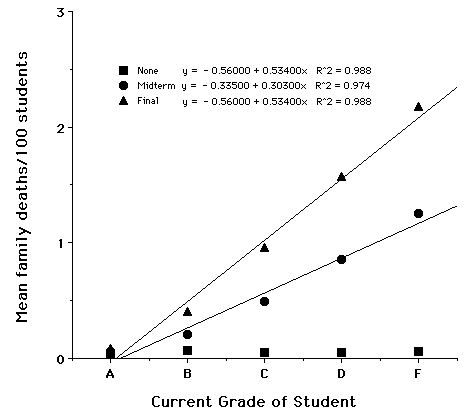
Grandmothers are far more likely to die suddenly just before the student takes an exam, than at any other time of year.

Poor grades among their grandchildren is especially dangerous to their golden years
16 May 2014 Leave a comment
in industrial organisation, law and economics, Richard Posner Tags: cartels
Posner and Easterbrook suggest that these industry behaviours together are suspicious.
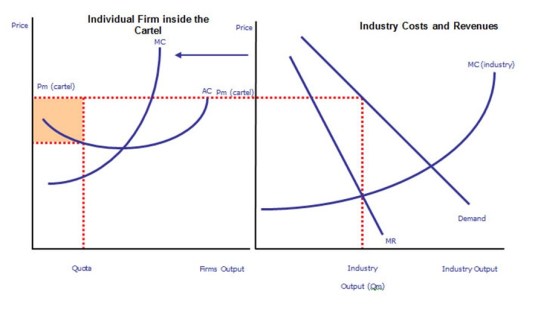
Aaron Director’s most creative suggestion of evidence of price collusion is disputes between the marketing and finance departments of a large company. The market department wants to cut prices because there would be a large increase in sales. The finance department says no because this would take the price below the monopoly or agreed cartel price.
Celebrating humanity's flourishing through the spread of capitalism and the rule of law
Scholarly commentary on law, economics, and more
Beatrice Cherrier's blog
Celebrating humanity's flourishing through the spread of capitalism and the rule of law
Celebrating humanity's flourishing through the spread of capitalism and the rule of law
Celebrating humanity's flourishing through the spread of capitalism and the rule of law
Why Evolution is True is a blog written by Jerry Coyne, centered on evolution and biology but also dealing with diverse topics like politics, culture, and cats.
Celebrating humanity's flourishing through the spread of capitalism and the rule of law
Celebrating humanity's flourishing through the spread of capitalism and the rule of law
A rural perspective with a blue tint by Ele Ludemann
DPF's Kiwiblog - Fomenting Happy Mischief since 2003
Celebrating humanity's flourishing through the spread of capitalism and the rule of law
The world's most viewed site on global warming and climate change
Tim Harding's writings on rationality, informal logic and skepticism
A window into Doc Freiberger's library
Let's examine hard decisions!
Commentary on monetary policy in the spirit of R. G. Hawtrey
Thoughts on public policy and the media
Celebrating humanity's flourishing through the spread of capitalism and the rule of law
Politics and the economy
A blog (primarily) on Canadian and Commonwealth political history and institutions
Reading between the lines, and underneath the hype.
Economics, and such stuff as dreams are made on
"The British constitution has always been puzzling, and always will be." --Queen Elizabeth II
Celebrating humanity's flourishing through the spread of capitalism and the rule of law
Celebrating humanity's flourishing through the spread of capitalism and the rule of law
WORLD WAR II, MUSIC, HISTORY, HOLOCAUST
Undisciplined scholar, recovering academic
Celebrating humanity's flourishing through the spread of capitalism and the rule of law
Res ipsa loquitur - The thing itself speaks
Celebrating humanity's flourishing through the spread of capitalism and the rule of law
Researching the House of Commons, 1832-1868
Articles and research from the History of Parliament Trust
Reflections on books and art
Posts on the History of Law, Crime, and Justice
Celebrating humanity's flourishing through the spread of capitalism and the rule of law
Exploring the Monarchs of Europe
Cutting edge science you can dice with
Small Steps Toward A Much Better World
“We do not believe any group of men adequate enough or wise enough to operate without scrutiny or without criticism. We know that the only way to avoid error is to detect it, that the only way to detect it is to be free to inquire. We know that in secrecy error undetected will flourish and subvert”. - J Robert Oppenheimer.
The truth about the great wind power fraud - we're not here to debate the wind industry, we're here to destroy it.
Celebrating humanity's flourishing through the spread of capitalism and the rule of law
Celebrating humanity's flourishing through the spread of capitalism and the rule of law
Economics, public policy, monetary policy, financial regulation, with a New Zealand perspective
Celebrating humanity's flourishing through the spread of capitalism and the rule of law
Restraining Government in America and Around the World



 Utopia, you are standing in it!
Recent Comments