
Now that every election policy must be fully costed, and every major party promises a return to surplus in a few years, the Ricardian theory of budget deficits is now an optimistic view of the power of fiscal policy.
By running a budget deficit, it shifts from collecting taxes today to collecting them tomorrow and fund the intervening shortfall was selling government bonds to the private sector. A finance minister may choose to lower taxes today (thereby increasing the deficit), but without any planned changes in the government’s expenditure program, such a policy must imply higher taxes at some point in the future.
The Ricardian theory of budget deficits is people are smart enough to recognise that today’s fiscal deficits mean tomorrow’s taxes must increase to to repay the debt so taxpayers cut back consumption dollar for dollar to save for those future taxes.
If you know your taxes will go up in the future, the right thing to do is save to pay those higher taxes. A fiscal stimulus is then completely offset by the reduction in private consumption. The stimulus has no effect on spending, prices, production, or interest rates because households know that deficit spending means future taxes: to smooth consumption, they save more now.
To make things worse, the lower taxes today and the higher taxes tomorrow encourage intertemporal substitution of labour. People will work more now because taxes are low but work less in the future when taxes are high. Investors also take into account that taxes on their investment income will be higher in the future so they will invest less now.
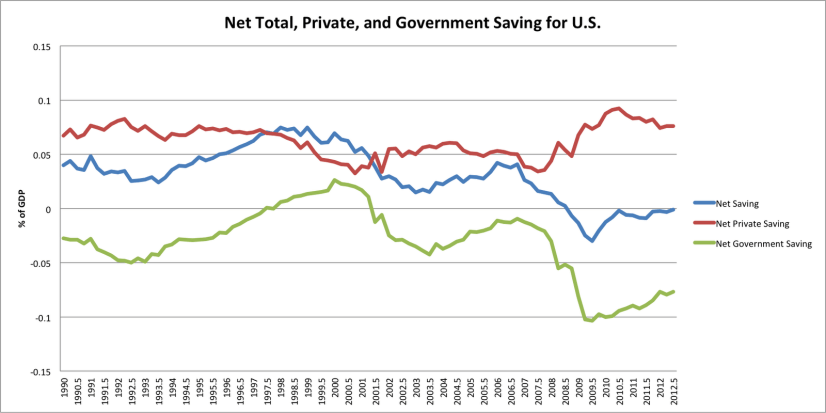
Notice below the mirror trends of net private and government savings as a per cent of U.S. GDP. Financing U.S. government consumption through deficits or through taxation is equivalent: households know net present value of taxation will rise and save to offset that.
HT: correctionspageone.blogspot
If you think a fiscal stimulus works by fooling people into ignoring the future tax hikes or spending cuts, then loudly announcing in an election campaign those tax hikes and spending cuts in a few year’s time that will pay for the current fiscal stimulus must undermine that stimulus even more!
When Robert Barro wrote in the 1970s and 1980s, he pointed out that there is no reason to assume that forecasting errors about future taxes are always biased in the direction of under-estimating the future taxes. People can over-estimate the future taxes. Individual uncertainty about their future tax liabilities does not normally induce them to save less, it induces them to save more.
The fact that much political debate surrounds government budget deficits clearly suggests that the voters understand the government budget constraint and that high budget deficits today signal higher taxes in the future and they change their behaviour accordingly.
Robert Barro likes to refer to Israel as a natural experiment in the Ricardian budget deficit theory. In 1983, the national saving rate of 13% of GDP corresponded to a private saving rate of 17% and a public saving rate of -4%. In 1984, the dramatic rise in the budget deficit reduced the public saving rate to -11%. Private saving rate rose to 26%, so that the national saving rate changed little. Then a stabilisation program in 1985 eliminated the budget deficit, so that the public saving rate rose to 0% in 1985-86 and -2% in 1987. The private saving rate declined dramatically to 19% in 1985 and 14% in 1986-87. The national saving rate remained relatively stable, going from 15% in 1984 to 18% in 1985, 14% in 1986, and 12% in 1987.
The best evidence that people do take future taxes into account is the method in which old age pensions are financed in different countries. An expansion of social security pensions for the retired is analogous to a deficit-financed tax cut. People respond to more social security by shifting private intergenerational transfers, rather than by consuming more.
In the US, the growth of social security strongly diminished the tendency of children to support their aged parents because they are paying taxes now and in the future to support them. In countries were weak social security, children spend more of their money looking after their parents.
51% of nonretirees doubt they will receive Social Security… on.gallup.com/1NcwzEa #GallupDaily http://t.co/ZhKnHYtr1X—
(@GallupNews) August 13, 2015
It is certainly the case that most younger people think they have to provide for their own retirement and that government will not tax enough to support them in 20 to 30 years time.
People have relatively sophisticated views of both long-run government spending and taxing in an ageing society and that deficits must be paid for. The voter is a fiscal conservative.
 Utopia, you are standing in it!
Recent Comments