
Walter Williams Asks: “How Much Can Discrimination Explain?”
04 Jul 2014 Leave a comment
via Cafe Hayek

If there is such a thing as a liquidity trap, bring it on!
04 Jul 2014 Leave a comment
in business cycles, fiscal policy, macroeconomics, Milton Friedman, monetary economics Tags: Allan Meltzer, JM Keynes, liquidity trap, Milton Friedman
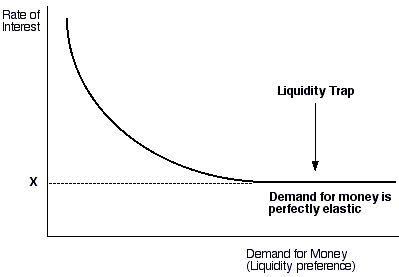
In the Keynesian pipedream, in a liquidity trap, there is perfect substitutability of money and bonds at a zero short-term nominal interest rate. This renders monetary policy ineffective.
Keynesians claim that the demand for money may be so persistently high that the rate of interest could not fall low enough to stimulate investment sufficiently to raise the economy out of the depression. Allan Meltzer explains:
A liquidity trap means that increases in money by the central bank (monetary base) cannot affect output, prices, interest rates or other variables. Changes in the money stock are entirely matched by changes in the demand to hold money.
With a liquidity trap, the public simply hoards the money the central bank creates rather than attempting to run down additions to their cash balances with increased consumer expenditure. This limitless accumulation of money by the public is not a real world phenomenon. The public will not forever accumulate money.
Auerbach and Obstfeld noted in "The Case for Open-Market Purchases in a Liquidity Trap" that to the extent that long-term interest rates are positive short-term interest rates are expected to be positive in the future, trading money for interest-bearing public debt through open market operations reduces future debt-service requirements.
- A massive monetary expansion during a liquidity trap should improve social welfare by reducing the taxes required in the future to service the now much smaller national debt!!!!
- A quantitative easing during a liquidity trap is, in effect, as good as or even better than a lump sum tax.
Central banks perhaps should contrive liquidity traps because they can then buy back the public debt because of the unlimited demand for money.
The logic of the liquidity trap is people will without limit give up bonds for non-interest bearing cash. If monetary policy is impotent near the zero bound, the central bank should buy trillions of dollars of federal bonds and payoff the public debt. This is a logical implication of liquidity traps for an optimal fiscal policy!!!! Is my reasoning wrong?
In addition to D.H. Robertson, Jacob Viner, Milton Friedman, Philip Cagan, Don Patinkin, Auerbach and Obstfeld, Robert H. Lucas, Greg Mankiw, and Bernanke and Blinder as sceptics about a liquidity trap, Keynes wrote in 1936:
Whilst the limiting case might become practically important in future, I know of no example of it hitherto. Indeed, owing to the unwillingness of most monetary authorities to deal boldly in debts of long term, there has not been much opportunity for a test.
Meltzer, who wrote A History of the Federal Reserve, Vol. 1: 1913-1951 points to several periods when interest rates were at or close to zero:
“In 1954, interest rates were 0.5 percent or below, and we had no problem recovering,” he says. “In 1948 to 1949, we had zero interest rates. Also in 1937 to 1938. We had no problem recovering.”
The Pigou effect states that when there is deflation of prices, employment (and output) will be increased due to an increase in wealth (and thus consumption). The deflation increases the value of cash balances and therefore the wealth of consumers. They spend some of this additional wealth.
After reading the annual reports of the Fed in the 1920s and 1930s, Milton Friedman noticed the following pattern:
In the years of prosperity, monetary policy is a potent weapon, the skilful handling of which deserves the credit for the favourable course of events; in years of adversity, other forces are the important sources of economic change, monetary policy had little leeway, and only the skilful handling of the exceedingly limited powers available prevented conditions from being even worse
Welfare economics of monopoly and rent seeking
04 Jul 2014 Leave a comment
in applied price theory, applied welfare economics Tags: monopoly, rent seeking, Tullock

Monopolisation has resulted in a higher price being paid (Pm not Pc) and the quantity bought (Qm not Qc) has been reduced. Part of the consumer surplus triangle has been shifted to producers as excess profits but part of it is totally lost to society as shown by the reduction in output from Qc to Qm.
The monopolised industry may result in more efficient production techniques and lowered costs. The net welfare gain or loss to the total economy is the difference between the red and blue areas.

Tullock’s (1967) argument is that if a successful monopolist can extort the excess profits from his customers such as through a government licence giving them a monopoly, such a large prize is worth the investment of up to an equivalent amount of resources equal to the capitalised value of the future monopoly profits.

Rational entrepreneurs should be willing to invest resources in attempts to form a monopoly until the marginal cost equals the properly discounted marginal return. Under certain assumptions (see Posner 1975) the competitive outlays to establish a monopoly will exactly equal the present value of the profit rectangle.

The Tullock rectangle may have to be added to the Harberger triangle when calculating the potential loss of welfare associated with monopoly.
Freedom of religion and equality before the law in a democracy
04 Jul 2014 4 Comments
in liberalism, politics - Australia, war and peace Tags: democracy, democratic equality, Freedom of religion, freedom of speech, rule of law

An individual’s religious beliefs does not excuse him from compliance with an otherwise valid law of general application prohibiting conduct that governments are free to regulate.
Allowing exceptions to every law or regulation that directly or indirectly affects religion would open the prospect of constitutionally required exemptions from legal obligations of almost every conceivable kind. Examples are compulsory military service, payment of taxes, polygamy, vaccination requirements, and child-neglect laws. some parliaments do provide exemptions and accommodations but that does not say they must.
Justice Frankfurter wrote in 1940:
conscientious scruples have not in the course of the long struggle for religious toleration relieved the individual from obedience to a general law not aimed at the promotion or restriction of religious beliefs.
The mere possession of religious convictions which contradict the relevant concerns of political society does not relieve the citizen from the discharge of political responsibilities
Religious freedom bars laws that prohibit:
- the holding of a religious belief,
- the right to communicate those beliefs to others, and
- the right of parents to direct the education of their children.
This approach also has the advantage of not placing courts into the position of having to determine the importance of a particular belief in a religion or the plausibility of a religious claim when weighing it against other government interests and the objectives of the disputed law.
It might be said that there should be a compelling government interest before a religious objection can be overridden. Deciding what is a compelling government interest raises questions of public policy.
Men and women decide what is more or less important in the course of making legislation goes to the very heart of democratic decision-making. This clash of opinions and visions of the good society and what laws should be passed or not are all resolved peacefully through the ballot box and free speech even in the most desperate times.

This is not to say that a parliament may if it wishes exempt people from certain obligations on the basis of religious objections or making other accommodations. What it does require is that religions take their chances in democratic politics like the rest of us when seeking exemptions from a law.


Minorities with strong feelings about an issue regularly prevail in legislative battles because they are willing to vote as a block on one issue and trade their block support with other groups in the society to assemble the necessary majority for what they want.

Indeed, a major discontent with contemporary democratic politics is minorities and special interests have too much say, not too little.

It is up to the political process to decide whether to disadvantage those religious practices that are not widely engaged in, but that unavoidable consequence of democratic government must be preferred to a system in which each conscience is a law unto itself. To quote Frankfurter again:
Its essence is freedom from conformity to religious dogma, not freedom from conformity to law because of religious dogma.
Religious loyalties may be exercised without hindrance from the state, not the state may not exercise that which except by leave of religious loyalties is within the domain of temporal power. Otherwise each individual could set up his own censor against obedience to laws conscientiously deemed for the public good by those whose business it is to make laws…
The validity of secular laws cannot be measured by their conformity to religious doctrines. It is only in a theocratic state that ecclesiastical doctrines measure legal right or wrong
The central role of the market in the emergence of fairness
04 Jul 2014 Leave a comment
in applied price theory, liberalism Tags: evolution of cooperation, experimental economics, game theory

Experiments in psychology and economics find that in market societies all over the world, a substantial fraction of individuals will be fair in anonymous interactions and will punish unfairness more.
In the dictator game , when played by participants in industrialized societies, the dictators gave away nearly half the prize — a division that probably sounds fair.

As for the noble savage, not corrupted by civilization and symbolising humanity’s innate goodness.what they do in the dictator game: hunter- gatherers, foragers, pastoralists and subsistence farmers were much less willing to share the prize, apparently because they didn’t feel an obligation to someone they didn’t know.

Success in the market correlates with the following characteristics:
- Be nice: cooperate, never be the first to defect.
- Be provocable: return defection for defection, cooperation for cooperation.
- Don’t be envious:: be fair with your partner.
- Don’t be too clever: or, don’t try to be tricky.
Being nice and not too clever or too tricky becomes ingrained to success in market societies so that is why in market societies people are fair in the dictator game as a matter of course.
Why drop your standards because some silly experiment by psychologists? After all, you may have future dealings with members of the experiment, and even if you don’t, such as in anonymous computer-based experiments of interaction, you don’t want risk picking up bad habits just to please a psychologist.
Adam Smith, in his study of religion, noticed was that religious sects with stricter codes of honesty and intense mutual monitoring by co-congregants for the slightest moral lapses proliferated in cities. Many successful businessmen belonged to these strict religions. These highly religious businessmen were successful in their businesses because they were looked upon by the public as reliable trading partners in a time of weak law enforcement.
Smith viewed participation in religion as a rational device by which individuals enhanced the value of their human capital.These businessmen did not know that this was profit maximising but the businessmen with religious backgrounds slowly gained market share over rivals that had less efficient ways of communicating both their reliability and that their personal honesty was under daily scrutiny.
Ethnic minorities are advantaged in the same way in business. Because of their extensive social interactions with each other because of their language, religious practices and inter-marriage, the costs of bad business behaviours are much higher due to the risk of social ostracism by everyone you know. This greater trustworthiness gives them a cost advantage in the marketplace even though they may be unaware of its source.
Repeat after me: fiscal policy is ineffective when there is a flexible exchange rate!
04 Jul 2014 2 Comments
in fiscal policy, macroeconomics Tags: exchange rate crowding out, fiscal policy, Mundell Fleming model
New Zealand, Australia, and most other economies are small open economies. Any expansion in the budget deficit will drive up the exchange rate because of the higher interest rates. This appreciation of the local currency in response to the capital inflow will make imports cheaper. Any increase in so-called aggregate demand will simply result in an decrease in net exports. There will be no increase in local production or employment.

- a fiscal expansion puts upward pressure on the domestic interest rate
- But this immediately invites a massive capital inflow.
- This appreciates the nominal exchange rate.
- This will decrease net exports, since we are able to import more goods and services with less money because of the currency appreciation, while foreigners will import less of our products because of our appreciated domestic currency
- The exchange rate appreciates and the trade balance worsens until the initial increase in government spending is completely offset.
Under a floating exchange rate and high capital mobility, fiscal policy is ineffective in stimulating the economy because of exchange rate crowding out. The appreciating exchange rate will increase imports and reduce exports to render fiscal policy impotent or at least to shadow of its former closed economies self.
How many people has the FDA killed today?
04 Jul 2014 Leave a comment
in economics of regulation, liberalism Tags: drug lags, FDA
Beta blockers regulate hypertension and heart problems. The FDA held up approval of beta blockers for eight years because it believed they caused cancer. Dr. Louis Lasagna of the Tufts University Center for the Study of Drug Development estimated that 119,000 people died who might have been helped by that medication.
Clozaril was first approved and used in 1970 in Europe to treat schizophrenics who did not respond to other medicines. The drug was not approved in the United States until 1990 because companies believed the FDA would reject it on the grounds that 1 per cent of all patients who take the drug contract a blood disease. Clozaril has a beneficial effect on 30 to 50 per cent of patients. FDA delay meant nearly 250,000 people with schizophrenia suffered needlessly.

Mevacor is a cholesterol-lowering drug that became available in Europe in 1989 but did not in the United States until 1992. Taking the drug reduced death due to heart disease by about 55 per cent. During that three-year period as many as a thousand people a year died from heart disease because of this FDA delay.
From 1938 until 1962, the FDA had sixty days to disapprove the application of a new drug. If it did not, the drug could be marketed. The system worked without significant incident.
The dead are many but who did the FDA save from unsafe drugs. There is an infallible test. That test is based on the FDA not being infallible.
The FDA must have made some errors and let some unsafe drugs slip through which caused the hundreds of thousands of deaths needed to make up for the deaths – the premature deaths – that were the result of drug delays. What were those drugs that slipped through the net?
via Unpleasant Economists : The Freeman : Foundation for Economic Education.
Do enough businesses survive long enough for the inherent inequality of bargaining power between the bosses and the workers to emerge?
04 Jul 2014 Leave a comment

Of mice and collective farms
04 Jul 2014 Leave a comment
in applied price theory, development economics, growth disasters Tags: Russian jokes
When Stalin was in office, he once noted that there were mice in his study and complained to President Kalinin about this.
The President thought for a moment and suggested, "Why don’t you put up a sign reading ‘Collective Farm’? Half the mice will die of hunger and the other half will run away."

Good old days alert: The Great London Smog | Stuff You Missed in History Class
04 Jul 2014 Leave a comment
in environmental economics, technological progress Tags: London smog, The Great Escape

A London bus conductor is forced to walk ahead of his vehicle to guide it through the smog, 9th December 1952.

In 1952, a choking cloud enveloped much of London and the Home Counties which killed thousands. Barbara Fewster walked 16-mile home – in heels – guiding her fiancé’s car.

the fog persisted until the 1960s when people stop using coal to heat their houses.

the London fogs which were regular from about the 1830s until the early 1960s were part of the good old days before the environment even got worse, if our friends in the environmental movement are to be believed.
via Missed In History: The Great London Smog | Stuff You Missed in History Class.
 Utopia, you are standing in it!
Recent Comments