WELFARE FACTS # 1: THREE OUT OF FOUR UK BENEFIT CLAIMANTS FOUND FIT FOR WORK

Business Roundtable's avatarRoger Kerr, New Zealand Business Roundtable Executive Director

Evidence of the need for reform of Britain’s £192 billion per annum welfare system continues to flow in, with applicants for the new Employment and Support Allowance (ESA) now having to submit to tough new tests called “work capability assessments”.  Currently 2.6 million Britons claim the incapacity benefit, costing taxpayers £12.5 billion a year. According to The Telegraph, four out of 10 new applicants for the ESA were found fit to work and:

Another 36 per cent abandoned their application before submitting to medical tests, leading ministers to suggest that many gave up their attempt after realising that they would have to be assessed by a doctor.

Just six per cent were signed off work, with another 16 per cent found to be capable of some form of employment if they received help and support.

UK Employment Minister Chris Grayling said the figures justified the government’s plans to shift…

View original post 84 more words

Alchian and Allen on investment advisors (and currency speculation too)

Image

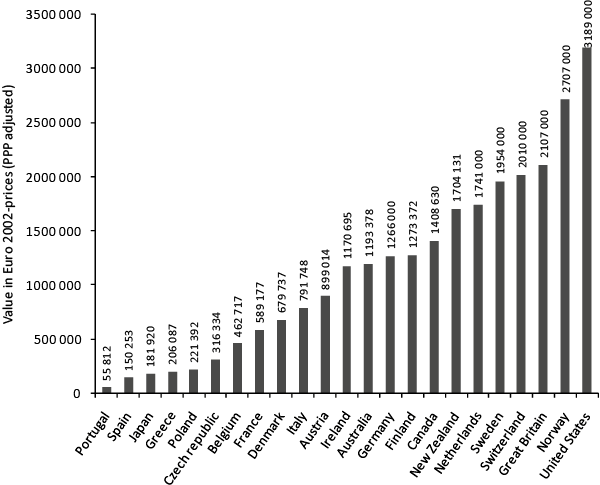
Official estimates for the value of a statistical life for road accidents in selected countries

I feel very valued compared to Australia.

HT: https://www.regjeringen.no/en/dokumenter/nou-2012-16/id700821/?docId=NOU201220120016000EN_EPIS&q=&navchap=1&ch=11

Market Failure, Considered as an Argument both for and Against Government| David Friedman

The separation of ownership from control

Eugene Fama divides firms into two types:  the managerial firm,  and the entrepreneurial firm.

The owners of a managerial firm advance, withdraw, and redeploy capital, carry the residual investment risks of ownership and have the ultimate decision making rights over the fate of the firm (Klein 1999; Foss and Lien 2010; Fama 1980; Fama and Jensen 1983a, 1983b; Jensen and Meckling 1976).

Owners of a managerial firm, by definition, will delegate control to expert managerial employees appointed by boards of directors elected by the shareholders (Fama and Jensen 1983a, 1983b). The owners of a managerial firm will incur costs in observing with considerable imprecision the actual efforts, due diligence, true motives and entrepreneurial shrewdness of the managers and directors they hired (Jensen and Meckling 1976; Fama and Jensen 1983b).

Owners need to uncover whether a substandard performance is due to mismanagement, high costs, paying the employees too much or paying too little, excessive staff turnover, inferior products, or random factors beyond the control of their managers (Jensen and Meckling 1976; Fama and Jensen 1983b, 1985). Any paucity in knowledge slows the reactions of owners in correcting managerial errors including slip-ups in the recruitment and the retention of experienced older employees.

The entrepreneurial firms are owned and managed by the same people (Fama and Jensen 1983b). Mediocre personnel policies and sub-standard staff retention practices within entrepreneurial firms are disciplined by these errors in judgement by owner-managers feeding straight back into the returns on the capital that these owner-managers themselves invested. Owner-managers can learn quickly and can act faster in response the discovery of errors in judgement. The drawback of entrepreneurial firms is not every investor wants to be hands-on even if they had the skills and nor do they want to risk being undiversified.

Many of the shareholders in managerial firms have too small a stake to gain from monitoring managerial effort, employee performance, capital budgets, the control of costs and the stinginess or generosity of wage and employment policies (Manne 1965; Fama 1980; Fama and Jensen 1983a, 1983b; Williamson 1985; Jensen and Meckling 1976). This lack of interest by small and diversified investors does not undo the status of the firm as a competitive investment.

Large firms are run by managers hired by diversified owners because this outcome is the most profitable form of organisation to raise capital and then find the managerial talent to put this pool of capital to its most profitable uses (Fama and Jensen 1983a, 1983b, 1985; Demsetz and Lehn 1985; Alchian and Woodward 1987, 1988).

More active investors will hesitate to invest in large managerial firms whose governance structures tolerate excessive corporate waste and do not address managerial slack and error. Financial entrepreneurs will win risk-free profits from being alert and being first to buy or sell shares in the better or worse governed firms that come to their notice.

The risks to dividends and capital because of manifestations of corporate waste, reduced employee effort, and managerial slack and aggrandisement in large managerial firms are risks that are well known to investors (Jensen and Meckling 1976; Fama and Jenson 1983b). Corporate waste and managerial slack also increase the chances of a decline in sales and even business failure because of product market competition (Fama 1980; Fama and Jensen 1983b). Investors will expect an offsetting risk premium before they buy shares in more ill-governed managerial firms. This is because without this top-up on dividends, they can invest in plenty of other options that foretell a higher risk-adjusted rate of return.

The discovery of monitoring or incentive systems that induce managers to act in the best interest of shareholders are entrepreneurial opportunities for pure profit (Fama and Jensen 1983b, 1985; Alchian and Woodward 1987, 1988; Demsetz 1983, 1986; Demsetz and Lehn 1985; Demsetz and Villalonga 2001). Investors will not entrust their funds to who are virtual strangers unless they expect to profit from a specialisation and a division of labour between asset management and managerial talent and in capital supply and residual risk bearing (Fama 1980; Fama and Jensen 1983a, 1983b; Demsetz and Lehn 1985). There are other investment formats that offer more predictable, more certain rate of returns.

Competition from other firms will force the evolution of devices within the firms that survive for the efficient monitoring the performance of the entire team of employees and of individual members of those teams as well as managers (Fama 1980, Fama and Jensen 1983a, 1983b; Demsetz and Lehn 1985). These management controls must proxy as cost-effectively as they can having an owner-manager on the spot to balance the risks and rewards of innovating.

The reward for forming a well-disciplined managerial firm despite the drawbacks of diffuse ownership is the ability to raise large amounts in equity capital from investors seeking diversification and limited liability (Demsetz 1967; Jensen and Meckling 1976; Fama 1980; Fama and Jensen 1983b; Demsetz and Lehn 1985).Portfolio investors may know little about each other and only so much about the firm because diversification and limited liability makes this knowledge less important (Demsetz 1967; Jensen and Meckling 1976; Alchian and Woodward 1987, 1988).

It is still unwise to still suppose that portfolio investors will keep relinquishing control over part of their capital to virtual strangers who do not manage the resources entrusted to them in the best interests of the shareholders (Demsetz 1967; Williamson 1985; Fama 1980, 1983b; Alchian and Woodward 1987, 1988).

Managerial firms who are not alert enough to develop cost effective solutions to incentive conflicts and misalignments will not grow to displace rival forms of corporate organisation and methods of raising equity capital and loans, allocating legal liability, diversifying risk, organising production, replacing less able management teams, and monitoring and rewarding employees (Fama and Jensen 1983a, 1983b; Fama 1980; Alchian 1950).

Entrepreneurs win profits from creating corporate governance structures that can credibly assure current and future investors that their interests are protected and their shares are likely to prosper (Fama 1980; Fama and Jensen 1983a, 1983b, 1985; Demsetz 1986; Demsetz and Lehn 1985). Corporate governance is the set of control devices that are developed in response to conflicts of interest in a firm (Fama and Jensen 1983b).

The market process is based on voluntary exchange

Image

Who distributes Distributive Justice?

Image

Merton Miller on beating the market

To beat the market you'll have to invest serious bucks to dig up information no one else has yet.  - Merton Miller

Image

Mutual fund facts and a question: Why are so many investors so willing to throw so much of their money away? | AEIdeas

index

The average expense ratio of actively managed equity mutual funds was 0.89% in 2013, which was more than seven times higher than the 0.12% average expense ratio for index equity funds. Some index mutual funds like the Vanguard S&P 500 Index have expense ratios as low as 0.05%.

via Mutual fund facts and a question: Why are so many investors so willing to throw so much of their money away? | AEIdeas.

Aside

U.S. voter demographics by age

via http://m.imgur.com/4dsodT2

Natural Disasters and Payday Lending

California foreclosures increase by 4.5 units per 1,000 homes in the year after a natural disaster, but the existence of payday lenders mitigates 1.0-1.3 of these foreclosures.

The advantages of passive investing or indexed linked investing: the impact of costs and fees

Figure 1: Impact of costs on returns


Half of all invested assets will outperform the market return before costs. After costs, a much smaller portion outperforms the market return.

The indexing concept makes no judgment as to market efficiency, size, or style, nor does it need efficient markets to be effective: Every market will always have an average return, whether the market is deemed efficient or otherwise. Indexing works because

whether markets are efficient or inefficient, investors as a group must fall short of the market return by the amount of the costs they incur

Active investors in strategies are exposed to commissions, management fees, bid-ask spreads, administrative costs, taxes, liquidity constraints, and other costs. In 2008, French in “The Cost of Active Investing” analysed the total cost to investors who have hired active managers to be more than $100 billion:

Professor French notes that while the total cost of trying to beat the market has grown over the years, the percentage of individuals who bear this cost has declined — precisely because of the growing popularity of index funds.

From 1986 to 2006, according to his calculations, the proportion of the aggregate market cap that is invested in index funds more than doubled, to 17.9 percent. As a result, the negative-sum game played by active investors has grown ever more negative.

The bottom line is this: The best course for the average investor is to buy and hold an index fund for the long term. Even if you think you have compelling reasons to believe a particular trade could beat the market, the odds are still probably against you.

Figure 2: Percentage of active funds underperforming low-cost index funds, For the ten years ended December 31, 2013

Percentage of active funds underperforming low-cost index funds

HT: vanguard.com

.

Bagehot on the bank bail-outs and moral hazard

alt

Image

Voltaire’s last words when asked to renounce Satan on his deathbed by a priest

Image

All good things comes to those that wait – they deserve each other

For those who have better things to do in their lives than follow minor parties in Australian politics, Clive Palmer is from a socially conservative economic nationalist party called the Palmar United Party; Bandt is from a socially liberal economic nationalist party– the Greens.  Both are MPs sitting in the  Australian House of Representatives on the cross-benches.

HT: Australian Libertarian Society

Previous Older Entries Next Newer Entries

Bassett, Brash & Hide

Celebrating humanity's flourishing through the spread of capitalism and the rule of law

Truth on the Market

Scholarly commentary on law, economics, and more

The Undercover Historian

Beatrice Cherrier's blog

Matua Kahurangi

Celebrating humanity's flourishing through the spread of capitalism and the rule of law

Temple of Sociology

Celebrating humanity's flourishing through the spread of capitalism and the rule of law

Velvet Glove, Iron Fist

Celebrating humanity's flourishing through the spread of capitalism and the rule of law

Why Evolution Is True

Why Evolution is True is a blog written by Jerry Coyne, centered on evolution and biology but also dealing with diverse topics like politics, culture, and cats.

Down to Earth Kiwi

Celebrating humanity's flourishing through the spread of capitalism and the rule of law

NoTricksZone

Celebrating humanity's flourishing through the spread of capitalism and the rule of law

Homepaddock

A rural perspective with a blue tint by Ele Ludemann

Kiwiblog

DPF's Kiwiblog - Fomenting Happy Mischief since 2003

The Dangerous Economist

Celebrating humanity's flourishing through the spread of capitalism and the rule of law

Watts Up With That?

The world's most viewed site on global warming and climate change

The Logical Place

Tim Harding's writings on rationality, informal logic and skepticism

Doc's Books

A window into Doc Freiberger's library

The Risk-Monger

Let's examine hard decisions!

Uneasy Money

Commentary on monetary policy in the spirit of R. G. Hawtrey

Barrie Saunders

Thoughts on public policy and the media

Liberty Scott

Celebrating humanity's flourishing through the spread of capitalism and the rule of law

Point of Order

Politics and the economy

James Bowden's Blog

A blog (primarily) on Canadian and Commonwealth political history and institutions

Science Matters

Reading between the lines, and underneath the hype.

Peter Winsley

Economics, and such stuff as dreams are made on

A Venerable Puzzle

"The British constitution has always been puzzling, and always will be." --Queen Elizabeth II

The Antiplanner

Celebrating humanity's flourishing through the spread of capitalism and the rule of law

Bet On It

Celebrating humanity's flourishing through the spread of capitalism and the rule of law

History of Sorts

WORLD WAR II, MUSIC, HISTORY, HOLOCAUST

Roger Pielke Jr.

Undisciplined scholar, recovering academic

Offsetting Behaviour

Celebrating humanity's flourishing through the spread of capitalism and the rule of law

JONATHAN TURLEY

Res ipsa loquitur - The thing itself speaks

Conversable Economist

In Hume’s spirit, I will attempt to serve as an ambassador from my world of economics, and help in “finding topics of conversation fit for the entertainment of rational creatures.”

The Victorian Commons

Researching the House of Commons, 1832-1868

The History of Parliament

Articles and research from the History of Parliament Trust

Books & Boots

Reflections on books and art

Legal History Miscellany

Posts on the History of Law, Crime, and Justice

Sex, Drugs and Economics

Celebrating humanity's flourishing through the spread of capitalism and the rule of law

European Royal History

Exploring the Monarchs of Europe

Tallbloke's Talkshop

Cutting edge science you can dice with

Marginal REVOLUTION

Small Steps Toward A Much Better World

NOT A LOT OF PEOPLE KNOW THAT

“We do not believe any group of men adequate enough or wise enough to operate without scrutiny or without criticism. We know that the only way to avoid error is to detect it, that the only way to detect it is to be free to inquire. We know that in secrecy error undetected will flourish and subvert”. - J Robert Oppenheimer.

STOP THESE THINGS

The truth about the great wind power fraud - we're not here to debate the wind industry, we're here to destroy it.

Lindsay Mitchell

Celebrating humanity's flourishing through the spread of capitalism and the rule of law

Alt-M

Celebrating humanity's flourishing through the spread of capitalism and the rule of law

croaking cassandra

Economics, public policy, monetary policy, financial regulation, with a New Zealand perspective

The Grumpy Economist

Celebrating humanity's flourishing through the spread of capitalism and the rule of law

International Liberty

Restraining Government in America and Around the World