Sunday Morning Quotation – Realism over Idealism

Grover Cleveland's avatarPILEUS

Robert Kaplan in Foreign Policy:

“It is realism in the service of the national interest — whose goal is the avoidance of war — that has saved lives over the span of history far more than humanitarian interventionism.”

I’m not exactly sure his comment about the goal of the national interest (or the goal of realism) makes any sense, but Kaplan’s larger point about realism vs. idealism is interesting and almost certainly true in the American context.  I’m curious how Sven would respond.

View original post

Larison’s Non-Interventionist Primer

Jason Sorens's avatarPILEUS

At The American Conservative, Daniel Larison has written a long, comprehensive description and defense of a principled non-interventionist foreign policy that manages to avoid the extremes of isolationism while retaining its coherence. How well does it succeed?

First, a general principle:

When a conflict or dispute erupts somewhere, unless it directly threatens the security of America or our treaty allies, the assumption should be that it is not the business of the U.S. government to take a leading role in resolving it. If a government requests aid in the event of a natural disaster or humanitarian crisis (e.g., famine, disease), as Haiti did following its devastating earthquake in 2010, the U.S. can and should lend assistance—but as a general rule the U.S. should not seek to interfere in other nations’ domestic circumstances.

That sounds right. The rub is how broadly we construe “directly threatens the security of American or…

View original post 790 more words

Elon Musk Wins the Economic Literacy Award

Grover Cleveland's avatarPILEUS

Marc earlier noted the depressing state of political literacy in the US.  However, I was pleasantly surprised to see a remarkable statement of economic literacy in the news today – and by someone who isn’t a trade economist.  In this case, the example came from entrepreneur Elon Musk (who was seconded by fellow businessman Lyndon Rive). He, unlike most Americans, seems to totally get one of the reasons why protectionism designed to offset foreign “external” subsidies (subsidies allegedly aimed at helping domestic – in this case Chinese – companies compete in a foreign market) is unwise:

When asked whether or not the U.S. should erect trade barriers designed to protect American solar-panel manufacturers, Mr. Musk said: “If the Chinese government wants to subsidize the rollout of solar power in America, OK, it is kind of like ‘thank you’ is what we should be saying.”

Now I’m not sure the…

View original post 11 more words

affirmative action and the academic pipeline

fabiorojas's avatarorgtheory.net

When people discuss affirmative action, they often have a mistaken view that higher education is filled with legions of under-qualified minorities. From the inside, we have the opposite view. The higher up you go, the less likely you will find folks from under-represented groups. So, what gives?

In addition to plain ideological differences, I think people are selectively looking at the academic pipeline. Basically, at some points in the career, affirmative action is indeed at work and some folks, including myself no doubt, will receive extra consideration. But most of the time, privilege is the rule. People will disproportionately focus on the parts of the pipeline where affirmative action is a modest benefit for some people.

To grasp the argument, it helps to break down what needs to happen in order for anyone to become a tenured professor:

  1. Getting a high college GPA.
  2. Applying to the “right” grad schools.
  3. Admission…

View original post 263 more words

Deirdre McCloskey on how Euroland can grow again

Image

Austrian macroeconomics vs. Keynesian macroeconomics in One Chart : The Circle Bastiat

Keynesian Economics vs Austrian Economics

Image

Whole Food Blues: Why Organic Agriculture May Not Be So Sustainable

Why are Japanese always asking your blood type?

Alice's avatarAlice Gordenker    アリス・ゴーデンカー

bloodtype_girls

In my Sept. 20 column in The Japan Times, I fielded a good question: why the heck are Japanese always asking your blood type? For the full explanation, read the column but the short answer is they want to know more about you; many Japanese believe you can tell someone’s personality by their blood type.

To whit, this depiction of the personality types:

bloodtype_girls_2

(translation,  from right to left; I’ll let you draw your own conclusions.)

Type A: What the f***? Don’t go putting lemon on everyone’s fried chicken!!

Type B: But it tastes better with lemon!

Type O: I’m fine either way.

Type B: Parsley is soooo delicious!

View original post

The Mathematicization of Economics

Economists vs the Public

Still Learning from Milton Friedman

John Taylor's avatarEconomics One

We can still learn much from Milton Friedman, who was born 100 years ago today. Here I focus on his role in the macroeconomic debates of the 1960s and 1970s, because they are so similar to the debates raging again today.

Friedman, Samuelson, and Rules Versus Discretion
First, go back to the early 1960s. The Keynesian school was coming to Washington led more than anyone else by Paul Samuelson who advised John F. Kennedy during the 1960 election campaign and recruited people like Walter Heller and James Tobin to serve on Kennedy’s Council of Economic Advisers. In fact, the Keynesian approach to macro policy received its official Washington introduction when Heller, Tobin, and their colleagues wrote the Kennedy Administration’s first Economic Report of the President, published in 1962.

The Report made an explicit case for discretion rather than rules: “Discretionary budget policy, e.g. changes in tax rates or expenditure…

View original post 876 more words

Barriers to entry alert: do late entrants have a chance

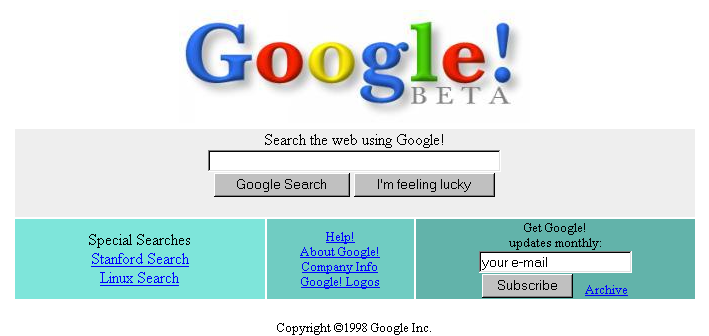
September 21, 1999 – Google came out of beta; the 17th search engine to officially enter the market.

Kirzner defines a competitive market as a market where no potential participant faces non-market obstacles to entry:

Following a long tradition in economics going back at least to Adam Smith, Austrians define a competitive market not as a situation where no participant or potential participant has the power to make any difference, but as a market where no potential participant faces nonmarket obstacles to entry.

(The adjective “nonmarket” refers, primarily, to government obstacles to entry; it is used to differentiate such obstacles from, for example, high production costs that might discourage entry. These latter do not constitute noncompetitive elements in a market; to be able to enter means to be able to enter a market if one judges such entry to be economically promising-it does not mean to be able to enter without having to bear the relevant costs of production.) That is, a situation is competitive if no incumbent participant possesses privileges that protect him against the possible entry of new competitors.

The achievements that free markets are able to attain depend, in the Austrian view, on freedom of entry, that is, on the absence of privilege.

what economists should learn from sociology

fabiorojas's avatarorgtheory.net

Fabio

I was giving a talk about my research on the politics of the anti-war movement at the GMU econ department’s public choice seminar. At lunch, my good friend Bryan Caplan and his colleague Ilea Rainer asked me: what are five things that economists should learn from sociology? We didn’t get through all five, but here are three that came up:

  1. Sociologists have a deep appreciation of imitation and conformity as a basic feature of human behavior. Economists rarely model this explicitly. If it is so important, as sociologists have shown, then economists are really missing the boat.
  2. Social networks/social structure matters. Simple idea but few economists sit around and model the effects of social structure. Usually the best you get is a recognition that “norms” matter. My argument is that economists should care because social structures produce opportunities (e.g., you hear about jobs through networks). Most models assume…

View original post 80 more words

Why Do Bad Ideas Spread? Luzzetti and Ohanian on the Rise and Fall of Keynesianism

Peter G. Klein's avatarOrganizations and Markets

| Peter Klein |

O&M generally takes a dim view of Keynesian economics. And yet Keynesianism triumphed after WWII and, while mostly dormant among academics from the 1970s to the 2000s, made a sweeping comeback over the last 2-3 years. If we anti-Keynesians are so smart, why is Keynesianism so popular?

This is an important question for the history, philosophy, and sociology of science, and we’ve addressed it before. Keynesianism appeals to fine-tuners, is easily formalized, appeared to “work” during and after WWII, has a “progressive” and “scientific” veneer, and justifies policies that governments have long championed (but all serious economists opposed).

Matthew Luzzetti and Lee Ohanian propose a similar narrative in their new NBER paper, “The General Theory of Employment, Interest, and Money After 75 Years: The Importance of Being in the Right Place at the Right Time.” In a nutshell, Keynesianism told people what they…

View original post 437 more words

The Failure of Macroeconomics

Mario Rizzo's avatarThinkMarkets

by Mario Rizzo  

The current issue of The Economisthas a very interesting article on the turmoil among macroeconomists (“The Other-Wordly Philosophers”). Essentially, the article argues that although the dominant macro model, dynamic stochastic general equilibrium theory [DSGE], appears to be in a state of near-total breakdown, there is no agreement among economists as to what should replace it.

“Would economists be better off starting from somewhere else? Some think so. They draw inspiration from neglected prophets, like Minsky, who recognised that the “real” economy was inseparable from the financial. Such prophets were neglected not for what they said, but for the way they said it. Today’s economists tend to be open-minded about content, but doctrinaire about form. They are more wedded to their techniques than to their theories. They will believe something when they can model it.”  

View original post 882 more words

Previous Older Entries Next Newer Entries

Bassett, Brash & Hide

Celebrating humanity's flourishing through the spread of capitalism and the rule of law

Truth on the Market

Scholarly commentary on law, economics, and more

The Undercover Historian

Beatrice Cherrier's blog

Matua Kahurangi

Celebrating humanity's flourishing through the spread of capitalism and the rule of law

Temple of Sociology

Celebrating humanity's flourishing through the spread of capitalism and the rule of law

Velvet Glove, Iron Fist

Celebrating humanity's flourishing through the spread of capitalism and the rule of law

Why Evolution Is True

Why Evolution is True is a blog written by Jerry Coyne, centered on evolution and biology but also dealing with diverse topics like politics, culture, and cats.

Down to Earth Kiwi

Celebrating humanity's flourishing through the spread of capitalism and the rule of law

NoTricksZone

Celebrating humanity's flourishing through the spread of capitalism and the rule of law

Homepaddock

A rural perspective with a blue tint by Ele Ludemann

Kiwiblog

DPF's Kiwiblog - Fomenting Happy Mischief since 2003

The Dangerous Economist

Celebrating humanity's flourishing through the spread of capitalism and the rule of law

Watts Up With That?

The world's most viewed site on global warming and climate change

The Logical Place

Tim Harding's writings on rationality, informal logic and skepticism

Doc's Books

A window into Doc Freiberger's library

The Risk-Monger

Let's examine hard decisions!

Uneasy Money

Commentary on monetary policy in the spirit of R. G. Hawtrey

Barrie Saunders

Thoughts on public policy and the media

Liberty Scott

Celebrating humanity's flourishing through the spread of capitalism and the rule of law

Point of Order

Politics and the economy

James Bowden's Blog

A blog (primarily) on Canadian and Commonwealth political history and institutions

Science Matters

Reading between the lines, and underneath the hype.

Peter Winsley

Economics, and such stuff as dreams are made on

A Venerable Puzzle

"The British constitution has always been puzzling, and always will be." --Queen Elizabeth II

The Antiplanner

Celebrating humanity's flourishing through the spread of capitalism and the rule of law

Bet On It

Celebrating humanity's flourishing through the spread of capitalism and the rule of law

History of Sorts

WORLD WAR II, MUSIC, HISTORY, HOLOCAUST

Roger Pielke Jr.

Undisciplined scholar, recovering academic

Offsetting Behaviour

Celebrating humanity's flourishing through the spread of capitalism and the rule of law

JONATHAN TURLEY

Res ipsa loquitur - The thing itself speaks

Conversable Economist

Celebrating humanity's flourishing through the spread of capitalism and the rule of law

The Victorian Commons

Researching the House of Commons, 1832-1868

The History of Parliament

Articles and research from the History of Parliament Trust

Books & Boots

Reflections on books and art

Legal History Miscellany

Posts on the History of Law, Crime, and Justice

Sex, Drugs and Economics

Celebrating humanity's flourishing through the spread of capitalism and the rule of law

European Royal History

Exploring the Monarchs of Europe

Tallbloke's Talkshop

Cutting edge science you can dice with

Marginal REVOLUTION

Small Steps Toward A Much Better World

NOT A LOT OF PEOPLE KNOW THAT

“We do not believe any group of men adequate enough or wise enough to operate without scrutiny or without criticism. We know that the only way to avoid error is to detect it, that the only way to detect it is to be free to inquire. We know that in secrecy error undetected will flourish and subvert”. - J Robert Oppenheimer.

STOP THESE THINGS

The truth about the great wind power fraud - we're not here to debate the wind industry, we're here to destroy it.

Lindsay Mitchell

Celebrating humanity's flourishing through the spread of capitalism and the rule of law

Alt-M

Celebrating humanity's flourishing through the spread of capitalism and the rule of law

croaking cassandra

Economics, public policy, monetary policy, financial regulation, with a New Zealand perspective

The Grumpy Economist

Celebrating humanity's flourishing through the spread of capitalism and the rule of law

International Liberty

Restraining Government in America and Around the World