

Alchian on Why Wages Adjust Slowly and Why It Matters
04 Sep 2014 Leave a comment
in economics

In my previous post, I reproduced a footnote from Armen Alchian’s classic article “Information Costs, Pricing and Resource Unemployment,” a footnote explaining the theoretical basis for Keynes’s somewhat tortured definition of involuntary unemployment. In this post, I offer another excerpt from Alchian’s article, elaborating on the microeconomic rationale for “slow” adjustments in wages. In an upcoming post, I will try to tie some threads together and discuss the issue of whether there might be, contrary to Alchian’s belief, a theoretical basis for wages to lag behind other prices, ata least during the initial stages of inflation. Herewith are the first four paragraphs of section II (Labor Markets) of Alchian’s paper.
Though most analyses of unemployment rely on wage conventions, restriction, and controls to retard wage adjustments above market-clearing levels, [J. R.] Hicks and [W. H.] Hutt penetrated deeper. Hicks suggested a solution consistent with conventional exchange theory. He…
View original post 428 more words
Preferences are demonstrated through choices – nothing more and nothing less
04 Sep 2014 Leave a comment

The personnel economics of putting up election billboards
04 Sep 2014 Leave a comment
in applied price theory, labour economics, managerial economics, organisational economics, personnel economics, politics - New Zealand, theory of the firm Tags: 2014 New Zealand election, agent principal problems, labour economics, moral hazard, New Zealand politics, paid versus unpaid labour, personnel economics
I’ve been out of late, helping put up election billboards. Maybe I should get a life, but I noticed that the quality of effort by volunteers was much better than that by the contractors hired by the Internet – Mana party. Everybody in that party appears to be paid including the leader for $140K year. She is not yet in Parliament.

The Internet-Mana party election billboards are very heavy, solid wooden signs and obviously pre-manufactured and must be driven around in a truck. They are certainly too heavy to be put on the back of a trailer behind a private car.
Our signs are constructed on site from a dozen pieces of wood of various sizes. The only pre-prepared part is the billboard itself with fits on the back of a trailer.
What first took my interest is the contractors hired by the Internet – Mana party signs seem to pay not all that much regard to the traffic flow. Some of their signs are parallel with the traffic so hardly anybody can see them. They are all one sided signs.
When we are putting up a election billboard, we squabble like a bunch of old women over the exact angle each sign should face the traffic to capture the most number of passing cars and buses. Everybody has an opinion including those doing it for the first time.

We then squabble about whether the sign should be one-sided or two sided depending upon how well it can be viewed from the other side by traffic coming the other way.
We also squabble about its positioning and height to maximise the number of views by the passing traffic relative to the positioning all the other signs.
There is also a lot of vandalism of these signs by rather naive people who don’t understand that the passing motorist looks at the vandalised signs first.

It takes a whole lot of hatred to vandalised a sign in this way. Photos of the above sign immediately went viral. For some reason, the National party has repaired that sign. I don’t know why.

Does the lower crime rate in the USA have something to do with harsher penalties and three strikes laws?
04 Sep 2014 Leave a comment
in applied price theory, economics of crime, law and economics Tags: crime and punishment, deterrence, incapacitation, three strikes laws, transatlantic crime rates
Oh my, the violent crime rate in Europe is higher than the US (and growing). onlinelibrary.wiley.com/doi/10.1111/j.… HT: @danarchism http://t.co/B8PH9xtIVE—
David Skarbek (@DavidSkarbek) August 29, 2014
Source: DavidSkarbek
What Austrian Economics IS and What It Is NOT
04 Sep 2014 Leave a comment
in economics

by Steve Horwitz*
Since the start of the financial crisis and recession, there has been a renewed interest in the ideas of Austrian economics by scholars, public intellectuals, and even the media. For the first time in a long time, the analytical framework of Austrian economics is being taken note of, if not taken seriously, by a variety of opinion makers. This is, of course, a good development.
However, at the same time, this popularity has led to many people using the “Austrian” label to refer to their views on issues beyond those involving the analytical framework they bring to economics. In particular, “Austrian” has become the near-equivalent of “free market” or “libertarian” not only indirectly, but directly through the use of terms such as “Austro-libertarian” to describe particular policy preferences or broader worldviews. The result is that, despite the additional publicity, what Austrian economics IS has often been distorted…
View original post 1,260 more words
Is infrastructure spending the “way out”?
04 Sep 2014 Leave a comment
in economics

In “How to shock the U.S. economy back to life” Mark Thoma prescribes the “infrastructure pill”:
During the Great Recession, U.S. gross domestic production — the nation’s total output of goods and services — dropped below the trend rate of growth that prevailed before the collapse. More than five years into the recovery, the economy shows no signs of returning to that prior rate of growth.
Instead, as the following graph shows, although the economy is growing at roughly the same rate as before the crisis, the growth is from a much lower level of output:
Is this the “new normal” we hear so much about? Do Americans have no choice but to accept the lower level of output, and the lower level of employment and living standards that comes with it, or is there something we can do to push the economy back to the pre-Great Recession trend?

View original post 402 more words
Proctologists from outer space alert: what would you do if you had just travelled many light years to visit Earth?
04 Sep 2014 Leave a comment
*Free Market Fairness*
04 Sep 2014 Leave a comment
in economics

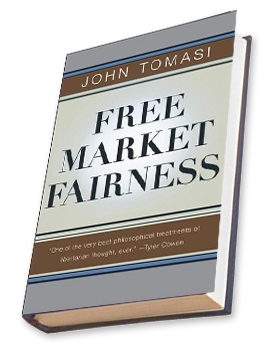
In Free Market Fairness, political philosopher John Tomasi sets forth a new research program in normative political theory that he calls “market democracy.” Market democracy triangulates orthodox libertarianism and social-democratic, egalitarian liberalism and, Tomasi hopes, provides a principled moral grounding for a moderate classical liberalism that has room for both a modest welfare state and a vigorous, competitive, free-market economy. Tomasi’s book is innovative — and, I should note, more readable than most contemporary political philosophy. The arguments he develops here pose important challenges to both “left” (social democrats) and “right” (traditional libertarians), and so it should be widely read.
The book is most effective in making the case that “justice as fairness” and a robust concern for basic economic liberties are not necessarily contradictory. At the same time, the book’s sketch of market democracy–and more specifically, “free market fairness,” the justificatory edifice for market democracy that Tomasi endorses–leaves…
View original post 2,874 more words
Redistribution of Grades
04 Sep 2014 Leave a comment
in economics
Andrew Breitbart has posted a video (HT: Phil Arena) showing liberal, pro-income-redistribution students rejecting out of hand the concept of redistributing grade point averages (GPAs) from the best-performing students to those less fortunate, saying things like “It’s not fair” and “I worked for my grades.” Does their position constitute hypocrisy, and does this experiment show that something like the libertarian conception of property rights (“from each as she chooses, to each as she is chosen”) is somehow more “natural” to us humans? One argument might go something like this: Being committed to income redistribution requires being committed to redistribution of grades. Being committed to redistribution of grades is unlikely to be justified. Therefore, being committed to income redistribution is unlikely to be justified.
To put some flesh onto the problem, it’s useful to narrow down possible justifications for redistribution, so I’ll focus on John Rawls’ Difference Principle, which…
View original post 312 more words
On Fiscal Policy
04 Sep 2014 Leave a comment
in economics

In recent weeks, there seems to have been a resurgence in the discussion of the relative effectiveness of counter-cyclical fiscal policy. This discussion is clouded by the fact that there are some whose political ideology seems to get in the way of reasonable discussion of evidence (and who believe that only those who disagree with them are biased!). In this post I would like to make the following points: (1) there is no such thing as “the” fiscal multiplier, (2) empirical and theoretical estimates are highly sensitive to assumptions about monetary policy — assumptions that seem to be violated by the behavior of central banks, and (3) New Keynesian models are flawed models for estimating a fiscal multiplier (especially in the context of log-linearized equations).
The most fundamental point surrounding the discussion of the fiscal multiplier is that there is, in fact, no such thing as “the” fiscal multiplier. Put…
View original post 1,258 more words
Yellen, Optimal Control, and Dynamic Inconsistency
04 Sep 2014 Leave a comment
in economics
For much of his career, Milton Friedman advocated a constant rate of money growth — the so-called k-percent rule. According to this rule, the central bank would increase the money supply at a constant rate, k, every year. In this case, there would be no need for an FOMC. A computer could conduct monetary policy.
The k-percent rule has often been derided as a sub-optimal policy. Suppose, for example, that there was an increase in money demand. Without a corresponding increase in the money supply, there would be excess money demand that even Friedman believed would cause a reduction in both nominal income and real economic activity. So why would Friedman advocate such a policy?
The reason Friedman advocated the k-percent rule was not because he believed that it was the optimal policy in the modern sense of phrase, but rather that it limited the damage done by activist monetary…
View original post 1,047 more words
Clarifications of the Austro-Wicksellian Business Cycle Theory
04 Sep 2014 Leave a comment
in economics
by Mario Rizzo
There has been a lively debate on forecasts of high inflation made by those worried about the Fed’s recent policy of quantitative easing. For details I refer the reader to Daniel Kuehn’s excellent blog. The question to which I address myself is solely “What do these predictions have to do with core Austrian Business Cycle Theory?” This is my answer.
We must start with a few general points. First, I am talking about the Austro-Wicksellian business cycle theory as developed by Friedrich Hayek and Ludwig von Mises and as synthesized by Roger Garrison in his book Time and Money. I cannot take responsibility for versions constructed by others. It is not that I think the others are necessarily wrong (and I mean no disrespect to them), but I do not know with sufficient precision what all these others are saying in the name of “Austrian theory.”
View original post 737 more words
 Utopia, you are standing in it!
Recent Comments