


Business Cycle “Symmetries & Asymmetries”
27 Sep 2014 Leave a comment
in economics

I liked very much this analysis by Ryan Avent on “what does ‘above potential’ mean” (I provide an extended quote for it to be understandable and highlight crucial points):
In a column at Vox Antonio Fatas and Ilian Mihov describe an interesting new paper of theirs which posits a third phase of the business cycle. Expansions and contractions we all know and love, but that two-way division leaves out important dynamics, they reckon. Better to describe cycles in terms of a recession, in which output falls well below trend, a recovery, in which output returns to trend, and then an expansion, in which the economy grows more or less at trend. It’s a neat approach which allows them, among other things, to isolate the cost of recessions by computing the aggregate GDP loss relative to trend. The cost is big; they peg the loss from the current cycle at…
View original post 805 more words


Bastiat’s Broken Window Fallacy
27 Sep 2014 6 Comments
in economics

In 1850, Frederic Bastiat wrote an essay titled That Which is Seen and That Which Is Not Seen. In the essay, he argues that money or resources spent to recover from destruction does not result in an economic net gain to society, but rather prevents from experiencing economic gains. In today’s world politicians and pundits alike often claim the opposite. Claims that fall prey to this fallacy include examples such as: that demolishing one bridge and building a new one will create jobs or that natural disasters, such as Hurricane Katrina, can positively affect the economy due to the massive rebuilding efforts and spending that come after. Here is Bastiat’s Broken Window Fallacy present in LAM format.
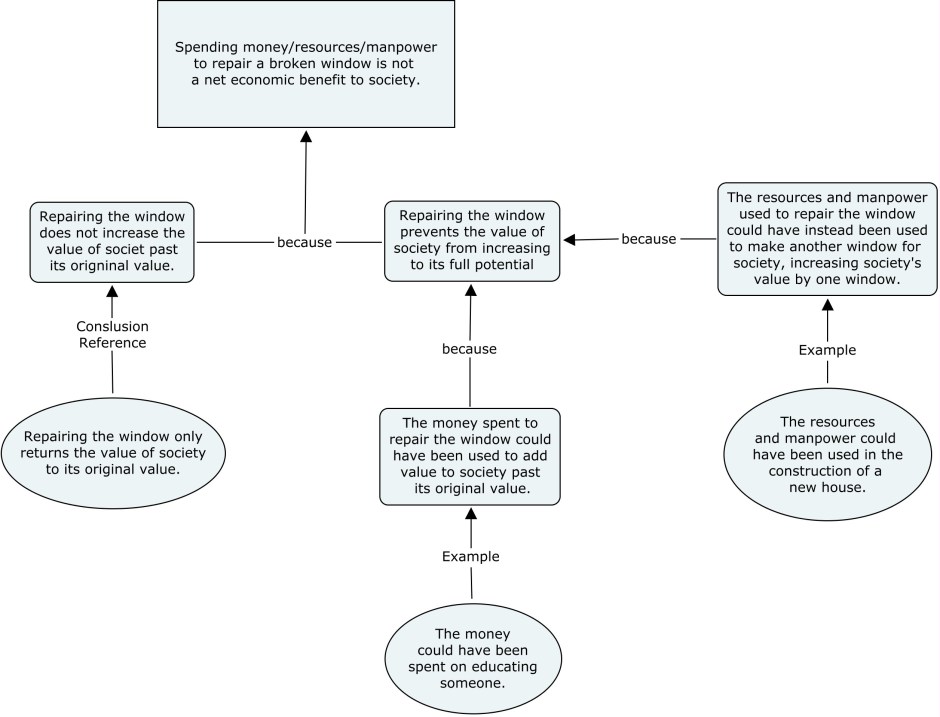
Feel free to comment below if you feel that Bastiat has it wrong, or if you think that this LAM does not accurately depict his argument.
Do cats outnumbered dogs in your country?
27 Sep 2014 Leave a comment
in cats Tags: cats, dogs, New Zealand

Cats out-number dogs 2:1 in New Zealand; about the opposite ratio in my home country of Australia. Check wonkblog/where-cats-are-more-popular-than-dogs-in-the-u-s-and-all-over-the-world for your own country.

The Recipe for Recovery Is Revealed
26 Sep 2014 Leave a comment
in economics

| Mike Sykuta |
The Obama administration has apparently revealed its recipe for economic recovery. Based on the rhetoric and policy proposals fronted thus far, the recipe appears as follows:
- Do everything possible to discourage potential high-value executives from working in troubled industries by capping executive pay in struggling industries.
- Eliminate high-powered market-based incentives for mid-level employees to perform their jobs well.
- Encourage distressed companies to renege on long-term contracts that populist politicians find offensive (or consider easy to target so as to appear they are being responsible with taxpayers’ money).
- Dole out a trillion dollars of taxpayer funds to pet projects and interest groups in the name of “economic stimulus” (enabled by the perception of “responsibility” created by their railing against the targets of #1-3).
- Ignore the economic consequences of the incentives created (or destroyed) in #1-3 as well as the fact that someone at some point will have…
View original post 70 more words
The Road to Serfdom: Good Hayek or Bad Hayek?
26 Sep 2014 Leave a comment
in economics

A new book by Angus Burgin about the role of F. A. Hayek and Milton Friedman and the Mont Pelerin Society (an organization of free-market economists plus some scholars in other disciplines founded by Hayek and later headed by Friedman) in resuscitating free-market capitalism as a political ideal after its nineteenth-century version had been discredited by the twin catastrophes of the Great War and the Great Depression was the subject of an interesting and in many ways insightful review by Robert Solow in the latest New Republic. Despite some unfortunate memory lapses and apologetics concerning his own errors and those of his good friend and colleague Paul Samuelson in their assessments of the of efficiency of central planning, thereby minimizing the analytical contributions of Hayek and Friedman, Solow does a good job of highlighting the complexity and nuances of Hayek’s thought — a complexity often ignored not only by…
View original post 2,242 more words


 Utopia, you are standing in it!
Recent Comments