Real business cycles, the declining clarity of information and learning by waiting

Willems and van Wijnbergen (2013) identified reduced clarity in information about business cycle fluctuations as a factor that is the lengthening the lag in the response of employment to output changes in recent US recessions.

Willems and van Wijnbergen (2013) – ungated – found that the trough in employment in the 1991 and 2001 recessions was much later than the troughs for earlier US recessions.

  • There was a stronger immediate reduction in employment in pre-1990 US recessions and a faster recovery, so the 1991 and 2001 recessions were initially job-preserving – the rate at which workers were laid off was less than in prior recessions.
  • Employment in the 1991 and 2001 recessions continued to fall for another year after the trough in output.
  • The job-preserving recessions in 1991 and 2001 were then followed by this delayed recovery in employment growth.
  • There is a lengthening labour adjustment lag that slows the loss of jobs at the start of recessions and delays the renewal of recruitment at the end of recessions.

Willems and van Wijnbergen (2013) attributed this combination of job-preserving recessions and delayed employment recoveries in 1991 and 2001 to the interaction of rising labour adjustment costs and a reduction in the clarity of entrepreneurial information about the business cycle.

The rising labour adjustment costs arose from the capital losses to employers of laying off employees who are increasingly rich in firm-specific human capital. The risks of laying off and investing precipitously have increased in recent decades because output growth subsequent to the great moderation in real output growth volatility is less predictable.

The US economy experienced a 50% reduction in volatility for many leading macroeconomic variables as well as low inflation since the early to mid-1980s. Similar declines in the real volatility and inflation rates occurred at about the same time in other industrial countries.
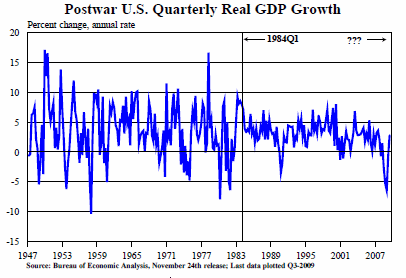
Prior to the mid-1980s, US real output growth was more variable, but this variation was more predictable. Frequent recessions were soon followed by recoveries. Since the early to mid-1980s in the US, major variations in real GDP growth have come increasingly as genuine surprises – 1983–2007 was one long boom punctuated by two mild recessions in 1991 and 2001.

The delay in the official dating of the peaks and troughs in business cycles in the US has increased from an average of 7½ months before 1990 to about 15 months in the post-1990 period (Willems and van Wijnbergen 2013).

With recessions more of a surprise – and the scope and depth of the panic of 2008 is an example of such a surprise in New Zealand and abroad – the value of waiting for better market information has increased.

Less certain information makes it more profitable than before for entrepreneurs to invest in waiting before laying off increasingly human capital-rich employees, making new investments and undertaking fresh recruitment. The impact of the business cycle on employment will be more muted.

Modern recessions can be initially job-preserving – layoffs are postponed for longer because the rising cost of laying off experienced labour is higher and because of the increased value of waiting to see. Recoveries in employment can be more sluggish as investors wait to be sure about the latest trends. These employers can use the employees they hoarded in larger numbers in the downswing to fill orders in the early days of the upswing in business:

We have presented evidence that the lag with which labour input reacts to structural economic shocks went up in the 1980s, thereby bringing jobless recoveries and recessions that were relatively job preserving to the US economy.

Using a real option model, this lagged response is shown to be optimal in a setting where labour input is costly to adjust and where employers are uncertain about the persistence of shocks that drive the business cycle

Leave a comment

This site uses Akismet to reduce spam. Learn how your comment data is processed.

Bassett, Brash & Hide

Celebrating humanity's flourishing through the spread of capitalism and the rule of law

Truth on the Market

Scholarly commentary on law, economics, and more

The Undercover Historian

Beatrice Cherrier's blog

Matua Kahurangi

Celebrating humanity's flourishing through the spread of capitalism and the rule of law

Temple of Sociology

Celebrating humanity's flourishing through the spread of capitalism and the rule of law

Velvet Glove, Iron Fist

Celebrating humanity's flourishing through the spread of capitalism and the rule of law

Why Evolution Is True

Why Evolution is True is a blog written by Jerry Coyne, centered on evolution and biology but also dealing with diverse topics like politics, culture, and cats.

Down to Earth Kiwi

Celebrating humanity's flourishing through the spread of capitalism and the rule of law

NoTricksZone

Celebrating humanity's flourishing through the spread of capitalism and the rule of law

Homepaddock

A rural perspective with a blue tint by Ele Ludemann

Kiwiblog

DPF's Kiwiblog - Fomenting Happy Mischief since 2003

The Dangerous Economist

Celebrating humanity's flourishing through the spread of capitalism and the rule of law

Watts Up With That?

The world's most viewed site on global warming and climate change

The Logical Place

Tim Harding's writings on rationality, informal logic and skepticism

Doc's Books

A window into Doc Freiberger's library

The Risk-Monger

Let's examine hard decisions!

Uneasy Money

Commentary on monetary policy in the spirit of R. G. Hawtrey

Barrie Saunders

Thoughts on public policy and the media

Liberty Scott

Celebrating humanity's flourishing through the spread of capitalism and the rule of law

Point of Order

Politics and the economy

James Bowden's Blog

A blog (primarily) on Canadian and Commonwealth political history and institutions

Science Matters

Reading between the lines, and underneath the hype.

Peter Winsley

Economics, and such stuff as dreams are made on

A Venerable Puzzle

"The British constitution has always been puzzling, and always will be." --Queen Elizabeth II

The Antiplanner

Celebrating humanity's flourishing through the spread of capitalism and the rule of law

Bet On It

Celebrating humanity's flourishing through the spread of capitalism and the rule of law

History of Sorts

WORLD WAR II, MUSIC, HISTORY, HOLOCAUST

Roger Pielke Jr.

Undisciplined scholar, recovering academic

Offsetting Behaviour

Celebrating humanity's flourishing through the spread of capitalism and the rule of law

JONATHAN TURLEY

Res ipsa loquitur - The thing itself speaks

Conversable Economist

Celebrating humanity's flourishing through the spread of capitalism and the rule of law

The Victorian Commons

Researching the House of Commons, 1832-1868

The History of Parliament

Articles and research from the History of Parliament Trust

Books & Boots

Reflections on books and art

Legal History Miscellany

Posts on the History of Law, Crime, and Justice

Sex, Drugs and Economics

Celebrating humanity's flourishing through the spread of capitalism and the rule of law

European Royal History

Exploring the Monarchs of Europe

Tallbloke's Talkshop

Cutting edge science you can dice with

Marginal REVOLUTION

Small Steps Toward A Much Better World

NOT A LOT OF PEOPLE KNOW THAT

“We do not believe any group of men adequate enough or wise enough to operate without scrutiny or without criticism. We know that the only way to avoid error is to detect it, that the only way to detect it is to be free to inquire. We know that in secrecy error undetected will flourish and subvert”. - J Robert Oppenheimer.

STOP THESE THINGS

The truth about the great wind power fraud - we're not here to debate the wind industry, we're here to destroy it.

Lindsay Mitchell

Celebrating humanity's flourishing through the spread of capitalism and the rule of law

Alt-M

Celebrating humanity's flourishing through the spread of capitalism and the rule of law

croaking cassandra

Economics, public policy, monetary policy, financial regulation, with a New Zealand perspective

The Grumpy Economist

Celebrating humanity's flourishing through the spread of capitalism and the rule of law

International Liberty

Restraining Government in America and Around the World