These People Want To Raise Fuel Prices For The Poor
31 Jan 2015 Leave a comment
in economics

In order to save the planet from global warming, these people want you to cut back your lifestyle, and raise fuel costs for the poor and elderly.
Al Gore

Barbara Streisand

Jeff Greene

Barack Hussein Obama

Prince Charles

Leonardo DiCaprio

Richard Branson

Tom Steyer

Deflation and Depression: Is There an Empirical Link?
31 Jan 2015 Leave a comment
in budget deficits, business cycles, economic growth, Euro crisis, great depression, great recession, macroeconomics, monetary economics, politics - Australia, politics - New Zealand, politics - USA Tags: deflation, fiscal policy, liquidity traps, monetary policy, stabilisation policy
Deflation has a bad reputation. People blame deflation for causing the great depression in the 1930s. What worse reputation can you get as a self-respecting macroeconomic phenomena?
The inconvenient truth for this urban legend is empirical evidence of deflation leading to a depression is rather weak.
The most obvious is confounding evidence, is up until the great depression, deflation was commonplace. In the late 19th century, deflation coincided with strong growth, growth so strong that it was called the Industrial Revolution.
For deflation to be a depressing force, something must have happened in the lead up to the Great Depression to change the impact of deflation on economic growth.
Atkeson and Kehoe in the AER looked into the relationship between deflation and depressions and came up empty-handed.
Deflation and depression do seem to have been linked during the 1930s. But in the rest of the data for 17 countries and more than 100 years, there is virtually no evidence of such a link.
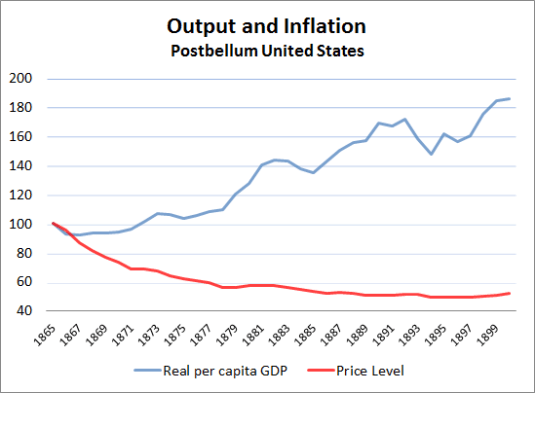

Deflation and Depression: Is There an Empirical Link?
Andrew Atkeson, and Patrick J. Kehoe, 2004.
Are deflation and depression empirically linked? No, concludes a broad historical study of inflation and real output growth rates. Deflation and depression do seem to have been linked during the 1930s. But in the rest of the data for 17 countries and more than 100 years, there is virtually no evidence of such a link.
View original post 1,842 more words
The average American household was poorer in 2013 than it was in 1983 – Vox
31 Jan 2015 1 Comment
in applied welfare economics, population economics, poverty and inequality, technological progress Tags: Brad De Long, The Great Enrichment, The Great Escape, The Great Fact, time machines
/cdn0.vox-cdn.com/uploads/chorus_asset/file/3351202/vox-chart_net-worth-change-v2_1024.0.png)
US net worth rose considerably over that period, which is what you would expect to see.
Technology has improved and productivity increased, so society has a greater capacity for wealth building. America was also quite a bit older on average in 2013 than it was in 1983, so average wealth should have gone up.
But all of these gains went to the top 20 percent of the population. It’s worse than that, actually.
Over 100 percent of the gains went to the top 20 percent, because the bottom 60 percent of the population got poorer.
What does this claim by Matthew Yglesias exactly mean? He writes frequently on economics, so his editor must think he knows something about it.
http://t.co/0hEAL8X1kS—
EPI Chart Bot (@epichartbot) July 04, 2015
If 60% of the population got poorer as compared to 1983, they would be better off stepping into a time machine to go back to 1983. That is the only logical interpretation of this claim about 60% of the population. I owe this time machine thought experiment to Brad De Long.

Of course, going back to 1983, would involve giving up all products and services invented since then, and all product upgrades since then.
https://twitter.com/classicepics/status/561432237976322048
More importantly, for a good proportion of the population, they have become very sick or die immediately when they stepped out side of the Time Machine. This is because of shorter life expectancies in 1983 and the unavailability of a whole range of lifesaving medicines.

Am I just pedantic because I want access to crucial diabetic and other medications unavailable 30 years ago? No Internet, no cable, no international travel and no mobile phones.

In his original thought experiment, De Long asks how much you would want in additional income to agree to go back in time to a specific year. De Long was an economic historian examining the differences in living standards as compared to 1890 and 1990 and how that gap is greatly underestimated in economic statistics. De Long would have refused to go into the time machine to return to 1890 unless he could pack a very large bag to take with him:
I would want, first, health insurance: the ability to go to the doctor and be treated with late-twentieth-century medicines.
Franklin Delano Roosevelt was crippled by polio. Without antibiotic and adrenaline shots I would now be dead of childhood pneumonia.
The second thing I would want would be utility hookups–electricity and gas, central heating, and consumer appliances.
The third thing I want to buy is access to information–audio and video broadcasts, recorded music, computing power, and access to databases.
None of these were available at any price back in 1890.
The 26 economic charts you shouldn’t have missed in January
31 Jan 2015 Leave a comment
in economics
Code Hypocrites
31 Jan 2015 Leave a comment
in economics

Back when President Bush announced that the United States would be going to war with Iraq, he did it from the Oval Office. When Pres. Obama announced that we would be going to war with Libya, he did it from a foreign country.
During and following the war in Iraq, Pres. Bush was attacked and condemned as a war criminal by the radicalized far left. One of the loudest anti-Bush groups was Code Pink: Women For Peace.
This group led marches in the Capital calling for the President to be impeached. They protested outside the private residences of the Bush administration carrying coffins. They disrupted congressional hearings by sneaking in and then shouting at the committees. They even went as far as trying to smear red paint on Secretary of State Rice.
At the time Code Pink announced that they were against all wars. That they…
View original post 516 more words
Good Deeds From 35 Years Ago
31 Jan 2015 Leave a comment
in economics
This is what Afghanistan looked like before Russia invaded, and the US hired Osama bin Laden to drive them out

This is what Iran looked like before Jimmy Carter brought them social justice, and ran off the Shah.

Look how we improved the lives of women in the Middle East.

The middle class has been shrinking for half a century because…
31 Jan 2015 Leave a comment
in applied welfare economics, politics - Australia, politics - New Zealand, politics - USA Tags: middle class stagnation, poverty and inequality
The New York Times passed over as quickly as it could the fact that up until the year 2000 the middle class was shrinking because more of them are moving into the upper middle class and the rich.
10 Questions for Anti-GMO Activists part 2
31 Jan 2015 Leave a comment
in economics

Yesterday, I posed five questions for the anti-GMO movement. I’ve heard the objections to biotechnology, but none of them make sense to me. A lot of the talking points, it seems, are the product of lies that capitalize on ignorance and fear, though there’s an entire subset of arguments that can be classified as appeals to Monsanto or argumentum ad Monsantium. This fallacy is so widely abused that smug fuck comedian Bill Maher un-ironically uses it on national television to argue that GMO technology is bad.
View original post 2,198 more words

 Utopia, you are standing in it!
Recent Comments