
Singapore Campaigns of the 70s/80s
17 Jan 2015 Leave a comment
in applied welfare economics, economic history, economics of regulation Tags: meddlesome preferences, nanny state, Singapore


 With intensive usage of media, campaigns are launched to achieve certain particular goals, usually in a political, social or commercial sense. Sometimes, a campaign represents an era, and some of its posters go on to become iconic representations that are even remembered after decades. One of the examples is the United States’ “I Want You For U.S. Army” poster in 1917.
 Campaigns are meant to have a long term impact. However, human errors, wrong judgement or a lack of foresight during the introduction of campaigns can sometimes lead to failures or even disasters to the country. In 1958, the new China launched the Four Pests Campaign in a bid to eliminate rats, flies, mosquitoes and sparrows. The sparrows were targeted because they ate the farmers’ grain seeds. In a short time, millions of Chinese were mobilised for the campaign. Sparrows, as well as other birds, were shot, with their nests…
View original post 3,146 more words
Good old days alert: 70`s Hairstyles
17 Jan 2015 Leave a comment
in economics of media and culture Tags: 1970s, the good old days
Michael Mann Doesn’t Trust Satellites Either
17 Jan 2015 Leave a comment
in economics

A few years ago, Mikey told us that he doesn’t trust tree rings after 1960. Now he says he doesn’t trust satellites either.
Some non-scientists who deny man-made global warming have pointed to satellite temperature records — which only go back to 1979 — which show a warming world, but no record this year and less of a recent increase than the longer-term ground thermometers. But Mann, Dessler, Francis and others say there have been quality and trustworthy issues with some satellite measurements and they only show what’s happening far above the ground. They said ground measurements are also more important because it is where we live.
My Way News – The heat is on; NOAA, NASA say 2014 warmest year on record
The only thing Mikey trusts is data which has been massively tampered with by his Real Climate buddies. The surface data is so reliable, that they had to do…
View original post 23 more words
Most consumers want GMO labels; but 80% also want to label food with DNA
17 Jan 2015 Leave a comment
in applied welfare economics, economics of information, economics of media and culture, liberalism, politics - New Zealand, politics - USA Tags: anti-GMO movement, Anti-Science left, GMOs, quackery
Uneven development, uneven sex ratios
17 Jan 2015 Leave a comment

Hey, you got your postmodern technology in my premodern ideology!
A new article in the Lancet shows convincing evidence of increasing sex-selective abortion in India. The evidence for sex ratio at birth shows an increase in the number of boys born when older children in the family are girls – the best (indirect) indicator that people with a preference for sons are having abortions when ultrasounds show a female fetus.
In a population where no one tampers with the sex ratio at birth, there will be about 104 boys born for every 100 girls – nature’s way of correcting for the tendency of the weaker sex (males) to die more. In India, that number is about 106 now. That’s not so bad, compared with some other countries, such as Vietnam (111) and Taiwan (109) — or China’s colossal 118. But when you look at the ratios…
View original post 386 more words
And the Oscar for “Best Tax Break” Goes to…
17 Jan 2015 Leave a comment
in economics of media and culture, movies, politics - New Zealand, politics - USA, Public Choice, rentseeking Tags: corporate welfare, film subsidies

HT: http://economics21.org/commentary/oscars-tax-break-american-sniper-2015-01-16 and http://www.washingtonexaminer.com/how-this-years-oscar-nominees-got-government-handouts/article/2558717
Security services can be stretched quite easily in their surveillance of terrorist suspects
17 Jan 2015 Leave a comment
Breaking science news: Yak dung burning pollutes indoor air of Tibetan households
17 Jan 2015 Leave a comment
in economics
Indoor air pollution is a huge human health problem throughout the developing world
Public’s Policy Priorities Reflect Changing Conditions at Home and Abroad | Pew Research Center for the People and the Press
17 Jan 2015 Leave a comment
in economics

Dear parents, you are being lied to.
17 Jan 2015 Leave a comment
in economics


In light of recent outbreaks of measles and other vaccine preventable illnesses, and the refusal of anti-vaccination advocates to acknowledge the problem, I thought it was past time for this post.
Dear parents,
You are being lied to. The people who claim to be acting in the best interests of your children are putting their health and even lives at risk.
View original post 1,175 more words
More Evidence against Big-Spending Keynesian Economics
17 Jan 2015 3 Comments
in macroeconomics, politics - USA Tags: Keynesian macroeconomics

Keynesian economics is a perpetual-motion machine for statists. The way to boost growth, they argue, is to have governments borrow lots of money from the economy’s productive sector and then spend it on anything and everything.
Even if the money is squandered on global defense against a make-believe alien attack, according to Keynesians like Paul Krugman!
Krugman also has argued that a real war is good would be good for growth since the goal is simply more spending.
Heck, Krugman even asserted the 9-11 attacks were good for the economy because governments then spent more money.
And Nancy Pelosi actually argued that paying people not to work was a great way of creating jobs. I’m not joking.
Amazing. It’s almost as if these people are secret libertarians and they’re saying crazy things to discredit Keynesianism.
But they’re actually serious. This makes it difficult to tell the difference between satire…
View original post 787 more words
Thoughts and Details on the Dearly Beloved, Bright and Shining, Depression of 1920-21, of Blessed Memory
17 Jan 2015 Leave a comment
in economics

Commenter TravisV kindly referred me to a review article by David Frum in the current issue of the Atlantic Monthly of The Delugeby Adam Tooze, an economic history of the First World War, its aftermath, and the rise of America as the first global superpower since the Roman Empire. Frum draws an interesting contrast between Tooze’s understanding of the 1920-21 depression and the analysis of that episode presented in James Grant’s recent paean to the Greatest Depression.
But in thinking about Frum’s article, and especially his comments on Grant, I realized that my own discussion of the 1920-21 depression was not fully satisfactory, and so I have been puzzling for a couple of weeks about my own explanation for the good depression of 1920-21. What follows is a progress report on my thinking.
Here is what Frum says about Grant:
Periodically, attempts have been made to rehabilitate the American…
View original post 3,062 more words
GISS Diverging From RSS At 1.2C/Century
17 Jan 2015 Leave a comment
in economics
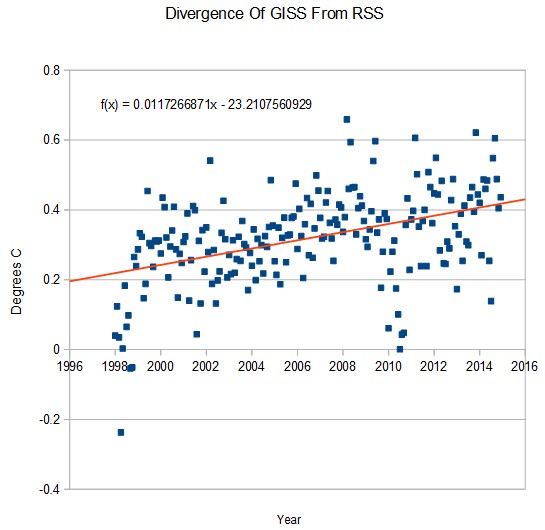
Global warming theory tells us that mid-troposphere temperatures should rise faster than surface temperatures. We are seeing the exact opposite.
 Utopia, you are standing in it!
Recent Comments