
Muslim Publics Share Concerns about Extremist Groups | Pew Research Center’s Global Attitudes Project
13 Jan 2015 1 Comment
in liberalism Tags: opinion polls, war on terror


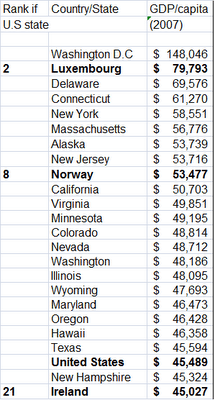
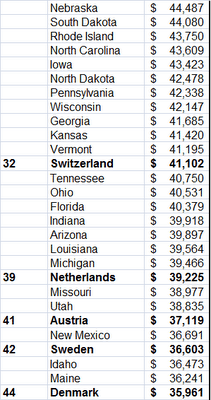
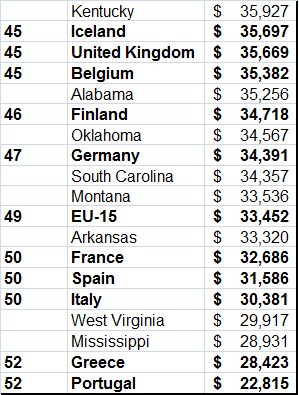
Super-Economy: Dynamic America, Poor Europe
13 Jan 2015 Leave a comment
in economic growth, liberalism, macroeconomics Tags: Eurosclerosis
Casual versus Causal Inference: Time series edition
13 Jan 2015 Leave a comment
in economics
A nice roundup. He concludes that the impact on teen employment is fairly small for the kind of minimum wage increases we have seen in this country.
This is not a surprising conclusion, giving the fact that employers can re-bundle the remuneration packages is for all but the most menial of low paid workers to avoiding crib increasing their net compensation when there is a modest minimum wage increase.
The real question that should be asked of minimum wage advocates is do you seriously expect modest minimum wage increases to increase the net incomes of workers given the fact that employers can simply cut back on other areas ranging from training to increased work intensity

In January 2014, a funny thing seems to have happened. Parts (though not all) of the econoblogosphere forgot why time series econometrics fell out of favor in the early 1990s when it comes to analyzing minimum wage policies. Besides the fact that there is a lot more variation in minimum wages than just the federal (or average) minimum wage in the U.S., the timing of the minimum wage increases is very uneven. For example, U.S. minimum wage increases tend to occur more frequently during the late phases of the business cycle (see Figure 4).
Now this timing issue makes trouble even for state panel studies, but it really wreaks havoc on time series analysis. By not having a control group, time series evidence has to rely solely on changes in trends around the time of minimum wage increases, as this blog post by Kevin Erdmann most recently tries to…
View original post 436 more words
Remember Ebola?
13 Jan 2015 Leave a comment
in economics of media and culture, health economics
Remember the Ebola epidemic? It's still not over. Here's the report from the ground. vox.com/e/7296796?utm_… http://t.co/8RKGL7yKs1—
Vox (@voxdotcom) January 12, 2015


Men are turning into a bunch of losers, academically speaking.
13 Jan 2015 Leave a comment
in discrimination, gender, human capital, labour economics Tags: gender analysis, gender gap, reversing gender gap


The Great Escape: survival rates from leukaemia
13 Jan 2015 Leave a comment
in health economics Tags: Quacks, The Great Escape
The role of the introduction of a five day working week in Japan’s Lost Decade
13 Jan 2015 2 Comments
in business cycles, economic growth, economic history, labour economics, labour supply, macroeconomics, monetarism Tags: Japan, Japanese banking system, Lost Decade
When I lived in Japan between 1995 and 1997, they are undergoing the transition from a six-day week to a five day week. At the time, workers at my University had to show up on Saturday morning. They then went home at lunchtime. Saturday morning at the office was phased out a few years later.
In explanations of the Lost Decade of growth in Japan dating from the early 1990s, with the exception of Ed Prescott, the explanation that the Japanese simply chose to produce less per worker over the course of the 1990s does not figure highly.
The Japanese working week was reduced by law from 48 to 44 hours per week in 1988 and further reduced by the same labour standards law to 40 hours per week from 1993 (Prescott 1999; Hayashi and Prescott 2002). The Japanese stopped routinely working on Saturdays over the 1990s. The number of national holidays was increased by three and an extra day of annual leave was also prescribed by law.
Figure 1 shows this regulatory change about the length of the standard working week that started in 1987 was followed by a sharp drop in hours worked per working per working age Japanese over the period 1988 to 1993. The Japanese working age population is defined as those aged 20 to 69 (Hayashi and Prescott 2002).
Figure 1: Weekly hours worked per Japanese aged 20 to 69, 1970-2000

Source: Hayashi and Prescott 2002.
The regulatory process to end the standard six day working week in Japan straddled the start of the Lost Decade. This major change in the regulation of the supply of labour per week in the number of hours worked and the stagnation of GDP growth soon after could be more than a coincidence (Prescott 1999; Hayashi and Prescott 2002).
Americans work more hours a year than workers in Japan. But both work less than before. Data: buff.ly/1LhU5gH http://t.co/7oaGYKLRmk—
HumanProgress.org (@humanprogress) August 18, 2015
More employment did not fill the short-fall in weekly labour supply per worker after the introduction of the 44 hour week and then the 40 hour week in Japan. Many offices and factories closed on Saturday rather than employ more to make up the hours. The regulatory change was a clear cut constraint on the length of the working week that was hard to get around because of the need to recruit a separate set of workers to come in on Saturday afternoon and then all day Saturday.
During the transition to a five day working week, Japanese real GDP growth should slow down because output levels must taper during a transitional period because one day per week less in labour is supplied in production and capital is being worked for one day a week less than before (Prescott 1999; Hayashi and Prescott 2002).
Output per working age person depends on capital-labour ratios, on hours worked per week and on changes in total factor productivity due to factors such as technological progress and changes in institutions and economic policies.
The effects of the change in the length of the working week on output per working age Japanese will persist for a significant time because investment plans and the capital stock must also adjust to a shorter working week. This is another example of a highly persistent shock that can partly account for the Lost Decade. As Prescott (1999) observed:
Given the change in Japanese law and the resulting drop in normal market hours, growth theory predicts the almost stagnant output of the Japanese economy in the 1990s. This reduction in market hours lowered the marginal product of capital, making investment unprofitable.
Given the lack of profitable domestic investment opportunities, the Japanese began saving by investing abroad. This explains Japan’s large trade surpluses
…The Japanese economy in the 1990s is not as depressed as the U.S. economy was in the 1930s. Market hours in Japan in the 1990s have fallen only half as much as market hours fell in the United States during the Great Depression.
More importantly, the reduction in market hours in Japan in the 1990s was the stated objective of policy.
The reduction in weekly hours worked will also reduce the working week of capital because labour and capital are usually complementary inputs. The reduced length of the working week will see some existing capital producing less, some capital will go spare, and the rate of wear and depreciation will fall.
The drop in weekly hours worked will lower the marginal productivity of existing and new capital which will make new capital investments in Japan less profitable than before. Net investment will be less while the Japanese capital stock is adjusting down to the reduced working week for capital and labour.
Measured total factor productivity will fall because of an under-utilisation of a capital stock that is now larger than required for the available labour force. Net investment will decline by a large amount because investment demand is a small yearly addition to the capital stock.
For example, if annual investment demand is 5 per cent of the capital stock, and the desired capital stock becomes 1 per cent smaller than previous, annual net investment will fall 20 per cent. GDP growth will resume at the trend rate once the lower level of output per working age person is reached.
For those that still doubt, consider the contrary, what would you expect to happen in your country moved from five day week before day working week? Do you expect workers to produce as much as before? Britain was on a three day working week during the coal miners’ strike. As expected, output fell because the working week was shorter.
The main gap in the English language literature about the reduction in the working week in Japan is a lack of publications I can find by Japanese economists discussing what predictions of a made about the likely consequences for output, investment and productivity before the reduction in the length of working week was legislated. Did the reduction in the length of the working week in Japan turn out as planned and predicted before it was implemented?
France introduced a 35 hour week some years ago. Although there were various options for over time, albeit strictly regulated, a uniform prediction was that the 35 hour week would reduce productivity. The new workweek was phased in slowly, with large firms adopting it in February 2000 and smaller firms doing so only in January 2002.
French employees were expected to bear only a small part of the cost of the working-time reduction, continuing to earn roughly the same monthly income – in line with the unions’ slogan ’35 hours pays. To ease that transition, the law reduced the overtime premium for small firms and increased their annual limit on overtime work compared with large firms.
The reduction in the length of the French working week failed as work sharing strategy and reduced productivity. This was a fair summary by the IMF:
The 35-hour workweek appears to have had a mainly negative impact. It failed to create more jobs and generated a significant—and mostly negative—reaction both from companies and workers as they tried to neutralize the law’s effect on hours of work and monthly wages.
While it cannot be ruled out that individuals who did not change their behaviour because of the law became more satisfied with their work hours, simple survey measures do not show increased satisfaction.
Between 1997 and 2000, Quebec reduced its standard workweek from 44 to 40 hours to stimulate jobs growth – the old work sharing ideal. The Quebec policy contained no suggestion or requirement that employers provide wage increases to compensate workers for lost hours.
Despite a 20% reduction among full-time workers in weekly hours worked beyond 40, the policy failed to raise employment at the provincial level or within industries. If anything, there were job losses.
Japan was the only case where a reduction in the length of the working week met with wide approval by the public and people simply stopped working on Saturdays. The law succeeded simply because it did but it was designed to do: reduce the number of days existing workers worked. Japan was undergoing mild deflation at the time, so the need to reduce wages was minimal.

Annual hours worked per employed Japanese has continued to slowly taper down since the late 1990s, which may be a further explanation of its continual slow growth.

David Andolfatto wrote a nice paper explaining the consequences for the financial and monetary sectors of this reduction in the length of the Japanese working week:
- a steady decline in bank lending;
- the money multiplier declines;
- nominal interest rates that are close to zero; and
- massive infusions of liquidity by the Bank of Japan that seem to have no effect at all.
In his analysis, David Andolfatto referred generally to a productivity slowdown as discussed by Prescott rather than to the specifically to the reduction in the length of the Japanese working week. Nothing detracts in his analysis, as Andolfatto said, that Japan has a problem: lagging productivity growth and as Andolfatto concluded:
…monetary and fiscal policies, or reforms directed exclusively at the banking sector, are unlikely to re-establish productivity growth. What is likely needed are economy-wide reforms that enhance the willingness and ability of individuals to adopt potentially disruptive technological advancements and work practices.
Radical Islam is the defining oppositional identity of our generation
13 Jan 2015 Leave a comment
in applied price theory, economics of religion, human capital, occupational choice Tags: economics of oppositional identities, Jihadists, radical Islam
Each generation has its defining oppositional identity.

Radical Islam is the oppositional identity of choice for today’s angry young men and women. Mind you, they have to buy Islam for dummies to understand what they’re signing up for in the most crude way.
In previous generations, it was communism, the Red Brigade, weird religious sects, eco-terrorism, animal liberationist terrorism and a variety of domestic terrorists of the left and right with conspiratorial motivations. Look at the level of diversity of the angry young men and women on the domestic terrorists list of the FBI.

Plenty of young people were attracted to communism in previous generations as a way of sticking it to the man.

The appeal of radical Islam Islamic State rests on what psychologists call personal significance. The quest for personal significance by these angry young men and women is the desire to matter, to be respected, to be somebody in one’s own eyes and in the eyes of others.
A person’s sense of significance may be lost for many reasons, including economic conditions. The anger can grow out of a sense of disparagement and discrimination; it can come from a sense that one’s brethren in faith are being humiliated and disgraced around the world.
Extremist ideologies be they communism, fascism or extreme religions are effective in such circumstances because it offers a quick-fix remedy to a perceived loss of significance and an assured way to regain it. It accomplishes this by exploiting primordial instincts for aggression, sex and revenge.
The Islamic State is using a social-networking website to answer mundane questions from aspiring militants. They want answers on what to wear, how cold it gets, access to medical and dental services, if they have to buy their own weapons, whether there is wi-fi, and how soon they can capture women to rape. the answer to the last question is “Dawlah [ISIS] sorts that out”.
The two brothers responsible for the attacks in Paris were known to French intelligence but were not seen as not much of a threat because they were judged to be dope smoking, 30 something has been Jihadists. They were thought by the French intelligence services to have aged out of radical jihad.
The main difference between the two brothers in France and a common garden spree killer is their grievance was given a narrative of radical Islam rather than just the plain old hate that drives other spree killers.
Radical Islam is a magnet for wannabe spree killers who need a support network and a bit of rationalisation to pluck up the courage to kill unarmed people who can’t fight back.

 Utopia, you are standing in it!
Recent Comments