@NZGreens are so polite on Twitter @MaramaDavidson @RusselNorman @greencatherine

One of the first things I noticed when feuding on Twitter with Green MPs was how polite they were. Twitter is not normally known for that characteristic and that is before considering the limitations of 144 characters. People who are good friends and work together will go to war over email without any space limitations for the making an email polite and friendly. Imagine how easy it is to misconstrue the meaning and motivations of tweets that can only be 144 characters.

The New Zealand Green MPs in their replies on Twitter make good points and ask penetrating questions that explain their position well and makes you think more deeply about your own. Knowledge grows through critical discussion, not by consensus and agreement.

Cass Sunstein made some astute observations in Republic.com 2.0 about how the blogosphere forms into information cocoons and echo chambers. People can avoid the news and opinions they don’t want to hear.

Sunstein has argued that there are limitless news and information options and, more significantly, there are limitless options for avoiding what you do not want to hear:

  • Those in search of affirmation will find it in abundance on the Internet in those newspapers, blogs, podcasts and other media that reinforce their views.
  • People can filter out opposing or alternative viewpoints to create a “Daily Me.”
  • The sense of personal empowerment that consumers gain from filtering out news to create their Daily Me creates an echo chamber effect and accelerates political polarisation.

A common risk of debate is group polarisation. Members of the deliberating group move toward a more extreme position relative to their initial tendencies! How many blogs are populated by those that denounce those who disagree? This is the role of the mind guard in group-think.
Sunstein in Infotopia wrote about how people use the Internet to spend too much time talking to those that agree with them and not enough time looking to be challenged:

In an age of information overload, it is easy to fall back on our own prejudices and insulate ourselves with comforting opinions that reaffirm our core beliefs. Crowds quickly become mobs.

The justification for the Iraq war, the collapse of Enron, the explosion of the space shuttle Columbia–all of these resulted from decisions made by leaders and groups trapped in “information cocoons,” shielded from information at odds with their preconceptions. How can leaders and ordinary people challenge insular decision making and gain access to the sum of human knowledge?

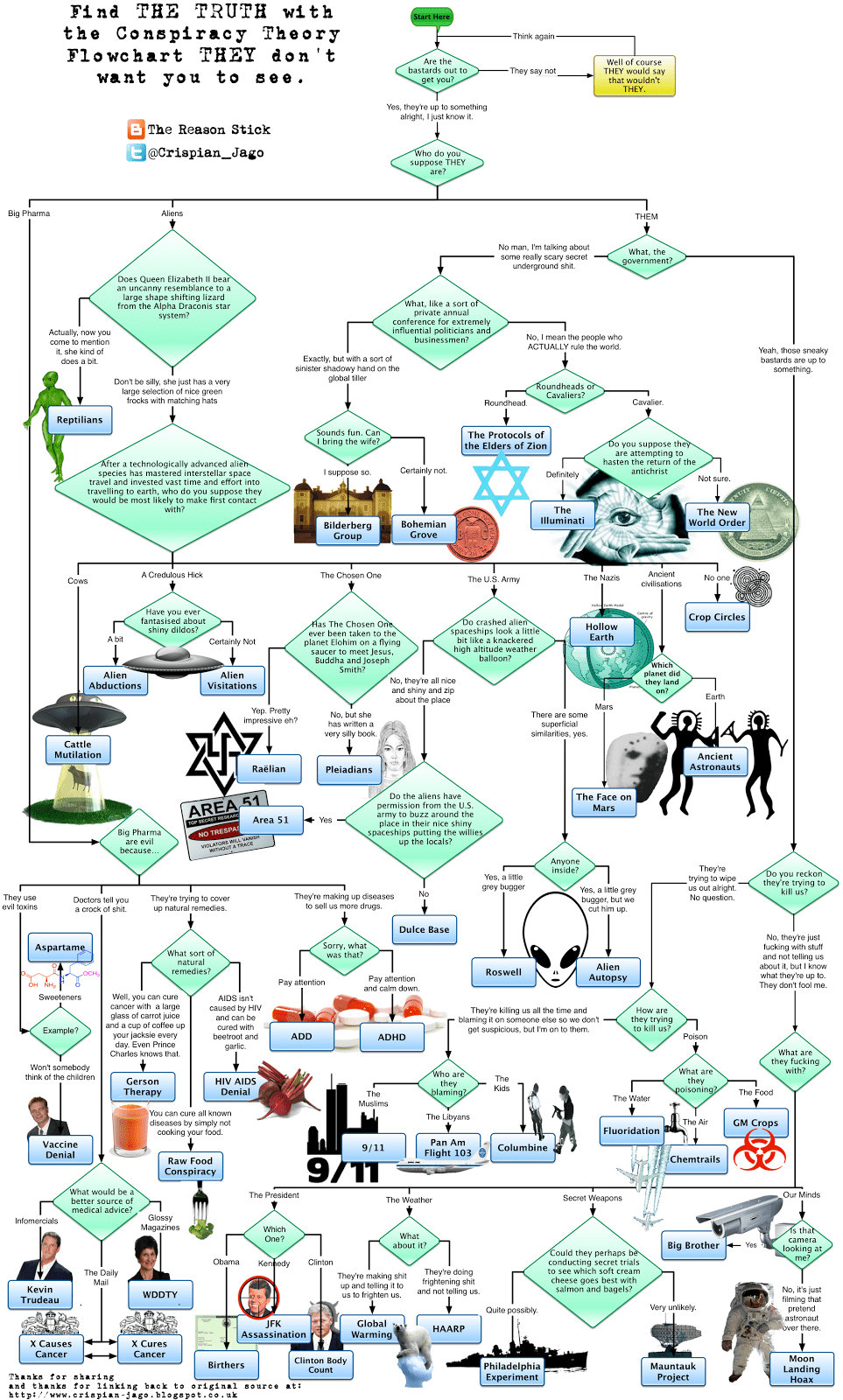
Conspiracy theories had enough momentum of their own before the information cocoons and echo chambers of the blogosphere gained ground.

J.S. Mill pointed out that critics who are totally wrong still add value because they keep you on your toes and sharpened both your argument and the communication of your message. If the righteous majority silences or ignores its opponents, it will never have to defend its belief and over time will forget the arguments for it.

As well as losing its grasp of the arguments for its belief, J.S. Mill adds that the majority will in due course even lose a sense of the real meaning and substance of its belief. What earlier may have been a vital belief will be reduced in time to a series of phrases retained by rote. The belief will be held as a dead dogma rather than as a living truth.

Beliefs held like this are extremely vulnerable to serious opposition when it is eventually encountered. They are more likely to collapse because their supporters do not know how to defend them or even what they really mean.

J.S. Mill’s scenarios involves both parties of opinion, majority and minority, having a portion of the truth but not the whole of it. He regards this as the most common of the three scenarios, and his argument here is very simple. To enlarge its grasp of the truth, the majority must encourage the minority to express its partially truthful view. Three scenarios – the majority is wrong, partly wrong, or totally right – exhaust for Mill the possible permutations on the distribution of truth, and he holds that in each case the search for truth is best served by allowing free discussion.

Mill thinks history repeatedly demonstrates this process at work and offered Christianity as an illustrative example. By suppressing opposition to it over the centuries Christians ironically weakened rather than strengthened Christian belief. Mill thinks this explains the decline of Christianity in the modern world. They forgot why they were Christians.

Lucas and Sargent on why new classical macroeconomics was unpopular

Image

Milton Friedman on Libertarianism and Humility

Austrians and Game Theory

Myth and reality about the countries hosting the most Middle-Eastern refugees

https://twitter.com/ianbremmer/status/640518268579614720/photo/1

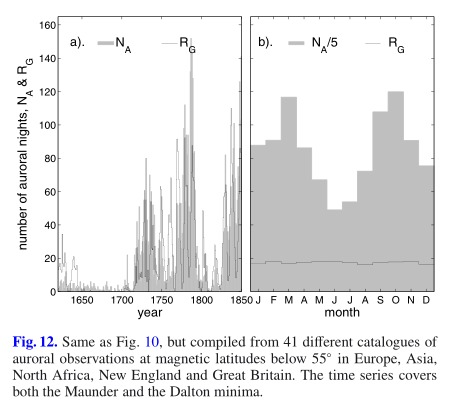
The Maunder minimum (1645 .. 1715) was indeed a grand minimum

tchannon's avatarTallbloke's Talkshop

This grand paper examines many lines of evidence, many well known authors, enjoy the feast

Image

The Maunder minimum (1645–1715) was indeed a grand minimum:
A reassessment of multiple datasets
Ilya G. Usoskin, Rainer Arlt , Eleanna Asvestari, Ed Hawkins, Maarit Käpylä, Gennady A. Kovaltsov, Natalie Krivova, Michael Lockwood Kalevi Mursula, Jezebel O’Reilly, Matthew Owens, Chris J. Scott, Dmitry D. Sokoloff, Sami K. Solanki, Willie Soon and José M. Vaquero

Astronomy & Astrophysics, accepted July 2015, 19 pages, access on registration
http://dx.doi.org/10.1051/0004-6361/201526652

ABSTRACT
Aims. Although the time of the Maunder minimum (1645–1715) is widely known as a period of extremely low solar activity, it is still being debated whether solar activity during that period might have been moderate or even higher than the current solar cycle #24. We have revisited all existing evidence and datasets, both direct and indirect, to assess the level of solar activity during the Maunder minimum.

View original post 234 more words

2015b: Greece and Turkey back to the polls

msshugart's avatarFruits and Votes

Both Greece and Turkey had notable elections earlier in 2015: Greece in January, when SYRIZA (the Coalition of the Radical Left) came to power; Turkey in June, when the AKP (Justice and Development Party) fell short of a majority and the HDP (Peoples’ Democratic party, which has much Kurdish support) cleared the country’s 10% threshold for the first time.

Now, both are going back to the polls before the year is out, meaning we will have elections “2015a” and “2015b” for both countries. Greece is no stranger to early elections, but I believe this will be a first for Turkey.

In Greece, once PM Alexis Tsipras completed the passage of the measures required to secure new EU loan guarantees (the third “bailout”), he resigned, triggering early elections. He passed the measures with the help of the opposition parties, given the negative votes from within SYRIZA. The

View original post 540 more words

The #nannystate goes to #China

What do #McDonalds & @GreenpeaceNZ no longer have in common? @NZGreens @RusselNorman

Like McDonalds, Greenpeace globally is a brand. I read the papers every day in detail but are utterly clueless as to who its leaders are. That is a deliberate branding decision so people cannot conflate the inevitably dodgy and far left backgrounds of its leaders and activist support base with self appointed environmental do-gooders brand.

That is no longer so in New Zealand where a middle-age political junkie retiring as co-leader of the New Zealand Greens will now be their CEO in New Zealand.

If Russell Norman wants to do his job properly, you should never give an interview, never appear in public.

What is worse is the carrying on by the Greens about the retirement of Russell Norman to lead the Greenpeace in New Zealand.

If they wanted to maintain the political effectiveness of Greenpeace, they should have made a short press release congratulating him on his retirement and wishing him well in his new job and saying little more. The Greens should stop carrying on as though you have taken over Greenpeace New Zealand.

I do not wish Greenpeace well with its anti-growth, anti-science, anti-human agenda, so I hope this was a mistake and I hope I am not interrupting them in making that mistake.

The new tsunami safe zone line down the road from us – must check effect on land values

Jim Rose's avatarUtopia, you are standing in it!

IMAG0370

image

View original post

Creative destruction in pizzas

Understanding the Impact of Robots on Employment – Part 1

disruptionscollective's avatarDisruptions Collective

By Siddharth Singh, 15th April 2015

The robots, they are coming. The International Federation of Robotics (a German organisation) forecasts a massive uptake of industrial robots in the next few years, particularly in China which is projected to witness an industrial robot growth of 174% between 2013 and 2017.

Industrial robots are employed when they are able to do more – and cost less – than their human counterparts. Indeed, raised productivity and therefore output (in the short run) are the motivation and outcomes of greater automation in production. Intuitively, this would at least lead to the restructuring of the labour force, if not aggregate job losses.

Jeffery Sachs (at The Earth Institute at Columbia University and the author of The End of Poverty) along with LaGarda and Benzell of Boston University explore the impact of robots in the economy through a theoretical framework in a working paper for NBER. They write,

“Our…

View original post 407 more words

Gone are these days, thanks to helicopter parenting, but maybe for the better

Is domestic violence getting worse?

Long-term evidence of the college premium

Previous Older Entries

Bassett, Brash & Hide

Celebrating humanity's flourishing through the spread of capitalism and the rule of law

Truth on the Market

Scholarly commentary on law, economics, and more

The Undercover Historian

Beatrice Cherrier's blog

Matua Kahurangi

Celebrating humanity's flourishing through the spread of capitalism and the rule of law

Temple of Sociology

Celebrating humanity's flourishing through the spread of capitalism and the rule of law

Velvet Glove, Iron Fist

Celebrating humanity's flourishing through the spread of capitalism and the rule of law

Why Evolution Is True

Why Evolution is True is a blog written by Jerry Coyne, centered on evolution and biology but also dealing with diverse topics like politics, culture, and cats.

Down to Earth Kiwi

Celebrating humanity's flourishing through the spread of capitalism and the rule of law

NoTricksZone

Celebrating humanity's flourishing through the spread of capitalism and the rule of law

Homepaddock

A rural perspective with a blue tint by Ele Ludemann

Kiwiblog

DPF's Kiwiblog - Fomenting Happy Mischief since 2003

The Dangerous Economist

Celebrating humanity's flourishing through the spread of capitalism and the rule of law

Watts Up With That?

The world's most viewed site on global warming and climate change

The Logical Place

Tim Harding's writings on rationality, informal logic and skepticism

Doc's Books

A window into Doc Freiberger's library

The Risk-Monger

Let's examine hard decisions!

Uneasy Money

Commentary on monetary policy in the spirit of R. G. Hawtrey

Barrie Saunders

Thoughts on public policy and the media

Liberty Scott

Celebrating humanity's flourishing through the spread of capitalism and the rule of law

Point of Order

Politics and the economy

James Bowden's Blog

A blog (primarily) on Canadian and Commonwealth political history and institutions

Science Matters

Reading between the lines, and underneath the hype.

Peter Winsley

Economics, and such stuff as dreams are made on

A Venerable Puzzle

"The British constitution has always been puzzling, and always will be." --Queen Elizabeth II

The Antiplanner

Celebrating humanity's flourishing through the spread of capitalism and the rule of law

Bet On It

Celebrating humanity's flourishing through the spread of capitalism and the rule of law

History of Sorts

WORLD WAR II, MUSIC, HISTORY, HOLOCAUST

Roger Pielke Jr.

Undisciplined scholar, recovering academic

Offsetting Behaviour

Celebrating humanity's flourishing through the spread of capitalism and the rule of law

JONATHAN TURLEY

Res ipsa loquitur - The thing itself speaks

Conversable Economist

Celebrating humanity's flourishing through the spread of capitalism and the rule of law

The Victorian Commons

Researching the House of Commons, 1832-1868

The History of Parliament

Articles and research from the History of Parliament Trust

Books & Boots

Reflections on books and art

Legal History Miscellany

Posts on the History of Law, Crime, and Justice

Sex, Drugs and Economics

Celebrating humanity's flourishing through the spread of capitalism and the rule of law

European Royal History

Exploring the Monarchs of Europe

Tallbloke's Talkshop

Cutting edge science you can dice with

Marginal REVOLUTION

Small Steps Toward A Much Better World

NOT A LOT OF PEOPLE KNOW THAT

“We do not believe any group of men adequate enough or wise enough to operate without scrutiny or without criticism. We know that the only way to avoid error is to detect it, that the only way to detect it is to be free to inquire. We know that in secrecy error undetected will flourish and subvert”. - J Robert Oppenheimer.

STOP THESE THINGS

The truth about the great wind power fraud - we're not here to debate the wind industry, we're here to destroy it.

Lindsay Mitchell

Celebrating humanity's flourishing through the spread of capitalism and the rule of law

Alt-M

Celebrating humanity's flourishing through the spread of capitalism and the rule of law

croaking cassandra

Economics, public policy, monetary policy, financial regulation, with a New Zealand perspective

The Grumpy Economist

Celebrating humanity's flourishing through the spread of capitalism and the rule of law

International Liberty

Restraining Government in America and Around the World