When the Twitter Left brands an opponent as a libertarian, I assume it’s a secret handshake among true believers trying to identify each other. You need time management counselling in your calling as a political junkie if you knew what a libertarian was until a few years ago. The only reason to change was the election of Senator Ron Paul.
The Twitter Left likes to smear opponents as libertarians despite the fact that certainly outside the USA and even within the USA few know what the libertarian means even with the help of scare quotes.
Only political junkies have an inkling of what a neoliberal is so why smear someone such an even more obscure label such as libertarian? Libertarian must be lower than a neo-liberal and should be hated even more by the Twitter Left must be the implication despite its poor marketing outreach value. I’m still puzzled as to why use such an obscure political label.
Today in the New York Times, a guide was published giving its readers the short answers to the key questions global warming. The author argued that most attacks on the science of global warming come from libertarians and other political conservatives who don’t like the implications of fighting global warming for growth in the size of government.

Source: Short Answers to Hard Questions About Climate Change – The New York Times via Environmental Economics: Short Answers to Hard Questions About Climate Change – The New York Times.
It is true that people attempt to discredit the arguments behind positions. Let he who is without sin cast the first stone.
“How to discredit an unwelcome report:
… Stage Four: Discredit the person who produced the report. Explain (off the record) that
1. He is harbouring a grudge against the Department.
2. He is a publicity seeker.
3. He is trying to get a Knighthood/Chair/Vice Chancellorship.
4. He used to be a consultant to a multinational.
5. He wants to be a consultant to a multinational.”
Sir Humphrey, The Greasy Pole.
As a professional economist, I am used to special interests as well as the Twitter Left arguing that economics is “just a theory” and its methodology is unrealistic along with various other attempts to avoid engaging with the actual advice put forward.
It is also true that scepticism about climate science has a partisan divide. In the USA, for example, Democrats are far more worried about global warming then independents or Republicans. (Independents is their name for swinging voters. They are called independents because if they register as one, they can vote in the Republican or Democratic primaries in many states).

I have argued in the blogosphere since 2011 that let the science be settled, only the economics matters because the economic cost of global warming is small.
Global warming, although real, is not apt to be severe. It will lower the level of GDP by maybe 2%. The loss of one year’s income growth! Courtesy of David Friedman’s reading of the report, this is what the most recent report of the IPCC said:
With these recognized limitations, the incomplete estimates of global annual economic losses for additional temperature increases of ~2°C are between 0.2 and 2.0% of income (±1 standard deviation around the mean)
I have also argued that the climate alarmists scored a great tactical victory in keeping the debate about the reliability of the science. By successfully baiting that trap for opponents, the climate alarmists have avoided having to discuss the costs and benefits of global warming.
Richard Tol on the scientific consensus about human-caused global warming skepticalscience.com/graphics.php?g… http://t.co/OpdRtsY1tx—
John Cook (@skepticscience) March 24, 2015
So it is rather curious that climate sceptics are playing to the strength of the climate alarmists rather than their weaknesses. Those weaknesses are the economics of global warming and the public choice economics of international climate agreements.
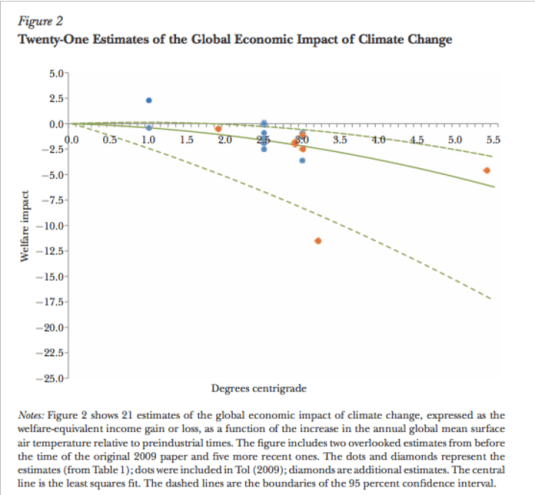
Source: Richard Tol.
Not only is the economic cost of global warming small, the chances of supplying an international public good such as a treaty to reduce carbon emissions is minimal.
The New York Times today in its Q&A guide did not quantify the costs and benefits of global warming. That makes their guide deeply misleading. This is because such estimates of the cost of global warming as a percentage of GDP are available from the IPCC. Which is worse? Being a libertarian or a misleading, low rent journalist?

Source: Short Answers to Hard Questions About Climate Change – The New York Times via Environmental Economics: Short Answers to Hard Questions About Climate Change – The New York Times.
What is even more bizarre in the guide today in the New York Times is the claim that politicians are finally taking climate change seriously. Anyone who claims that a climate change treaty will come out of Paris that is in any way binding is simply not paying attention to the last 5 years of politics and who controls the U.S. Congress. They cannot be taken seriously as a political commentator.
Obama gave up on a climate bill passed by the House of Representatives in 2010 despite the fact that he had the numbers in the Senate to break a filibuster. There were 5 Republican senators who would have voted for cap and trade in April 2010: Lindsey Graham, Susan Collins, Olympia Snowe, Scott Brown, and George LeMieux. There were 57 Democrat Senators. It takes 60 votes to break a filibuster.
Obama gave up because he didn’t want the additional political flak of passing a climate change bill in the aftermath of the political costs of passing Obamacare. President Obama could have fought harder to get the Bill the House passed through the Senate but he did not.
Concern about global warming fads away when it becomes a hip pocket issue. Rather than blaming vast right-wing conspiracies, using Google searches for “unemployment” and “global warming”, Kahn and Kotchen found that:
- Recessions increase concerns about unemployment at the expense of public interest in climate change;
- The decline in global-warming searches is larger in more Democratic leaning states; and
- An increase in a state’s unemployment rate decreases in the probability that Americans think global warming is happening, and reduces the certainty of those who think it is.
As Geoff Brennan has argued, CO2 reduction actions will be limited to modest unilateral reductions of a largely token character. There are many expressive voting concerns that politicians must balance to stay in office and the environment is but one of these. Once climate change policies start to actually become costly, expressive voting support for these policies will fall away, and it has.

 Utopia, you are standing in it!
Dec 01, 2015 @ 13:11:28
sceptics?
I have never met a sceptic plenty of deniers though.
When the monktons and tols use plainly wrong methods to disprove something you know it is because of politics.
LikeLike
Dec 01, 2015 @ 13:12:35
no room in your world for honest disagreement
LikeLiked by 1 person
Dec 01, 2015 @ 20:25:02
I haven’t seen honesty used as yet and that is al about the politics.
LikeLiked by 1 person