Too little and too much

homepaddock's avatarHomepaddock

Oh Dear.

Labour leader Andrew Little still wants to stiff-arm banks:

. . . ‘I stand by the stance I took, which is to get very heavy-handed with the banks. Because the truth is when the banks fail to follow the signal that the Reserve Bank is sending, that’s keeping money out of the back pockets of ordinary Kiwis, and I will always fight for their interests and for their rights. If the banks don’t want to play ball when it comes to the way we run our monetary policy, actually, there’s only one outfit that can really take them on, and that’s the government.’. . .

The Reserve Bank is independent because it’s not the government’s role to set interest rates.

Retail banks are independent businesses and it’s not the government’s role to tell them what interest rates they should charge.

Interest rates are at historically low…

View original post 637 more words

China Censors Discussion Of Panama Papers Showing President’s Family Members With Millions in Foreign Bank Account

jonathanturley's avatarJONATHAN TURLEY

130px-Mao_Zedong_portraitIt appears that the Communist censors of China are concerned about more than just discussion of the absence of civil liberties. It appears that one of the greatest concerns for Communist censors is any proof that its Communist leaders are capitalists. Networks like Sina Weibo and Wechat has deleted all discussion of the Panama Papers leak which names several members of China’s elite, including President Xi Jinping’s brother-in-law, as hiding huge amounts of money in foreign accounts. Mao warned that “There is a serious tendency towards capitalism among the well-to-do peasants.” It appears that the well-to-do peasants have discovered foreign bank accounts.

View original post 80 more words

Some people do not understand the principle of the lever

HT: Julian Weeks

What do economists think of Karl Polanyi?

brayden king's avatarorgtheory.net

This is a guest post by Marko Grdesic, a doctoral candidate at the University of Wisconsin. Marko’s research focuses on social movements and political sociology. You can learn more about Marko at his website.

What do economists think of Karl Polanyi? For sociology, Polanyi is a classic. His book The Great Transformation is part of the sociological canon and is of special relevance to economic sociologists. Polanyi’s agenda has recently received an important update by two well-known sociologists. But what do economists think of his work? Have they read it? If so, what do they think of it? The motivation behind this small research project was to investigate the disciplinary differences between economics and sociology, by looking at an author who is arguably relevant for both fields. In order to do this, I sent a bunch of emails to economists. I wrote to a randomly chosen 10…

View original post 970 more words

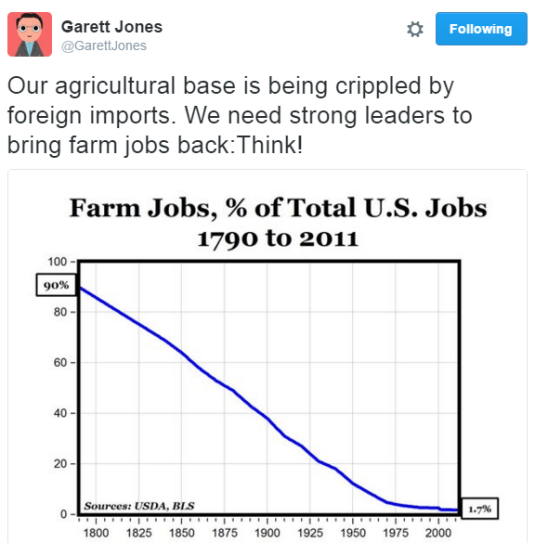
@jeremycorbyn @realdonaldtrump @BernieSanders would want to save these jobs

Image

The Greatest Speech Ever – Robert F Kennedy Announcing The Death Of Martin Luther King

Jim Rose's avatarUtopia, you are standing in it!

This speech will take your breath away.

HT: Mohammad Azzam

View original post

Video

The dark underbelly of The Great Escape: Japanese BMI trends

japanese Trends and Forecast in Adult BMI

Image

Syria ~ Map Update dd April 3, 2016

Moral of the Story: Tax Havens Are Okay if You’re a Politically Connnected Leftist

Dan Mitchell's avatarInternational Liberty

Earlier this year, I had some fun when it was revealed that the President’s new Treasury Secretary had a lot of money in the Cayman Islands.

After all, leftists want us to believe tax havens are rogue regimes that should be eliminated. Some of them even want military intervention against these low-tax jurisdictions!

Much to my amusement, Mr. Lew even pretended he was financially illiterate to justify making sensible decisions to invest via the Cayman Islands.

And unlike the President’s first Treasury Secretary, Mr. Lew didn’t break the law and cheat on his tax return.

You probably won’t be surprised to learn that Secretary Lew wasn’t the first Democrat to utilize tax havens. Lawmakers such as John Kerry, Bill Clinton, John Edwards, and others on the left also have utilized tax havens to boost their own personal finances.

And it appears that Mr. Lew won’t be the last…

View original post 790 more words

Another Attack on Tax Competition: “Panama Papers” Is a Non-Controversy Controversy

Dan Mitchell's avatarInternational Liberty

Three years ago, thieves stole a bunch of information from “offshore” service providers in the Cook Islands and British Virgin Islands. This was supposed to be a ground-breaking exposé with huge ramifications, but it turned out to be a tempest in a teapot. As I pointed out at the time, all that we really learned is that people who use offshore services are generally honest and law-abiding. And they definitely had far more integrity than the politicians who routinely attack the offshore world.

Well, here we go again. We’ve learned that thieves have now obtained client data from a global law firm based in Panama, and leftists once again are making this seem like a giant story.

But here’s what you really need to know. This is simply another chapter in the never-ending war by high-tax governments against tax competition, fiscal sovereignty, and financial…

View original post 811 more words

Review of Gridlock: Why we’re stuck in traffic and what to do about it by Randal O’Toole

David M Levinson's avatarDavid Levinson

Review of Gridlock: Why we’re stuck in traffic and what to do about it. by Randal O’Toole. Cato Institute Press, 2010. ISBN 978-1-935308-23-2
Gridlock by Randal O’Toole is one of a slew of recent books and reports about transportation that has been released in anticipation of federal surface transportation reauthorization, the “highway” bill that is passed every five or six years by Congress which sets federal spending limits and establishes policies for both highway and urban public transit in the United States. This book identifies major problems with US transportation policy, pinning problems on planning and planners, and what it considers their misguided emphasis on rail and land use-based solutions to a variety of problems that would be better addressed without what is dubbed “social engineering” and instead focusing on technology and sound principles of economic efficiency. Reading this book in one-sitting, I found I could not dispute most of…

View original post 1,554 more words

Forgetting Faster Than We Learn

David A. King's avatarDavid Levinson

There are many players in the world of transport policy these days. On net, this influx of new actors into the policy, advocacy and planning realms is likely a benefit, but does offer some concerns. One thing that I see again and again is that new entrants and existing players in the world of urban transport policy too often don’t know or have forgotten lessons learned in the past. On one level this is just a nuisance, and it is good that old knowledge is rediscovered. On another more troubling level this is like health professionals having to rediscover penicillin every other generation.

Here are two recent examples where existing knowledge is ignored or not known or marginalized.

In a recent Vox piece the concept of induced demand was discussed with reference to recent empirical work by the economists Gilles Duranton and Matthew Turner (a few months ago Wired also…

View original post 996 more words

To Ease Traffic, L.A. Needs Much More Than Trains | CityLab

David M Levinson's avatarDavid Levinson

Laura Bliss writes in CityLab: To Ease Traffic, L.A. Needs Much More Than Trains: Metro’s $120 billion rail proposal alone won’t transform how Angelenos get around. I get quoted:

Which leads to a final point: Transit doesn’t have to reduce traffic to be successful. Indeed, its central aim probably shouldn’t be serving the people who don’t actually use it. Transit’s best selling point is that it offers mobility to those who, for any number of reasons, can’t or choose not to drive. It also underpins bustling economic activity, pushes people into job centers, and improves long-term sustainability. The transportation scholar David Levinson wrote in 2015 about the warped notion that the goal of public transit funding should be to benefit non-transit users:

Transit today is, in almost all U.S. markets, slower than driving. People who depend on transit can reach fewer jobs than those who have automobiles available. Some people use…

View original post 50 more words

Creative destruction in video store employment

image

Image

Life expectancy is increasing, but so is poor health in old age

https://twitter.com/JohnDaley_/status/440951146547384320

Previous Older Entries

Bassett, Brash & Hide

Celebrating humanity's flourishing through the spread of capitalism and the rule of law

Truth on the Market

Scholarly commentary on law, economics, and more

The Undercover Historian

Beatrice Cherrier's blog

Matua Kahurangi

Celebrating humanity's flourishing through the spread of capitalism and the rule of law

Temple of Sociology

Celebrating humanity's flourishing through the spread of capitalism and the rule of law

Velvet Glove, Iron Fist

Celebrating humanity's flourishing through the spread of capitalism and the rule of law

Why Evolution Is True

Why Evolution is True is a blog written by Jerry Coyne, centered on evolution and biology but also dealing with diverse topics like politics, culture, and cats.

Down to Earth Kiwi

Celebrating humanity's flourishing through the spread of capitalism and the rule of law

NoTricksZone

Celebrating humanity's flourishing through the spread of capitalism and the rule of law

Homepaddock

A rural perspective with a blue tint by Ele Ludemann

Kiwiblog

DPF's Kiwiblog - Fomenting Happy Mischief since 2003

The Dangerous Economist

Celebrating humanity's flourishing through the spread of capitalism and the rule of law

Watts Up With That?

The world's most viewed site on global warming and climate change

The Logical Place

Tim Harding's writings on rationality, informal logic and skepticism

Doc's Books

A window into Doc Freiberger's library

The Risk-Monger

Let's examine hard decisions!

Uneasy Money

Commentary on monetary policy in the spirit of R. G. Hawtrey

Barrie Saunders

Thoughts on public policy and the media

Liberty Scott

Celebrating humanity's flourishing through the spread of capitalism and the rule of law

Point of Order

Politics and the economy

James Bowden's Blog

A blog (primarily) on Canadian and Commonwealth political history and institutions

Science Matters

Reading between the lines, and underneath the hype.

Peter Winsley

Economics, and such stuff as dreams are made on

A Venerable Puzzle

"The British constitution has always been puzzling, and always will be." --Queen Elizabeth II

The Antiplanner

Celebrating humanity's flourishing through the spread of capitalism and the rule of law

Bet On It

Celebrating humanity's flourishing through the spread of capitalism and the rule of law

History of Sorts

WORLD WAR II, MUSIC, HISTORY, HOLOCAUST

Roger Pielke Jr.

Undisciplined scholar, recovering academic

Offsetting Behaviour

Celebrating humanity's flourishing through the spread of capitalism and the rule of law

JONATHAN TURLEY

Res ipsa loquitur - The thing itself speaks

Conversable Economist

In Hume’s spirit, I will attempt to serve as an ambassador from my world of economics, and help in “finding topics of conversation fit for the entertainment of rational creatures.”

The Victorian Commons

Researching the House of Commons, 1832-1868

The History of Parliament

Articles and research from the History of Parliament Trust

Books & Boots

Reflections on books and art

Legal History Miscellany

Posts on the History of Law, Crime, and Justice

Sex, Drugs and Economics

Celebrating humanity's flourishing through the spread of capitalism and the rule of law

European Royal History

Exploring the Monarchs of Europe

Tallbloke's Talkshop

Cutting edge science you can dice with

Marginal REVOLUTION

Small Steps Toward A Much Better World

NOT A LOT OF PEOPLE KNOW THAT

“We do not believe any group of men adequate enough or wise enough to operate without scrutiny or without criticism. We know that the only way to avoid error is to detect it, that the only way to detect it is to be free to inquire. We know that in secrecy error undetected will flourish and subvert”. - J Robert Oppenheimer.

STOP THESE THINGS

The truth about the great wind power fraud - we're not here to debate the wind industry, we're here to destroy it.

Lindsay Mitchell

Celebrating humanity's flourishing through the spread of capitalism and the rule of law

Alt-M

Celebrating humanity's flourishing through the spread of capitalism and the rule of law

croaking cassandra

Economics, public policy, monetary policy, financial regulation, with a New Zealand perspective

The Grumpy Economist

Celebrating humanity's flourishing through the spread of capitalism and the rule of law

International Liberty

Restraining Government in America and Around the World