If you take up the cause of criticizing the validity of the state, you soon discover that there are certain criticisms that are strictly verboten. Public education, roads, PBS, NPR, the National Parks, the EPA, NASA, the NIH and libraries among others are all pretty much sacrosanct. Any criticism of these institutions or initiatives will generally draw opprobrium and general accusations of being an enemy of human decency and a retrograde neanderthal.
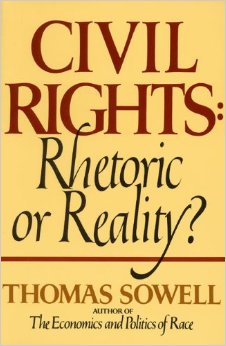
Of all the sacred cows, the biggest of all is perhaps civil rights. Bring up civil rights, Brown v. Board of Education, the ’64 Civil Rights Act, Martin Luther King Jr. and you’re likely to hear swooning praise from all political persuasions that these pieces of legislation, court decisions, leaders and the movements which agitated for them were brave, principled, and an unequivocal American success. Legislative successes which helped set America on a path towards rectifying a sordid past filled…
Despite its own blatant obsession with profits and artifice disguised as substance, Hollywood has been deeply unkind to Wall Street in its films. It’s unsurprising given the fact that liberals have colonized Hollywood and an overwhelming majority of films and television shows have varying quantities of leftist editorial. You’d assume they’d be nicer given that plenty of Wall Street hedge fund money flows into Hollywood. Perhaps the tone of reproach and recrimination that forms the backdrop of The Big Short can be attributed to Wall Street’s increasing reticence to fund Hollywood ventures. Regardless, The Big Short is filled to the brim with contempt for banking and partisan agitprop.
I went into the cinematic adaptation of The Big Short expecting it to have the same editorial flaws as the book and these expectations were confirmed. Unfortunately, the film exceeds the dishonesty of the book and makes additional errors which alternate…
To be a party of government requires compromise, a willingness to appeal to the average voter, and to adopt policies because they are wedge issues rather than because they are principled stands.
Labour (at least their social democratic wings) want to win and govern by adopting policies that work; Greens want to send a message.
Anti-war MPs such as Jeremy Corbyn should be sued for abuse of public office and crimes against peace for not making the knockdown argument against the 2nd war against Iraq.
Instead, Corbyn said he did not like war without explaining how this was different from appeasement and surrender. The easiest way to stop a war is to surrender. The easiest way to start a war is to look weak to an aggressor.
That knockdown argument against the 2nd Iraq war argument was right under the noses of the peace movement. It was yes, Iraq has weapons of mass destruction.
It is madness to invade a country that has weapons of mass destruction because they might use them especially if the objective is regime change. Iraq may not have had nuclear weapons, but the potential for Iraq to have biological and chemical weapons secreted away was real.
No one is mad enough to invade North Korea. They will use chemical and biological weapons on Seoul and Tokyo. Syria has chemical and biological weapons to make sure no one invades it.
From what I read, in the current Civil War, Syria uses chemical and biological weapons when it is on the retreat but does not use them to advance and claim new territory.
The reason why the renegade left could not possibly make this obvious argument against the war in Iraq, which was it could be a massive disaster if these chemical and biological weapons were used in desperation, was these peace activists would have to admit nuclear deterrence works. To stop a war by having to admit that weapons of mass destruction deter war was too much for the peace movement to swallow.
Since 1945, at least seven or eight wars have occurred where one side had nuclear weapons. In 1973, Israel had nuclear weapons it could have used.
The reason for the non-use of nuclear weapons in those seven or eight wars including the 1973 Yom Kippur War was none were wars of annihilation. Nuclear weapons were more likely to be used if the suspected intention is to invade or occupy a country.
The Yom Kippur war was launched with a plan by President Sadat to reclaim the Sinai then after a few days agreed to an internationally brokered ceasefire. He was intending on reclaiming lost territory, not invading Israel proper continue and risk nuclear retaliation.
Saddam destroyed his nuclear, biological, and weapons but not his weapons development capability soon after he lost the first Iraq war. Saddam played a double strategy: make sure he was not caught with contraband but play a fine game of bluff making everybody think Iraq still has them so he remains a regional strongman.
The ingrained belief that Saddam Hussein’s regime retained chemical and biological warfare capabilities, was determined to preserve and if possible enhance its capabilities, including at some point in the future a nuclear capability, and was pursuing an active policy of deception and concealment, had underpinned UK policy towards Iraq since the Gulf Conflict ended in 1991.
The 2nd Iraq war started because Saddam fooled his enemies into thinking he had chemical, biological and nuclear weapons. He certainly had the Japan option. This is having in place the capability to produce weapons of mass destruction such as chemical and biological weapons quickly if he wanted.
Why Evolution is True is a blog written by Jerry Coyne, centered on evolution and biology but also dealing with diverse topics like politics, culture, and cats.
“We do not believe any group of men adequate enough or wise enough to operate without scrutiny or without criticism. We know that the only way to avoid error is to detect it, that the only way to detect it is to be free to inquire. We know that in secrecy error undetected will flourish and subvert”. - J Robert Oppenheimer.






 Utopia, you are standing in it!
Recent Comments