
Below is a very good video from the Marginal Revenue University. Specifically, you learn how variations in real GDP per capita can set countries leagues apart from one another. It takes a dive into the growth of the US economy over time and see how the economies of other countries stack up in comparison. The Indian economy now is like a trip back to the US of 1880. You’ll see why China today is like the America of the Jazz Age. They also explain why living in Italy today is related to a time when Atari was popular in the US.
Political leanings of American professors @robhosking
29 Jul 2016 2 Comments
in economics of education, labour economics, occupational choice, politics - New Zealand, politics - USA Tags: academic bias
Sociologists are rather level-headed compared to that hotbed of political bias, which is American history professors. Hardly any of them see themselves as a Republican. I must take back a few nasty things I said about political bias and sociologists.

Source: THE SOCIAL AND POLITICAL VIEWS OF AMERICAN PROFESSORS Neil Gross and Solon Simmons, Working Paper, September 24, 2007
Has ethical investing ever beaten the market? @GreenpeaceNZ
29 Jul 2016 Leave a comment
in environmentalism, financial economics Tags: active investing, efficient markets hypothesis, entrepreneurial alertness, ethical investing, passive investing
VFTSX is the Vanguard social investing index fund – a fund that invests in an index made up of ethical investing funds.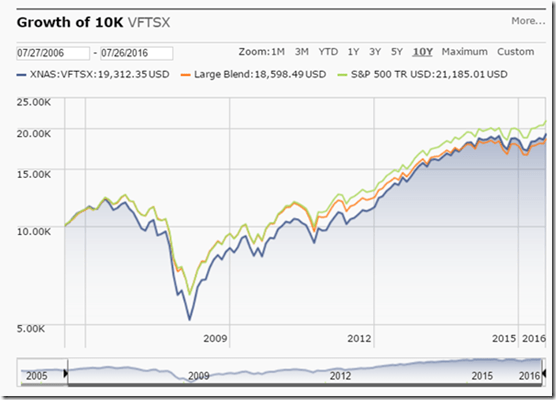
Source: VFTSX Vanguard FTSE Social Index Inv Fund VFTSX Quote Price News.
Sometimes the gap is a little bigger than we think
29 Jul 2016 Leave a comment
in economics, economics of media and culture Tags: Darwin awards
WSJ News Graphics: How the Trump Coalition Performs Among Voter Groups
29 Jul 2016 Leave a comment
in economics

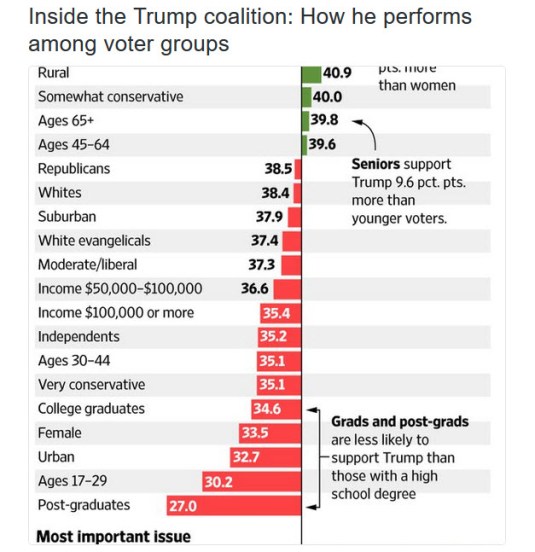 Source: WSJ News Graphics, Inside the Trump coalition: How he performs among voter groups, Twitter.com, March 27, 2016, pic.twitter.com/c9gdTRaR2F
Infographic: Aviation Accidents
29 Jul 2016 Leave a comment
in economics
Asiana Airlines Flight 214 was a scheduled transpacific passenger flight from Incheon International Airport near Seoul, South Korea, to San Francisco International Airport (SFO) in the United States. On the morning of Saturday, July 6, 2013, the Boeing 777-200ER aircraft operating the flight crashed on final approach into SFO. Of the 307 people aboard, two passengers died at the crash scene, and a third died in a hospital several days later, all three of them teenage Chinese girls. Another 187 individuals were injured, 49 of them seriously. Among the injured were three flight attendants who were thrown onto the runway while still strapped in their seats when the tail section broke off after striking the seawall short of the runway. It was the first crash of a Boeing 777 that resulted in fatalities since that aircraft model entered into service in 1995. [1]
Since the mid 1980’s, the trend has…
View original post 134 more words
democrats dump the antiwar movement
29 Jul 2016 Leave a comment
in economics

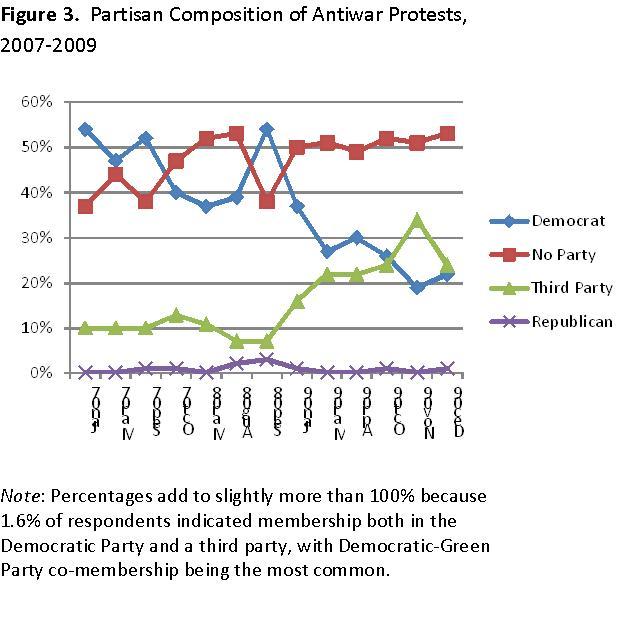
Observe how Democratic participation sharply drops after the Obama inauguration.
My collaborator, Michael Heaney, and I have a new working paper called “The Partisan Dynamics of Contention: Demobilization of the Antiwar Movement in the United States, 2007-2009.” The key argument is that the decline of the antiwar movement can be attributed, in part, to the fact that Democrats have stopped using the peace movement as a platform for anti-Bush sentiment. In other words, at its peak, the ranks of the antiwar movement were swelled by partisans. Once Obama won the presidency, and other issues emerged, the movement shrank when Democrats stopped showing up. The remaining protesters were more likely to be non-partisan or third party, and these non-Democrats were more likely to disapprove of Obama’s management of Iraq and Afghanistan. When Democrats gained power, the movement converged on a core of peace activists who were not strongly identified with the Democratic party.
analyzing the anti-iraq war movement 10 years later
29 Jul 2016 Leave a comment
in economics
Our friends at Notre Dame have another interesting forum on the topic of social movements. What should we learn from anti-Iraq War movement? Mobilizing Ideas recruited some top notch movement researchers and activists to comment, such as Catherine Corrigal-Brown, David Cortright, William Gamson, Kathy Kelly, Lisa Leitz, David Meyer, Andrew Yeo, and Eric Stoner.
My co-author, Michael Heaney, was invited to respond as well. A few clips from his essay:
The antiwar movement helped Barack Obama to establish credibility as a genuine antiwar candidate in 2008 by creating the space for him to speak at a 2002 antiwar rally in Chicago when he was an Illinois state senator. As a result, the antiwar movement contributed to US Senator Barack Obama’s victory in the 2008 Democratic primary contest against Hillary Clinton, which paved the way to his election to the presidency. It…
View original post 149 more words
obama chills out the anti-war movement
29 Jul 2016 Leave a comment
in economics
On the 10th anniversary of the Iraq War, my co-author, Michael Heaney, was asked to comment on the rise and decline of the antiwar movement. From The International:
Michael Heaney, an assistant professor at the University of Michigan, reveals in his book manuscript in progress, that the anti-war movement came to a halt because a majority of US protests were inspired by anti-Bush and anti-Republican feelings.
According to Heaney, people felt less threatened when Obama entered office, even though he continued to pursue the war. “They were willing to trust their president, [they] thought he’d deal with it in the right way.”
This notion of trust may have prevented Obama’s supporters from seeing the truth. Heaney explains that, “Obama’s policies were very similar to Bush’s policies. Bush had started reducing troops; Bush signed the Status of Forces Agreement. Obama said he’d bring them home faster than he…
View original post 54 more words
Reviewing government assistance to business
29 Jul 2016 Leave a comment

The Australian Productivity Commission’s latest annual Trade and Assistance Review was released quite recently. These, statutorily required, reviews contain
the Commission’s latest quantitative estimates of Australian Government assistance to industry
as well as useful discussion and analysis of key recent developments in the trade and industry assistance area. As the Commission notes in the Foreword to this year’s report
Views inevitably differ on what constitutes industry assistance and whether it is warranted. Fundamental to these questions is transparency of measures. The annual Review seeks to identify government arrangements that may be construed as assistance, as well as their target, size, and nature. This information provides a basis for considered assessment of the benefits and costs of the arrangements.
Transparency alone usually can’t stop daft policies being adopted or continued, but with good and reasonably empirical estimates and disinterested analysis, it is harder to push back against the special interest lobbying governments for…
View original post 860 more words
 Utopia, you are standing in it!
Recent Comments