Where are you two from, Nose City?
23 Aug 2016 Leave a comment
in economics, movies Tags: Monty Python

The West Wing: President Walken in the Situation Room
23 Aug 2016 Leave a comment
in television Tags: West Wing
Creative destruction in New Zealand advertising market shares
23 Aug 2016 Leave a comment
in economics of media and culture, industrial organisation
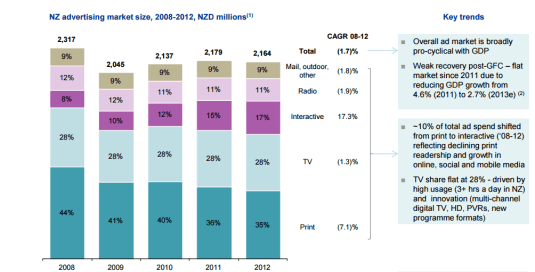
Source: KPMG valuation report on Television New Zealand Limited, 18 December 2013 via Valuation Reports for SOEs -2013 — The Treasury – New Zealand.
Daniel Hannan Explains Socialism at The Oxford Union
23 Aug 2016 Leave a comment
in economics

Daniel Hannan is a British politician, author, and Member of the European Parliament representing South East England, who will, I guess, shortly be losing his job to BREXIT, which I believe he favored. Here he is clearing the air a little, about the wonders of socialism.
He is a very clear speaker, and I wouldn’t want to be on the opposing side of a debate with him. Good guy, always interesting.
I worry more about global cooling
23 Aug 2016 Leave a comment
in economic history, economics of natural disasters, environmental economics, global warming Tags: global cooling, global warming, ice ages, Little ice age

Do You Understand the Electoral College?
23 Aug 2016 Leave a comment
in constitutional political economy, economics, politics - USA
Carole King and James Taylor Perform “So Far Away” in 1971
23 Aug 2016 Leave a comment
in economics, Music Tags: Carole King, James Taylor
Football salaries – superstar and tournament effects.
23 Aug 2016 1 Comment
in economics

Amongst the extensive coverage of the Olympic Games from Rio, the start of the Football season in Europe has slipped under the radar. Michael Cameron’s blog post on footballer salaries was timely and in particular his discussion around the difference between the superstar and tournament effects.
Superstar effects – this is where a player is rewarded with a higher salary than his/her team mates for generating higher revenues for their club.
Tournament effects – this is the situation where wage differences are based NOT on marginal productivity but instead upon relative differences between the individuals. Ultimately each player only needs to be a little bit better than the second best player in order to ‘win’ the tournament.
Michael Cameron looks at the salaries of Ronaldo and Messi and states that it is unlikely that either of these players would generate more than twice as much value as the others on the graph below…
View original post 206 more words
Who’s progressive?
22 Aug 2016 Leave a comment
in economics

While we at The Initiative have been pretty happy with the hearing our report on zero percent loans has received, some of the partisan responses have been more than a little depressing.
It would have been surprising if Labour would have said, “Yeah, you know what, we messed that one up. Shouldn’t have done it. Oops.”
Labour’s education spokesman Chris Hipkins takes that a step further and says taking away interest-free student loans “reinforces inequity”.
“It would make inequity worse because those on the lowest incomes would be penalised the most. It’s an incredibly regressive system.”
Hipkins said the think tank was taking a “narrow view of the value of tertiary education”.
“This is exactly the type of ideological right wing clap-trap i’ve come to expect from the successor to the business roundtable.”
“They assume it’s all personal benefit, they don’t look at the fact we put significant…
View original post 844 more words
Jean-Baptiste Say: Grandfather of French Political Economy
22 Aug 2016 Leave a comment
in economics

Say’s law is an influential idea still being controversial amongst contemporary economists, the law derived from his magnus opus A Treatise on Political Economy (Or the Production, Distribution and Consumption of Wealth). The volume is divided into 3 books, the first one concerns production. Say discussed the nature of production which is to generate goods and service for sale, thus creating demands. He then distinguished between, productive use of capital, industry and property vs unproductive usage. He shattered many early misconceptions such as economics is a zero-sum game, money is lost through trading and government as a means of production. Say’s law derived from the first volume where he stated:
As each of us can only purchase the productions of others with his own productions – as the value we can buy is equal to the value we can produce, the more men can produce, the more they will purchase.
He also…
View original post 303 more words
 Utopia, you are standing in it!
Recent Comments