Dad’s Army – The Movie. Church Scene
22 May 2017 Leave a comment
in movies, television Tags: Dad's army
UCLA Black Student Group Demands $40 Million Endowment And Mandatory Cultural Awareness Training
22 May 2017 Leave a comment
in economics

 We have been following the demands made by students as part of Black Lives Matter and other groups calling for racial justice. Few would top the demands of the Afrikan Student Union at the University of California which has issued a list of demands including a $40 million endowment. The group claims a pattern of “racial attacks” on campus.
View original post 371 more words
Map of Europe if the Central Powers won World War I
22 May 2017 Leave a comment
in International law, war and peace Tags: economics of borders, maps, World War I
Steve Wozniak Debunks One of Apple’s Biggest Myths
22 May 2017 Leave a comment
in economic history, entrepreneurship, industrial organisation Tags: creative destruction
Codebreaking has moved on since Turing’s day, with dangerous implications
22 May 2017 Leave a comment
in economics


infobunny, CC BY
Bill Buchanan, Edinburgh Napier University
We have always been been intrigued by keeping secrets and uncovering the secrets of others, whether that’s childhood secret messages, or secrets and codebreaking of national importance. 
With a film, The Imitation Game, reprising the life of Alan Turing and his role in breaking the Nazi’s Enigma cipher of World War II, how does one codebreak, then and now?
It’s all in the cipher
Imagine that Bob and Alice wish to secretly communicate, and Eve, who wishes to listen in. Here “plain text” refers to the original message, and “cipher text” as the coded message.

Bill Buchanan, Author provided
There are two ways of creating the cipher text:
- Having an algorithm (a cipher) that only Bob and Alice know, so that…
View original post 1,241 more words
Is Distribution According to Contribution Fair?
22 May 2017 Leave a comment
in economics

In a recent article on “The Income Gap,” economist Mark Thoma asks whether the distribution of income is fair. To answer this question, he adopts (at least for the sake of argument) the neoclassical view of income distribution. Assuming a perfectly competitive market economy, “each person in society receives an income equal to their contribution to national output.” Thoma admits that judgments of fairness are best left to society as a whole rather than economists, but says that “if we adopt the simple notion that every person has a right to a share of output equivalent to their contribution to it… then a competitive economic system does produce a justifiable outcome, at least in theory.” Thoma’s criticism of this view is that it relies on “a whole host of assumptions,” and that when these idealized conditions (such as perfect competition) don’t hold, “there is nothing that says the…
View original post 774 more words
Big Government Is Stifling India’s Economy
22 May 2017 Leave a comment
in economics

As part of yesterday’s column about global growth, poverty, and inequality, I realized that I’ve written several columns about economic policy in China, but never once focused on overall policy in India.
Indeed, a quick look through the archives reveals only three columns that even addressed specific policies in India. And all of them were negative.
- The Indian government’s mistreatment of private schools.
- The Indian government’s war on cash.
- A member of the Bureaucrat Hall of Fame from India.
So it’s time to assess overall economic policy in India, which means this is an opportunity to point out that there are some positive developments in the world’s second-most populous nation.
One of my Cato colleagues, Swaminathan S. Anklesaria Aiyar, wrote an exhaustive study on India’s economy last year. The bottom line is that there’s been some progress, most of which took place in the 19990s.
India’s economic…
View original post 983 more words
Measles outbreaks linked to vaccine refusal
22 May 2017 1 Comment
in economic history, health economics Tags: anti-vaccination movement, vaccinations
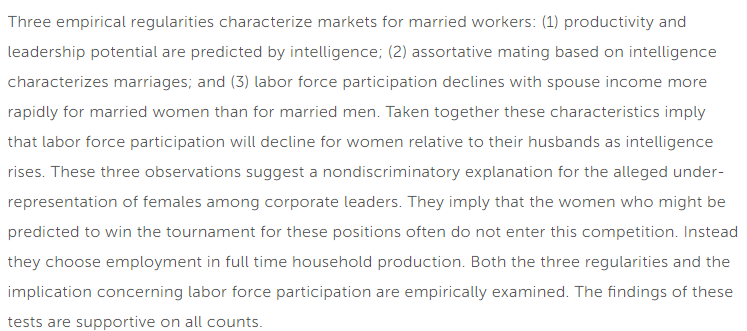
ASSORTATIVE MATING OR GLASS CEILING?
22 May 2017 Leave a comment
in discrimination, economics of love and marriage, gender, human capital, labour economics, labour supply, occupational choice Tags: assortative mating, dating market, gender wage gap, glass ceiling
The Continued Importance of Austrian Capital Theory
22 May 2017 Leave a comment
in Austrian economics, business cycles Tags: Austrian business cycle theory
 Utopia, you are standing in it!
Recent Comments