Nancy MacLean’s generalized rewriting of James Buchanan’s views on democracy
25 Jul 2017 Leave a comment
in economics
The New York Times covers Dawkins’s deplatforming
25 Jul 2017 Leave a comment
in economics

As we all know, radio station KPFA in Berkeley decided to withdraw its sponsorship of a book talk by Richard Dawkins, cancelling the fundraising even; the reason, they said, was that Dawkins had insulted Islam (see my coverage here and here). As they explained, “While KPFA emphatically supports serious free speech, we do not support abusive speech.”
That’s ridiculous, for criticizing a faith is not “abusive”. KPFA’s de-platforming was an unconscionable breach of free speech, especially by a Left-wing station that has, over the years, broadcast a lot of what could be seen as much worse “hate speech.” As I’ve noted, this wasn’t an explicit violation of the First Amendment, as KPFA is not a government-run station nor has anything to do with the University of California, but free speech goes far deeper than the Constitution. It’s a tradition—a sine qua non—of progressivism, and to do what KPFA…
View original post 877 more words
Of Pardons and Presidents: Why Trump Can But Shouldn’t Use His Power To Pardon His Family and Aides
25 Jul 2017 Leave a comment
in economics

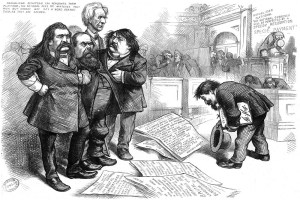 Below is my column in the Washington Post on the controversy over the possible use of pardon authority by President Donald Trump to protect his family and aides involved in the Russian investigation. Trump’s tweet reference to his “complete power to pardon” fueled rumors that he is considering pardons, including a possible self-pardon.
View original post 1,153 more words
Renting and buying
25 Jul 2017 Leave a comment
in economics

In his Sunday Star-Times column this week, economist Shamubeel Eaqub announced that “I’ve bought a house at last” . He and his wife had had quite a lot of coverage for their choice to stay renting, even though they could readily have purchased a house in Auckland. As they noted in their book Generation Rent, their decision to rent had been both a lifestyle and a financial one.
Economists have form in this area. Most people want to own their own house sooner or later, and in the longer-term those who don’t are usually those who can’t. When economists don’t buy it is usually a choice.
The most prominent New Zealand economist who once chose not to buy was the then new Governor of the Reserve Bank, Don Brash. Taking up his role as Governor in 1988 involved shifting from Auckland to Wellington. At the…
View original post 1,787 more words
Game of monopoly was invented to demonstrate the evils of capitalism!
25 Jul 2017 Leave a comment
in economics

The earlier avatar of Monopoly was called Landlord’s game and was invented by Liz Magie. She drew inspiration from her father’s works which showed how capitalism was exploiting people:
Magie invented and in 1904 patented what she called the Landlord’s Game. Laid out on the board as a circuit (which was a novelty at the time), it was populated with streets and landmarks for sale. The key innovation of her game, however, lay in the two sets of rules that she wrote for playing it.
Under the ‘Prosperity’ set of rules, every player gained each time someone acquired a new property (designed to reflect George’s…
View original post 446 more words
Buchanan’s master plan to undermine the welfare state is just a mundane economics paper
25 Jul 2017 Leave a comment
in economics

In her recent interview with The Chronicle of Higher Education, Nancy MacLean was asked the following question:
Henry Farrell, a political scientist on the left at George Washington University, points to your discussion of a document Buchanan wrote laying out a strategy for dividing the coalition of groups who supported the welfare state. You suggest this was a kind of master plan that shaped much of the American right, but Farrell thinks you fail to provide evidence either for the crucial role played by this document or that Buchanan himself was more than a midlevel intellectual within a much larger movement. What’s your response?
Her response :
In the document in question, Buchanan was providing the Cato Institute with counsel for its then-top policy priority: privatization of Social Security, which Buchanan expressly pointed out had no support from any demographic group of voters, so he proposed an indirect approach…
View original post 2,776 more words
NZ top 1% should be drummed out of the international ruling class? @EricCrampton
25 Jul 2017 Leave a comment
in applied welfare economics, politics - New Zealand, poverty and inequality
What a poor effort! The US top 1% is going from strength to strength by whatever explanation or conspiracy theory is your poison. The NZ top 1% is failing completely on its job as the ruling class extracting the labour surplus without mercy or pity to immiserise the proletariat just because it thinks that is a viable long-term strategy for its class.

Source: The material wellbeing of NZ households: Overview and Key Findings from the 2017 Household Incomes Report and the companion report using non-income measures (the 2017 NIMs Report) prepared by Bryan Perry, Ministry of Social Development, Wellington, July 2017.
The income share of the New Zealand top 1% has been falling and falling for a long time now. The class struggle has been cancelled in New Zealand. What is a point of the class war if the ruling class is losing and the proletariat winning. Marxists have nothing to whine about.
Green Losers
25 Jul 2017 Leave a comment
in economics


There is much to like about a recent Daily Beast article by Joel Kotkin, who is no fan of Trump, but sees clearly why he is winning against the greens. In writing Why the Greens Lost and Trump Won, Kotkin encapsulates in a few paragraphs all the reasons why so many of us detest the climatists. (Article reblogged below with some images added)
When President Trump pulled out of the Paris climate accords, embraced coal, and stacked his administration from people from fossil-fuel producing states, the environmental movement reacted with near-apocalyptic fear and fury. They would have been better off beginning to understand precisely why the country has become so indifferent to their cause, as evidenced by the victory not only of Trump but of unsympathetic Republicans at every level of government.
Yet there’s been little soul-searching among green activists and donors, or in the generally pliant media since…
View original post 1,595 more words
The Polish president’s veto
25 Jul 2017 Leave a comment
in economics

Polish President Andrzej Duda has exercised his veto against two of the government’s bills to change the appointment of judges. Media accounts are treating this action as a “surprise”, but it really should not be seen as such. Both the government (premier and cabinet) and the president (directly elected) are of the same party, Law and Justice (PiS), and the institutional dynamics make the action unsurprising.
First of all, such a possibility was signaled by the president on 18 July. Secondly, the theory of presidentialized parties (Samuels and Shugart, 2010) should make presidential action against their own governing party’s controversial decisions the default expectation. That is, the institutions “predict” such actions, and it is politics that sometimes intervenes and prevents the president from acting on his or her independent mandate. In this case, the institutions prevailed.
Duda is not the leader of the party in the sense of…
View original post 553 more words
Pielke on Climate #4
25 Jul 2017 Leave a comment
in economics

Welcome to issue #4 of my occasional newsletter on climate and energy issues. As a reminder, my day-to-day research or writing is focused on sports governance and various issues of science policy. But I’ve written a fair bit on the topics of climate and energy over the past 25 years, including two recent books and a boatload of academic papers, and I’m paying attention. So caveat lector!
A few things to say up front:
- If you don’t like what I write or don’t like me, then don’t read it – no big deal, I’m just a professor with a blog.
- If you appreciate the perspective, consider the tip jar to your right.
- And thanks to those of you who have tipped – very much appreciated! (Know that your contributions helped to underwrite my recent talk in London.)
- If you’d like to engage, consider a comment, a Tweet @ me (
View original post 1,054 more words
Britain’s National Health Service about to ban homeopathy
24 Jul 2017 Leave a comment
in economics
Reader Barrie called my attention to an article in The Independent that offers some good news: Britan’s NHS, based on a 48-page document about items that shouldn’t be prescribed in primary care medicine, seems set to stop prescribing Magic Water, otherwise known as homeopathic medicine.
The motivation for the whole document was to eliminate, as a cost-cutting measure, those prescribed items that were of low clinical effectiveness. So there are many drugs listed, but on page 14 you’ll find this:
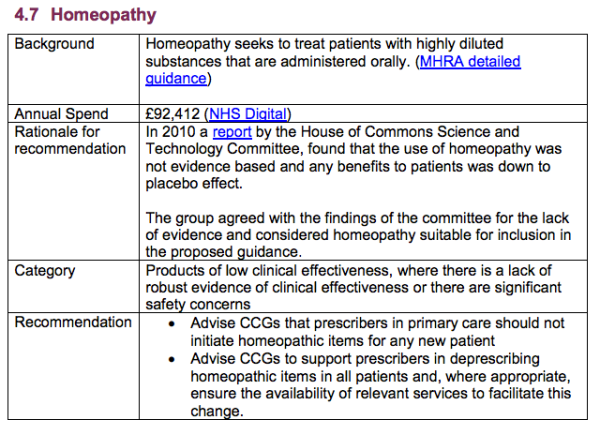
Actually, given Prince Charles’s fondness for this quackery (he even uses it own his own farm animals), I’m surprised the expenditure by the NHS is less than £100,000 per year, but it sends an important signal to people that the government health agency sees homeopathy as ineffective. Now I’m sure that patients who want Magic Water can still buy it themselves, but at least doctors can’t prescribe it.
Here’s a…
View original post 117 more words
 Utopia, you are standing in it!
Recent Comments