The Myth of Social Costs
03 Dec 2017 Leave a comment
in economics

Illyyas Ahmed and Prince Jain
This week’s discussion was based on the age-old economic problem of efficient resource allocation which we analyzed as presented in Mr. Steven Cheung’s monograph – The Myth of Social Cost.
The argument began by describing the efficient allocation state using the Pareto condition, the definition of which plays a defining role in our understanding of the choices in an economic environment and goes as follows:
“A state where it is no longer possible to re-allocate the use of resources so that one individual will gain without loss to another”
In a Robinson Crusoe economy (one-man economy), the absence of other agents implies an inability to contemplate inefficiency as every decision, assuming rationality, will be taken in best interests of the individual without any loss to others. The resources thus will always be efficiently allocated. This property however is lost in a society with other subjects…
View original post 1,108 more words
‘Family Guy’ Perfectly Mocks PC Social Justice Warriors on Twitter
03 Dec 2017 Leave a comment
in television Tags: political correctness
Germany’s costly experiment with renewable energy
03 Dec 2017 Leave a comment

Holly Nicholas of Rebel Media notes that environmentalists love to tout Germany as the place to imitate if we want to make renewable energy mainstream, so she looks into some of the major problems they’ve encountered with their Energiewende program which is being copied in Canada.
NASA fixes Voyager 1 deep space probe by firing thrusters not used in 37 years
02 Dec 2017 Leave a comment
in economics


Getting any response from 13 billion miles away is quite a feat.
But what will the aliens make of Chuck Berry?
Engineers experience “joy and incredulity” as a successful test extends the life of the farthest human-made object from Earth, reports Sky News.
NASA has been able to extend the life of one of its space probes travelling 13 billion miles from Earth by firing up dormant thrusters not used for 37 years.
Voyager 1 was launched in September 1977 and is the only human-made object in interstellar space – the environment between the stars.
But after four decades of exploration which have taken in fly-bys of Jupiter and Saturn, engineers found that the primary thrusters which orient the space probe had severely degraded.
So, in an attempt to keep Voyager 1 operable, NASA tested four thrusters on the back side of the spacecraft which have not been…
View original post 108 more words
Guilty: Subsidised Wind & Solar Drive Australia’s Rocketing Retail Power Prices
02 Dec 2017 2 Comments
in economics

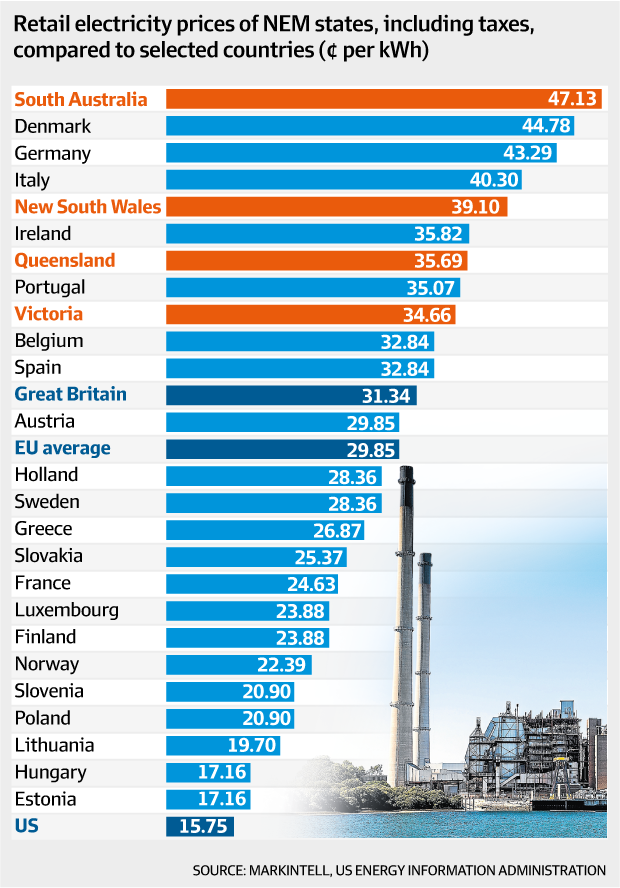
Among the dwindling band of deluded wind and sun worshippers, no two words are more prone to send them into apoplexy than ‘South Australia’. Held up as the example of how to run an economy on sunshine and breezes (sprinkled with a liberal dose of pixie dust and batteries that cost $150 million to power SA for four minutes when the wind stops blowing), its rocketing retail power prices and rickety grid (SA experienced even more grid failures in the last week) offer the perfect retort to renewable energy zealots, and the rent-seekers who depend upon them as ‘useful idiots’.
South Australia’s vapid Premier, Jay Weatherill recently ran a top-class fake news story that South Australia’s power was now the cheapest in the nation (see below). Try telling that to the householders and businesses who already pay the highest power prices in the world (see above). And who can only…
View original post 3,619 more words
How to win without science: argumentum ad hominem
02 Dec 2017 Leave a comment
in economics

See the French translation
The “argumentum ad hominem” is a method to address an argument by attacking one’s adversary’s character. It used to be a fallacy – now it seems to be how anti-industry environmental activists score points when their science, evidence and data is worth very little, or as is often the case, when the activists do not understand the science (but understand the consequences).
Over the last few days, environmental NGOs and anti-industry anarchists on both sides of the Atlantic have been busily refuting scientific findings by showing how some researchers involved have, or many years ago, had ties to industry. Somehow these intellectual neophytes feel that when the evil wand of industry touches a scientist, he or she becomes incapable of a clear scientific observation. The antis surround themselves with others who think the same, retweet them, join in their character assassinations, but as far as I can see, have never…
View original post 956 more words
Ten Practices Linking Environmentalism with Fascism
02 Dec 2017 Leave a comment
in economics
Recent news that the German Green Party is willing to work with the extreme right “Alternative for Germany” (AfD) in order to secure a vote to ban glyphosate has shocked many political actors seeking a cordon sanitaire around the German fascist party. The Risk-Monger though is not surprised. He has often used words like “undemocratic”, “Machiavellian” and “fascist” to describe the self-righteous environmental activist campaign strategies.
Contradictions for the Cause
The Greens are a party of inherent contradictions. They talk of democracy and the voice of the common person yet the consequences of their food and energy policies favour the elite and the privileged (at the expense of the poor). Greens will lead transparency campaigns and moves to expose corporate lobbying, and yet they themselves, as transparocrites, often do not disclose from whom and how they use their (public) funds. They seek development and increased aid for emerging economies…
View original post 1,816 more words
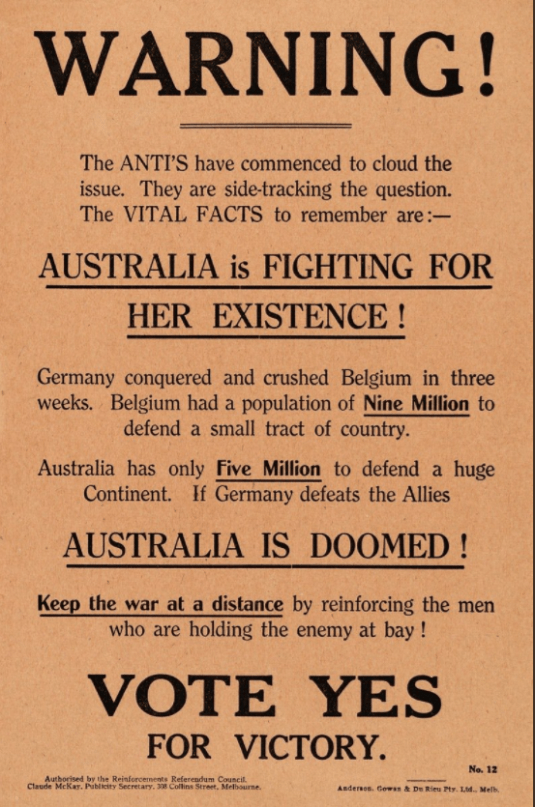
1916 Conscription plebiscite pamphlet is still basis of Australian national security policy. New Zealand’s too. (Keep war at a distance; have a great and powerful friend).
02 Dec 2017 Leave a comment
Vernon Smith asked how did we struggle out of the caves, much less build civilizations under the weight of all these cognitive biases
02 Dec 2017 Leave a comment
in applied price theory, development economics, economic history Tags: cognitive psychology, The Great Enrichment
 Utopia, you are standing in it!
Recent Comments