- Comment
- Reblog
-
Subscribe
Subscribed
Already have a WordPress.com account? Log in now.
Celebrating humanity's flourishing through the spread of capitalism and the rule of law
Celebrating humanity's flourishing through the spread of capitalism and the rule of law
Scholarly commentary on law, economics, and more
Beatrice Cherrier's blog
Celebrating humanity's flourishing through the spread of capitalism and the rule of law
Celebrating humanity's flourishing through the spread of capitalism and the rule of law
Celebrating humanity's flourishing through the spread of capitalism and the rule of law
Why Evolution is True is a blog written by Jerry Coyne, centered on evolution and biology but also dealing with diverse topics like politics, culture, and cats.
Celebrating humanity's flourishing through the spread of capitalism and the rule of law
Celebrating humanity's flourishing through the spread of capitalism and the rule of law
A rural perspective with a blue tint by Ele Ludemann
DPF's Kiwiblog - Fomenting Happy Mischief since 2003
Celebrating humanity's flourishing through the spread of capitalism and the rule of law
The world's most viewed site on global warming and climate change
Tim Harding's writings on rationality, informal logic and skepticism
A window into Doc Freiberger's library
Let's examine hard decisions!
Commentary on monetary policy in the spirit of R. G. Hawtrey
Thoughts on public policy and the media
Celebrating humanity's flourishing through the spread of capitalism and the rule of law
Politics and the economy
A blog (primarily) on Canadian and Commonwealth political history and institutions
Reading between the lines, and underneath the hype.
Economics, and such stuff as dreams are made on
"The British constitution has always been puzzling, and always will be." --Queen Elizabeth II
Celebrating humanity's flourishing through the spread of capitalism and the rule of law
Celebrating humanity's flourishing through the spread of capitalism and the rule of law
WORLD WAR II, MUSIC, HISTORY, HOLOCAUST
Undisciplined scholar, recovering academic
Celebrating humanity's flourishing through the spread of capitalism and the rule of law
Res ipsa loquitur - The thing itself speaks
In Hume’s spirit, I will attempt to serve as an ambassador from my world of economics, and help in “finding topics of conversation fit for the entertainment of rational creatures.”
Researching the House of Commons, 1832-1868
Articles and research from the History of Parliament Trust
Reflections on books and art
Posts on the History of Law, Crime, and Justice
Celebrating humanity's flourishing through the spread of capitalism and the rule of law
Exploring the Monarchs of Europe
Cutting edge science you can dice with
Small Steps Toward A Much Better World
“We do not believe any group of men adequate enough or wise enough to operate without scrutiny or without criticism. We know that the only way to avoid error is to detect it, that the only way to detect it is to be free to inquire. We know that in secrecy error undetected will flourish and subvert”. - J Robert Oppenheimer.
The truth about the great wind power fraud - we're not here to debate the wind industry, we're here to destroy it.
Celebrating humanity's flourishing through the spread of capitalism and the rule of law
Celebrating humanity's flourishing through the spread of capitalism and the rule of law
Economics, public policy, monetary policy, financial regulation, with a New Zealand perspective
Celebrating humanity's flourishing through the spread of capitalism and the rule of law
Restraining Government in America and Around the World
 Utopia, you are standing in it!
Aug 03, 2019 @ 09:08:54
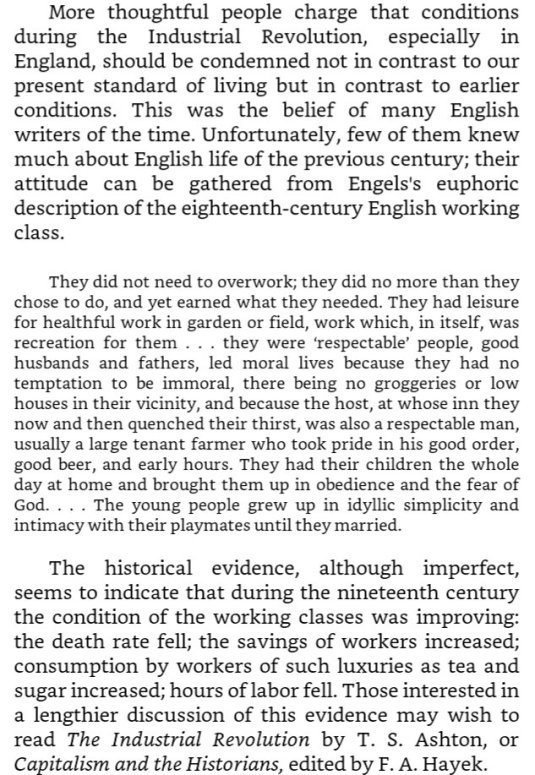
The title is in contrast to the Engels quote, which would make Engels appear to be in the camp of Romantics who opposed the developing capitalist order. Completely false. Whatever about the suffering imposed by the Industrial Revolution, Marx and Engels were all for it. Nowhere has capitalism been praised more than in the Communist Manifesto. They had no time for the Romantic notion of an unspoiled peasantry. Here is Engels:
“In short, the English industrial workers of those days lived and thought after the fashion still to be found here and there in Germany, in retirement and seclusion, without mental activity and without violent fluctuations in their position in life. They could rarely read and far more rarely write; went regularly to church, never talked politics, never conspired, never thought, delighted in physical exercises, listened with inherited reverence when the Bible was read, and were, in their unquestioning humility, exceedingly well-disposed towards the “superior” classes. But intellectually, they were dead; lived only for their petty, private interest, for their looms and gardens, and knew nothing of the mighty movement which, beyond their horizon, was sweeping through mankind. They were comfortable in their silent vegetation, and but for the industrial revolution they would never have emerged from this existence, which, cosily romantic as it was, was nevertheless not worthy of human beings. In truth, they were not human beings; they were merely toiling machines in the service of the few aristocrats who had guided history down to that time. The industrial revolution has simply carried this out to its logical end by making the workers machines pure and simple, taking from them the last trace of independent activity, and so forcing them to think and demand a position worthy of men.”
[Source:https://www.marxists.org/archive/marx/works/1845/condition-working-class/ch02.htm%5D
LikeLiked by 1 person