Review of “Ted Kennedy: A Life” by John A. Farrell
14 Nov 2022 Leave a comment

 Ted Kennedy: A Life
by John A. Farrell
752 pages
Penguin Press
Published: Oct 2022
“Ted Kennedy: A Life” is John Farrell’s just-released biography of the youngest son of Joseph P. Kennedy. Farrell is a former correspondent for The Boston Globe who has written biographies of Tip O’Neill and Richard Nixon (a Pulitzer Prize finalist and my favorite biography of Nixon among the twelve I read during my journey through the best presidential biographies).
Edward Kennedy (1932-2009) was the youngest of nine children and presumed to be the least likely of the four sons to achieve success or sustain the Kennedy brand. Although famously flawed, Ted was elected to the US Senate at the age of 30 and spent the next forty-seven years mastering its intricacies and advocating for social justice. He was the third longest-serving US senator in American history.
Like Farrell’s biographies of O’Neill and Nixon…
View original post 409 more words
Coastal dwellers not being warned of rising sea level risk and property prices skewed, says nutty professor
14 Nov 2022 Leave a comment
Reviewing monetary policy
14 Nov 2022 Leave a comment

Way back in 1990 Parliament formally handed over the general responsibility for implementing monetary policy to the Reserve Bank. The government has always had the lead in setting the objectives the Bank is required to work to, and has the power to hire and fire if the Bank doesn’t do its job adequately, but a great deal of discretion has rested with the Bank. With power is supposed to come responsibility, transparency, and accountability.
And every so often in the intervening period there have been reviews. The Bank has itself done several over the years, looking (roughly speaking) at each past business cycle and, distinctly, what role monetary policy has played. These have generally been published as articles in the Bank’s Bulletin. When I looked back, I even found Adrian Orr’s name on one of the policy review articles and mine on another. It was a good initiative by…
View original post 2,264 more words
Earth-sun distance dramatically alters seasons in the equatorial Pacific in a 22,000-year cycle
13 Nov 2022 Leave a comment

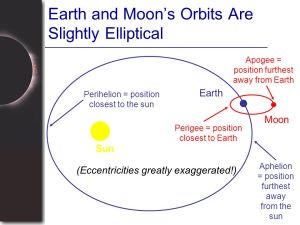 Apogee = position furthest away from Earth. Earth. Perihelion = position closest to the sun. Moon. Perigee = position closest to Earth. Sun. Aphelion = position furthest away from the sun. (Eccentricities greatly exaggerated!)
Planetary cycles affecting climate. The study title: ‘Two annual cycles of the Pacific cold tongue under orbital precession’. Some real climate change theory to ponder.
– – –
Weather and climate modelers understand pretty well how seasonal winds and ocean currents affect El Niño patterns in the eastern equatorial Pacific Ocean, impacting weather across the United States and sometimes worldwide, says Robert Sanders, University of California – Berkeley (via Phys.org).
But new computer simulations show that one driver of annual weather cycles in that region—in particular, a cold tongue of surface waters stretching westward along the equator from the coast of South America—has gone unrecognized: the changing distance between Earth and the sun.
The cold…
View original post 398 more words
Solar farm business goes under after borrowing £655million from local council
13 Nov 2022 Leave a comment

The UK electricity system’s so-called transition to renewables hits yet another bump in the road. The dream of guaranteed income was just an expensive illusion.
– – –
One of the country’s largest solar farm owners has entered administration amid the fallout from a scandal that forced an Essex council leader to resign, reports The Guardian.
Administrators at Interpath Advisory have been appointed to Toucan Energy Holdings, which owns a portfolio of 53 solar parks with a combined capacity of 513 megawatts across England, Wales and Northern Ireland.
A recent investigation by the Bureau of Investigative Journalism found that Thurrock council in Essex, Toucan’s main creditor, borrowed hundreds of millions of pounds to invest in the solar farm scheme run by globetrotting financier Liam Kavanagh.
View original post 153 more words
High-Speed Rail Doesn’t Depend on Megaregions
13 Nov 2022 Leave a comment

On my Discord channel, I was reminded of the late-2000s work by some institutional American urbanists about the concept of megaregions. Wikipedia has a good summary of the late-2000s discourse on the subject. In short, there are linear ties across the East Coast from Boston to Washington (“BosWash”), with more or less continuous suburban development in between, and some urbanists tried to generalize this concept to other agglomerations of metropolitan areas, not usually successfully. The American work on this carved most of the country’s population into 10 or 11 megaregions, sometimes annexing portions of Canada, as in the Regional Plan Association’s America 2050 program:

There is a lot to critique about this map. Canada has a strong self-conception as a distinct entity from the United States; while there’s a case for lumping Vancouver with Seattle and Portland as the Pacific Northwest, lumping Toronto with the Midwest is irresponsible…
View original post 694 more words


Want Cheap & Reliable Power? Then Stop Voting for Deluded RE Obsessed Lunatics
12 Nov 2022 Leave a comment


Voters get the governments are to serve, so it’s said, which means that sympathy for their current energy woes runs thin. Voters who walked into a booth thinking they would save the planet by backing candidates and parties who promised to go all in on the grand wind and solar ‘transition’, might be suffering a little buyer’s remorse, right now. Particularly as they struggle to pay power and gas bills that have shot into orbit, and particularly so the next time they’re boiling (or freezing) in the dark, when the sun sets and/or calm weather sets in and there aren’t enough coal-fired plants left to meet their immediate power needs.
Sooner or later, we all sit down to a banquet of consequences.
As Stuart Ballantyne outlines below, if voters keep ticking the box in favour of deluded lunatics who are hellbent on destroying Western civilisation from within (see above), they…
View original post 572 more words
A five-minute conversation with the average voter….
12 Nov 2022 Leave a comment

… is the best argument against democracy.”
So, it is often claimed, did Winston Churchill pronounce upon our system of government – his system of government – as one of his famous quotes.
Except it’s not.
As the International Churchill Society points out on their wonderful website with Red Herrings: Famous Quotes Churchill Never Said:
No attribution. Though he sometimes despaired of democracy’s slowness to act for its preservation, Churchill had a more positive attitude towards the average voter.
I often find myself in need of such positive attitudes when looking at the state of politics in this country and across the Western world, particularly in the wake of the results of the US Mid-term elections.
No, I do not say that because the GOP did less well than they should have, or because they lost some key races. I’m not a doppelgänger for the shrieking hysterics of the…
View original post 767 more words
ABYSS: THE CUBAN MISSILE CRISIS by Max Hastings
12 Nov 2022 Leave a comment

![June 3, 1961: Soviet Premier Nikita Khrushchev, left, and U.S. President John F. Kennedy sit in the residence of the U.S. ambassador in Vienna, Austria, at the start of their historic talks. [AP/Wide World Photo]](https://2009-2017.state.gov/cms_images/7khruschev_kennedy1_600.jpg)
(Soviet Premier Nikita Khrushchev and President John F. Kennedy)
Vladimir Putin’s ill-advised invasion of Ukraine last February has not produced the results that he expected. As the battlefield situation has degenerated for Russian army due to the commitment of the Ukrainian people and its armed forces, along with western assistance the Kremlin has resorted to bombastic statements from the Russian autocrat concerning the use of nuclear weapons. At this time there is no evidence by American intelligence that Moscow is preparing for that eventuality, however, we have learned the last few days that Russian commanders have discussed the possible use of tactical nuclear weapons. The conflict seems to produce new enhanced rhetoric on a daily basis, and the world finds itself facing a situation not seen since the Cuban Missile Crisis of October 1962 amidst the Cold War.

(A map of Cuba annotated by former U.S. President John F. Kennedy…
View original post 1,877 more words
Economic management in years gone by
12 Nov 2022 Leave a comment
Last week I reread Victoria University historian Jim McAloon’s history of New Zealand economic policymaking from 1945 to 1984, Judgements of all Kinds, first published a decade or so ago. Good works of economic history, let alone of the history of economic policymaking, aren’t thick on the ground in New Zealand, and as McAloon himself notes in a journal article published a year or two later:
“Economic history has a relatively low profile in New Zealand. Few economics programmes offer much in the way of economic history, and none of them offer courses in New Zealand economic history. Very few academics in New Zealand economics programmes publish in economic history. Victoria University, once boasting the only New Zealand chair in economic history,
has largely abandoned the field.”
(Actually, when I was at Victoria in the early 80s – and not wise enough myself to have done much economic history…
View original post 4,664 more words


Recent Comments