Reality Check: Europe’s ‘Inevitable’ Wind & Solar Transition Unwinds In Ukraine

stopthesethings's avatarSTOP THESE THINGS

That the West has become weak and silly, is best exemplified by its concerted efforts to wreck hitherto reliable and affordable energy supplies. While policy wonks will argue forever about the precise casus belli for Putin’s attack on Ukraine, it is unarguable that Europe’s insatiable demand for Russian oil and gas has allowed Putin to hold wind and solar obsessed Europe to ransom. His swagger and belligerence rests on the confidence that, without Russian oil and gas, Europe would grind to a halt, very quickly.

Hence, he has little to fear from Germany entering the fray; all he needs do is turn off the tap and he will cripple Germany, within a week.

Not so long ago, the Germans had an enviable fleet of coal-fired and nuclear power plants, which provided them with abundant electricity, whatever the weather. Not so, now.

Michael Shellenberger explains how its self-inflicted renewable energy disaster…

View original post 959 more words

The Failure of Bidenomics, Part IV

Dan Mitchell's avatarInternational Liberty

As part of my ongoing efforts to show that free enterprise produces better results than statism, I often use data on per-capita economic output – especially when comparing nations over long periods of time.

And I’ll sometimes build upon those numbers by comparing consumption levels in different nations.

But what if we’re looking at one country rather than several nations?

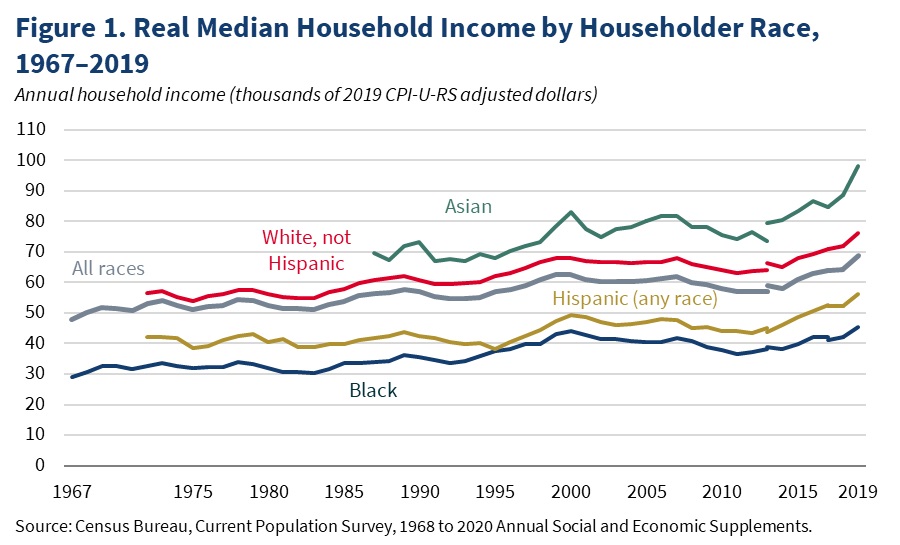
In the case of the United States, it is useful to peruse data on GDP and consumption, but I’m also a big fan of using the Census Bureau’s data on inflation-adjusted median household income (though even this data isn’t perfect because household sizes are declining over time).

These numbers allow us to gauge, over multi-year periods, whether government policies are making life better for average families. Or whether they are producing stagnation.

But what if we don’t have several years of data?

That’s a very relevant question…

View original post 494 more words

Elasticity of Substitution or Why Simple Tools Teach Us Tons

Vincent Geloso's avatarEconomist Writing Every Day

I enjoy simple methods in economics. For economic history, which is my field of specialization, its often by constraint that I have to use them. Because of that, one has to be creative. In the process, however, one spots how well-used simple methods can be more powerful (both in terms of pedagogy and explanatory uses) than more advanced methods. Let me show you an example from Canadian history: the fur trade industry.

Yes, Canada’s mighty beaver! Generally known for its industriousness, the beaver has been mostly appreciated for its pelt which was the main export staple from Canada during the 17th and 18th centuries. In fact, if one is pressed to state what they think of when they think about Canada, fur pelts come in the top 10 (if not the top 5). It is thus unsurprising that there are hundreds of books on the business history of the fur…

View original post 1,028 more words

Not being entirely straightforward

Michael Reddell's avatarcroaking cassandra

No posts last week between some mix of the war news (including related economics and financial markets news) being more interesting, and Covid – in our house that is. Not being too sick, but not being entirely well either I wasn’t concentrating very hard for very long. Fortunately, the isolation is now half over and no one’s health is particularly concerning. So back to some domestic economics and policy.

The leader of the National Party yesterday gave what he billed as a “State of the Nation” speech. You can read it all here. It was, however, largely a tax speech. And – and I say this as someone who would really really like to be able to vote for National – it was pretty disappointing.

It wasn’t that I disagreed with any of the tax ideas – none of them very radical anyway. So when he committed to repealing…

View original post 1,529 more words

The House of Windsor: Edward VIII (1936)

Great Books Guy's avatarGreat Books Guy

Hopeless romantic? Or selfishly indulgent bon vivant? Controversial in the highest degree, Edward VIII is the only King of England to have ever willingly abdicated the throne. He also holds the record for being the shortest reigning British monarch (less than one year). Born Edward Albert Christian George Andrew Patrick David, the future king grew up with the nickname “David.” During his early lifetime, he was a popular man. He was raised by a cohort of nannies and occasionally by his priggish yet distant parents. Prince Edward served in the Navy and also in the army during World War I (however he was forbidden from actually engaging in combat). Intellectually, he was an underwhelming specimen –he attended Oxford for a spell but left without any academic qualifications.

During the reign of his father (George V), Prince Edward traveled the world where he quickly developed a reputation as a dashing…

View original post 983 more words

Goodfellas: Tommy Gets “Made”

The Failure of Bidenomics, Part III

Dan Mitchell's avatarInternational Liberty

In Part I of this series, I pointed out that Biden’s plethora of proposed handouts and subsidies would lead to higher prices and more inefficiency. And in Part II, I explained that his discussion of inflation was embarrassingly inaccurate.

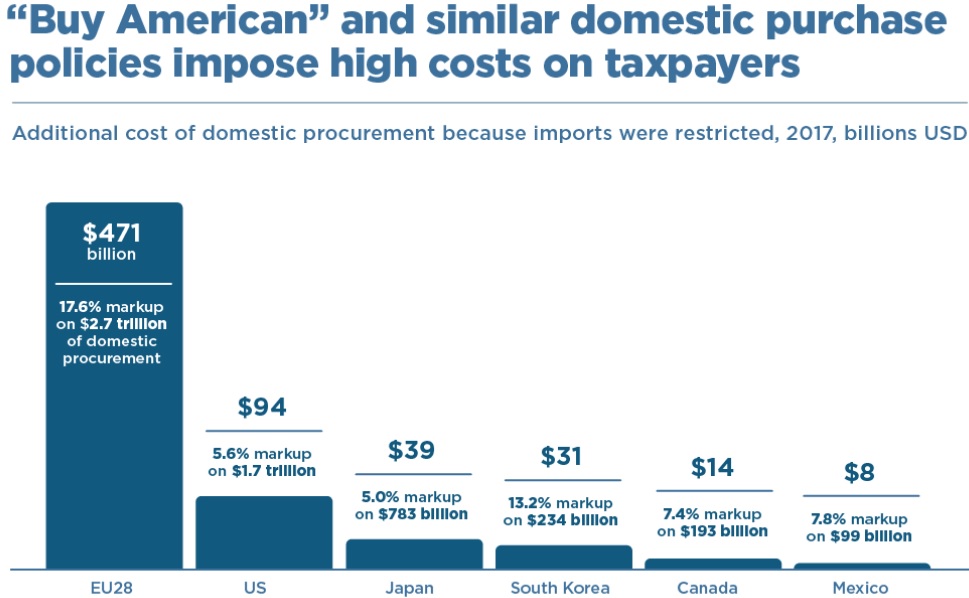
In today’s column, we’re going to analyze his strident support for protectionist “Buy America” provisions, which drive up costs for taxpayers by making it harder for foreign firms to compete for government contracts and thus give American firms the ability to charge higher prices.

How much of a burden are these policies? How much more are taxpayers having to pay because governments can’t opt for the lowest qualified bidder?

According to research shared by the Peterson Institute for International Economics (PIIE), American taxpayers lose $94 billion per year.

The good news (if we have a very generous definition of “good”) is that procurement protectionism “only” pushes up costs in the United…

View original post 657 more words

Net Zero To Cost £50 Billion a Year

The Failure of Bidenomics, Part I

Dan Mitchell's avatarInternational Liberty

Joe Biden’s economic policy has been a disaster.

  • He’s bad on the issues where Trump wasbad (spending and trade).
  • He’s bad on the issues where Trump was good (most notably, taxes).
  • And he’s bad on the issues where Trump had a mixedrecord (regulation).

Based on his track record as a long-time Senator, none of this is a surprise. According to vote ratings from the Club for Growth and National Taxpayers Union, Biden was to the left of even Crazy Bernie.

Unfortunately, a bad president (anyone remember Nixon?) can do a lot more damage than a bad senator.

Today is Part I of a series of columns analyzing Biden’s failure.

We’ll start with his so-called Build Back Better plan. Joe Biden didn’t explicitly mention “BBB” is his State of the Union address, but he did promote almost all of the specific policies that are in that…

View original post 212 more words

Seinfeld–Newman interrogates Jerry–Mail fraud

Sanctions

Completely Clueless: How Idiots Hijacked Our Reliable & Affordable Energy Supplies

stopthesethings's avatarSTOP THESE THINGS

Death and taxes are guaranteed, so are rocketing power prices and power rationing once intermittent wind and solar are added to the grid.

Duplicating capital costs to destabilise and undermine a generating system that works, with one that only ‘works’ when the wind is blowing just right and the sun is shining in a cloudless sky, is just the beginning.

As a matter of mathematical certainty every single MW of wind or solar generating capacity has to be backed up with a MW of instantly dispatchable generating capacity from coal, gas, nuclear or (where available) hydro.

The cultists would add giant lithium batteries to that list. But batteries do not generate electricity, they store it and waste 20-30% of the energy that goes in in the transfer process. The cost is colossal; the amount of power stored and released is trivial, which is why mega-batteries are used at the margins…

View original post 955 more words

Presentation on free trade (with a dash of Brexit)

julianhjessop's avatarPlain-speaking Economics

Here are the slides from a talk I gave this week to A-level students of economics and politics…

View original post

Female Dukes

Stuart Handley's avatarThe History of Parliament

In the latest post for the Georgian Lords, Dr Stuart Handley considers the cases of peerages held by women in the 18th century, and the way in which they were able to exercise political influence even though denied a seat in Parliament.

In a note on page 4 of his biography of Winston Churchill, published in 2001, Roy Jenkins allows himself a somewhat waspish comment about the 7th duke of Marlborough being described as the 6th duke, when clearly he was not. However, such numbering was not unusual and is explicable because the second duke was in fact a duchess.

Henrietta, countess of Godolphin & duchess of Marlborough, print by Francis Kyte, aft. Sir Godfrey Kneller, (c) Trustees of the British Museum

John Churchill was made duke of Marlborough in December 1702. However, his only son, also John, died in February 1703. In 1706 an Act of Parliament was passed…

View original post 695 more words

Pielke Jr.: The IPCC goes all-in with implausible scenarios and political activism

oldbrew's avatarTallbloke's Talkshop

Credit: BBC
Using far-fetched worst-case scenarios, the IPCC has become a cheerleader for emissions reductions. Propaganda has overtaken real science in a big way.
– – –
The Intergovernmental Panel on Climate Change (IPCC) is an important organization with a primary purpose to assess the scientific literature on climate in order to inform policy, says Roger Pielke Jr. @ Climate Change Dispatch.

The IPCC spans the physical sciences, impacts, adaptation and vulnerability, and economics.

I have often stated that the IPCC is so important that if it did not exist we’d need to invent it because the challenge of climate change presents significant risks.

View original post 370 more words

Previous Older Entries Next Newer Entries

The War on Prices

Celebrating humanity's flourishing through the spread of capitalism and the rule of law

The Bleeding Heart Libertarian

Celebrating humanity's flourishing through the spread of capitalism and the rule of law

More Stories from the Stories I Publish!

Celebrating humanity's flourishing through the spread of capitalism and the rule of law

In My Tribe

Celebrating humanity's flourishing through the spread of capitalism and the rule of law

Coordination Problem

Celebrating humanity's flourishing through the spread of capitalism and the rule of law

Libertarian Land

Celebrating humanity's flourishing through the spread of capitalism and the rule of law

Arin’s Substack

Celebrating humanity's flourishing through the spread of capitalism and the rule of law

David Andolfatto

Celebrating humanity's flourishing through the spread of capitalism and the rule of law

Monetary Non-Neutrality

Celebrating humanity's flourishing through the spread of capitalism and the rule of law

Reason Magazine

Celebrating humanity's flourishing through the spread of capitalism and the rule of law

Coyote Blog

Celebrating humanity's flourishing through the spread of capitalism and the rule of law

Thoughts from the North

Celebrating humanity's flourishing through the spread of capitalism and the rule of law

Fardels Bear

A History of the Alt-Right

Vincent Geloso

Econ Prof at George Mason University, Economic Historian, Québécois

Bassett, Brash & Hide

Celebrating humanity's flourishing through the spread of capitalism and the rule of law

Truth on the Market

Scholarly commentary on law, economics, and more

The Undercover Historian

Beatrice Cherrier's blog

Matua Kahurangi

Celebrating humanity's flourishing through the spread of capitalism and the rule of law

Temple of Sociology

Celebrating humanity's flourishing through the spread of capitalism and the rule of law

Velvet Glove, Iron Fist

Celebrating humanity's flourishing through the spread of capitalism and the rule of law

Why Evolution Is True

Why Evolution is True is a blog written by Jerry Coyne, centered on evolution and biology but also dealing with diverse topics like politics, culture, and cats.

NoTricksZone

Celebrating humanity's flourishing through the spread of capitalism and the rule of law

Homepaddock

A rural perspective with a blue tint by Ele Ludemann

Kiwiblog

DPF's Kiwiblog - Fomenting Happy Mischief since 2003

The Dangerous Economist

Celebrating humanity's flourishing through the spread of capitalism and the rule of law

Watts Up With That?

The world's most viewed site on global warming and climate change

The Logical Place

Tim Harding's writings on rationality, informal logic and skepticism

Doc's Books

A window into Doc Freiberger's library

The Risk-Monger

Let's examine hard decisions!

Uneasy Money

Commentary on monetary policy in the spirit of R. G. Hawtrey

Barrie Saunders

Thoughts on public policy and the media

Liberty Scott

Celebrating humanity's flourishing through the spread of capitalism and the rule of law

Point of Order

Politics and the economy

James Bowden's Blog

A blog (primarily) on Canadian and Commonwealth political history and institutions

Science Matters

Reading between the lines, and underneath the hype.

Peter Winsley

Economics, and such stuff as dreams are made on

A Venerable Puzzle

"The British constitution has always been puzzling, and always will be." --Queen Elizabeth II

The Antiplanner

Celebrating humanity's flourishing through the spread of capitalism and the rule of law

Bet On It

Celebrating humanity's flourishing through the spread of capitalism and the rule of law

History of Sorts

WORLD WAR II, MUSIC, HISTORY, HOLOCAUST

Roger Pielke Jr.

Undisciplined scholar, recovering academic

Offsetting Behaviour

Celebrating humanity's flourishing through the spread of capitalism and the rule of law

JONATHAN TURLEY

Res ipsa loquitur - The thing itself speaks

Conversable Economist

In Hume’s spirit, I will attempt to serve as an ambassador from my world of economics, and help in “finding topics of conversation fit for the entertainment of rational creatures.”

The Victorian Commons

Researching the House of Commons, 1832-1868

Books & Boots

Reflections on books and art