Abdication of the German Monarchies. Part I
12 Nov 2021 Leave a comment

The Armistice ending World War I was agreed upon at 5:00 a.m. on November 11, 1918, to come into effect at 11:00 a.m. Paris time (noon German time), for which reason the occasion is sometimes referred to as “the eleventh hour of the eleventh day of the eleventh month”.
The German Empire consisted of 26 states, each with their own nobility, four constituent kingdoms, six grand duchies, five duchies (six before 1876), seven principalities, three free Hanseatic cities, and one imperial territory. While Prussia was one of four kingdoms in the realm, it contained about two-thirds of Empire’s population and territory, and Prussian dominance had also been constitutionally established, since the King of Prussia was also the German Emperor (German: Kaiser)
In this post I will give a brief summary of the abdications of the German monarchs at the end of the war. Today I will mention the four kingdoms…
View original post 1,080 more words


Infrastructure multipliers: Valerie A. Ramey
11 Nov 2021 Leave a comment
in applied price theory, applied welfare economics, budget deficits, business cycles, defence economics, econometerics, economic growth, economic history, financial economics, fiscal policy, history of economic thought, labour economics, labour supply, macroeconomics, monetary economics Tags: Keynesian macroeconomics, new classical macroeconomics, New Keynesian macroeconomics
RBNZ will be feeling the heat as critics assail its focus on climate change – and mention bank research to buttress their stance
10 Nov 2021 Leave a comment

That whistling sound out of Wellington has come from the Establishment as it witnesses a powerful attack on the Reserve Bank.
One volley has been fired by senior economist Matt Burgess in a research note for the Wellington-based think-tank, the NZ Initiative. In Climate of fear: How the Reserve Bank is overstepping its mandate, he documents what he maintains are serious breaches of the RBNZ’s responsibilities as regulator of the financial system, including one instance of misconduct, as it becomes unduly preoccupied with climate change.
A second volley was fired by the NZ Initiative’s chief economist, Eric Crampton, in an article posted by Newsroom. He raises questions about the RBNZ’s independence from political interference.
A third has been fired by an experienced business journalist, Jenny Ruth, in an article for Business Desk. She has questioned the bank governor’s credibility.
All three refer to the RBNZ’s recent Climate Changed
View original post 977 more words
Charles I Jones | The past and future of economic growth: a semi-endogenous perspective
10 Nov 2021 Leave a comment
in applied price theory, applied welfare economics, development economics, economic growth, economic history, economics of education, entrepreneurship, fiscal policy, human capital, labour economics, labour supply, macroeconomics, population economics Tags: endogeneous growth theory
Productivity Commission at sea
10 Nov 2021 Leave a comment

Were I writing yesterday’s post now I would word some things differently. Yesterday afternoon the Productivity Commission drew my attention to their supplementary paper called “The wider wellbeing effects of immigration” which – despite the title – turns out to be mainly about core economic dimensions of the issue, including a substantive discussion of some of the macroeconomic arguments I have been making. Strangely, there had been no cross-referencing to this document in the parts of the body of the main report where, as discussed yesterday, these issues were briefly discussed. I had seen an earlier draft of the macroeconomic bit of this supplementary paper and had provided some comments on it to the Commission.
Awareness of that supplementary paper does not change my main concern about the overall draft report. There is still little or no compelling analysis or insight on any of wider economic issues, no arguments or…
View original post 1,413 more words
Anarchast Ep. 231 David Friedman: The Machinery of Freedom!
10 Nov 2021 Leave a comment
in applied price theory, applied welfare economics, comparative institutional analysis, constitutional political economy, David Friedman, defence economics, economics of crime, law and economics, property rights
Debate: Abolish Banking Insurance?
10 Nov 2021 Leave a comment
in applied price theory, applied welfare economics, business cycles, economic history, economics of bureaucracy, financial economics, great depression, Ludwig von Mises, monetary economics, Public Choice Tags: deposit insurance, moral hazard
Nixon quits–36 years on
10 Nov 2021 Leave a comment

Richard Nixon resigned the presidency 36 years ago today–the only American president to have done so.
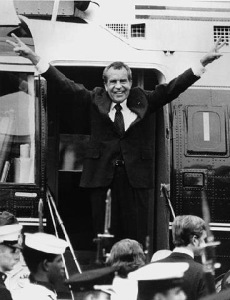
He left the White House on August 9, 1974, to avoid certain impeachment and conviction. By then it had become clear that Nixon had ordered senior aides to cover up the Watergate scandal’s signal crime, the burglary in June 1972 at Democratic national headquarters.
As I write in Getting It Wrong, my new book about media-driven myths, forcing Nixon’s resignation “required the collective if not always the coordinated forces of special prosecutors, federal judges, both houses of Congress, the Supreme Court, as well as the Justice Department and the FBI.”
But in the years since 1974, the dominant popular narrative of the Watergate scandal has become the heroic-journalist meme, the widely held notion that the investigative reporting of two young, tireless reporters for the Washington Postled the way in bringing down
View original post 550 more words
November 9, 1841: Birth of King Edward VII of the United Kingdom. Part I
10 Nov 2021 Leave a comment
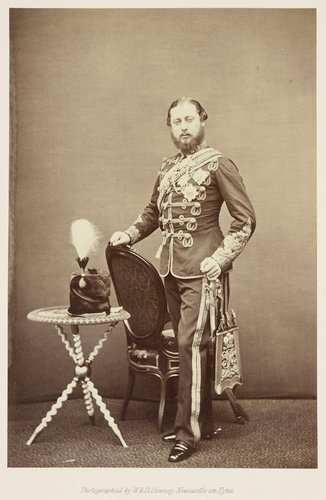
Edward VII (Albert Edward; November 9, 1841 – May 6, 1910) was King of the United Kingdom of Great Britain and Ireland and the British Dominions, and Emperor of India from January 22, 1901 until his death in 1910.
Edward was born at 10:48 in the morning on November 9, 1841 in Buckingham Palace. He was the eldest son and second child of Queen Victoria of the United Kingdom and her husband, Prince Albert of Saxe-Coburg and Gotha. He was christened Albert Edward at St George’s Chapel, Windsor Castle, on January 25, 1842.
He was named Albert after his father and Edward after his maternal grandfather, Prince Edward, Duke of Kent and Strathearn. He was known as Bertie to the royal family throughout his life. He was related to royalty throughout Europe.
 As the eldest son of the British sovereign, he was automatically Duke of Cornwall and Duke of Rothesay…
View original post 679 more words


Recent Comments