David Friedman
27 Oct 2021 Leave a comment
in applied price theory, applied welfare economics, comparative institutional analysis, constitutional political economy, David Friedman, economics of crime, financial economics, law and economics, property rights
Lecture 5: Firm-level misallocation: benchmark model and early results
27 Oct 2021 Leave a comment
in applied price theory, applied welfare economics, comparative institutional analysis, development economics, economic growth, economic history, entrepreneurship, growth disasters, growth miracles, human capital, industrial organisation, labour economics, labour supply, macroeconomics, occupational choice, survivor principle
How intangible capital may explain rising labour productivity during recessions
26 Oct 2021 Leave a comment
in applied price theory, business cycles, economic growth, economic history, Edward Prescott, entrepreneurship, financial economics, global financial crisis (GFC), great recession, macroeconomics, monetary economics
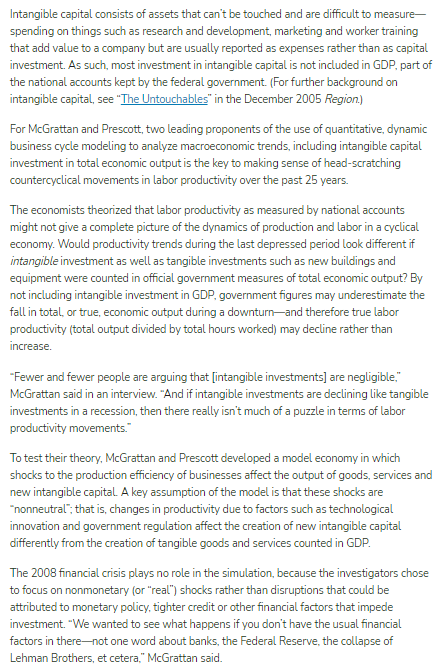
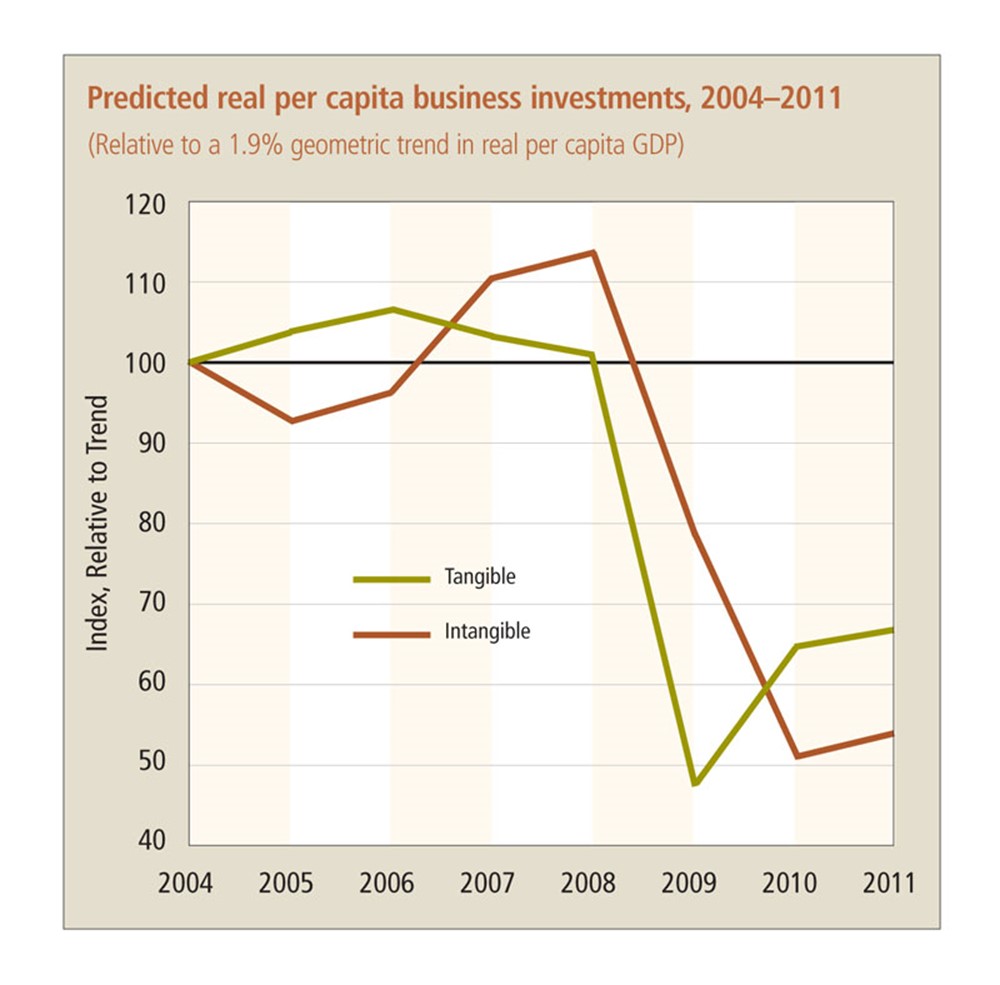
“The sharp drop in intangible investment contributes to a decline in actual economic output greater than that measured by official government GDP accounts. This implies that in the actual U.S. economy, true labor productivity declined significantly during the recent recession—a finding consistent with established aggregate theory based on the neoclassical model of economic growth. Thus, McGrattan and Prescott’s experiment solves the labor productivity puzzle by reconciling the apparent mismatch between theory and economic data that show labor productivity bucking the GDP trend. “The addition of intangible capital and non- neutral technology to the model was crucial in accounting for high productivity and low GDP during the period,” they write.”
From https://www.minneapolisfed.org/article/2012/unmeasured-investment
Massive losses, for nothing
26 Oct 2021 Leave a comment

All sorts of items of public spending have attracted attention since March 2020 when the Covid-related spending really began. Some of the things money has been spent on – the wage subsidy for example – were large but necessary and appropriate. Some things, often quite small in scale, were pure waste. Others were dressed up under a Covid label but were really just poor-quality (but quite large scale) spending.
One of the items that has had almost no attention is the huge losses that have resulted from the Reserve Bank’s Large Scale Asset Purchase (LSAP) programme. I guess it is a bit harder to report, since neither the Bank nor the government puts out press releases boasting of losing $4bn or so.
The government has, with no parliamentary authorisation or scrutiny, agreed to idemnify the Reserve Bank for any losses it incurs on the LSAP. That, at least, has the…
View original post 2,552 more words
YOU WANNA KNOW THE TRUTH, Nah didn’t think so.
26 Oct 2021 Leave a comment

If the bunch of special needs people assembling at Gleneagles resort for the latest extravaganza for those luminaries who have their snouts well submerged in the swill trough in the name of Climate are so far up their own back passages, no information can reach through their egotistical hypocrisy. You think that is an OTT statement, dwell for one moment on the almost unbelievable moras that surrounds their transport provision for the seventy five Km journey from the airport to their swill trough in the luxury surrounds where another pointless exercise in insanity played out at the after match of the 1977 Commonwealth Heads meeting to solve the ending of apartheid in The Republic of South Africa.
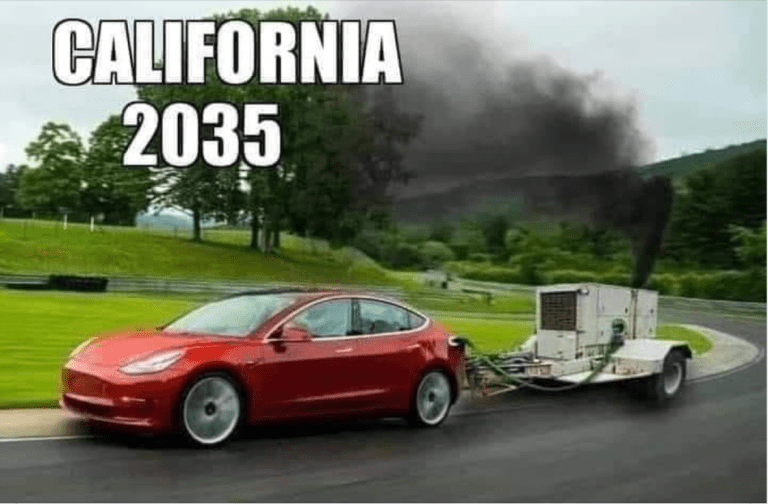
A fleet of Teslas have been purchased to ferry the elites for this latest waste of money but alas there is only one single charging station for those particular vehicles…
View original post 61 more words

How the Labor Market Adjusts to Technological Shocks (Lessons from Hoover Boot Camp) | Ch 3
26 Oct 2021 Leave a comment
in applied price theory, economic growth, economic history, economics of education, economics of regulation, entrepreneurship, health and safety, history of economic thought, human capital, industrial organisation, labour economics, labour supply, market efficiency, minimum wage, occupational choice, occupational regulation, personnel economics, poverty and inequality, survivor principle, unemployment
Daron Acemoglu on How Inequality Weakens Nations
26 Oct 2021 Leave a comment
in applied price theory, constitutional political economy, development economics, economic growth, economic history, economics of bureaucracy, economics of education, economics of regulation, entrepreneurship, financial economics, growth disasters, growth miracles, history of economic thought, human capital, income redistribution, industrial organisation, labour economics, labour supply, law and economics, macroeconomics, poverty and inequality, property rights, Public Choice, rentseeking, survivor principle
Lee Ohanian on Sweden’s Experiment with Socialism
26 Oct 2021 Leave a comment
in applied price theory, applied welfare economics, comparative institutional analysis, constitutional political economy, economic history, economics of education, economics of regulation, entrepreneurship, history of economic thought, human capital, income redistribution, industrial organisation, labour economics, labour supply, law and economics, liberalism, Marxist economics, poverty and inequality, property rights, Public Choice, survivor principle Tags: Sweden
Backing Net-Zero Emissions & Not Backing Nuclear Power Generation: You Can’t Be Serious
25 Oct 2021 Leave a comment


The anti-capitalist, anti-progress, anti-human climate zealot reveals himself by backing net-zero emissions while rejecting nuclear power generation.
The crony capitalist pursuing a net-zero target is, of course, easy to spot; with him, it’s a case of follow the money. Whip up the fear and imminent climate catastrophe and then point to the only ‘solution’ on offer in rent-seeker town: wind and solar power, only made possible by massive and endless subsidies, that naturally fuel his interest in ‘saving the planet’.
The crony capitalist will merrily line his pockets while depriving the Third World and the working poor in his own country of reliable and affordable electricity, and the jobs and prosperity it brings. His motive is simply greed and profit. Think Al Gore and his buddies.
The climate zealot does it because he has a burning antipathy towards all humans to do not share his doomsday-is-nigh sense of pessimism.
View original post 2,316 more words
Minimum wages kill opportunity
25 Oct 2021 Leave a comment
in applied price theory, income redistribution, industrial organisation, labour economics, minimum wage, personnel economics, Public Choice, rentseeking, survivor principle, unemployment
Have You Seen The Guardian’s Climate Disaster? It Appears To Have Gone Missing!
25 Oct 2021 Leave a comment
Biden’s Befuddlement on Corporate Taxation
25 Oct 2021 Leave a comment

Let’s look today at the wonky issue of “book income” because it’s an opportunity to point out that there are three types of leftists.
- Honest leftists who understand economics and recognize tradeoffs (I think of them as “Okunites“).
- Dishonest leftists who understand economics but pretend that tradeoffs don’t exist (the “demagogues“).
- Leftists who have no idea what they’re saying or thinking (I think of them as, well, Joe Biden).
I’m being snarky about the President because of this recent tweet, which contains a couple of big, glaring mistakes.
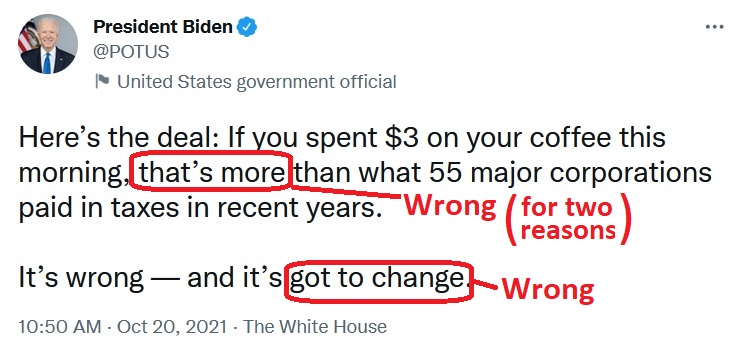
What are the mistakes (I’m not calling them lies because I don’t think Biden has the slightest idea that he is wrong, much less why he’s wrong).
- The first mistake is that corporations pay a lot of tax (payroll tax, property tax, etc) even if they are losing money and don’t owe any corporate income…
View original post 569 more words


Recent Comments