Alan Manning: “Monopsony and the wage effects of migration”
08 Oct 2021 Leave a comment
in applied price theory, applied welfare economics, economics of education, human capital, international economics, labour economics, labour supply Tags: economics of migration, monopsony
Stern Review on the Economics of Climate Change: William Nordhaus
08 Oct 2021 Leave a comment
in applied price theory, applied welfare economics, energy economics, environmental economics, financial economics, global warming Tags: carbon tax, carbon trading
Innovation and Growth Cycles
08 Oct 2021 Leave a comment
in applied price theory, business cycles, economic growth, economic history, financial economics, industrial organisation, labour economics, labour supply, macroeconomics, monetary economics, survivor principle, unemployment Tags: creative destruction, real business cycles
Essential Coase: The Lighthouse in Economics
08 Oct 2021 Leave a comment
in applied price theory, applied welfare economics, comparative institutional analysis, economic history, economics of bureaucracy, history of economic thought, law and economics, property rights, Public Choice, Ronald Coase
In The Footsteps of Mr Kurz by Michela Wrong (2000)
07 Oct 2021 Leave a comment

Comparing Michela Wrong and David van Reybrouck
David van Reybrouck’s account of Congo’s modern history is basically an orthodox chronological account and political analysis interspersed with interviews with the many veterans and eye witnesses he has tracked down and spoken with at length.
Wrong’s account feels completely different, less chronological or, indeed, logical, more thematic. Instead of historical analysis, she brilliantly conveys what it felt like to live in Zaire under Mobutu as she sets about systematically exploring and describing different aspects of Zaire society and culture. Her vividness of approach is demonstrated by the way the book opens with the fall of Mobutu in 1997, going light on political analysis and strong on vivid descriptions of what it felt like to live in a crumbling, corrupt third world country.
Chapter one dwells on the role played in so many African states by key international hotels in their capitals, in…
View original post 7,029 more words

RES-GES Webinar: Racial Inequality Glenn Loury
06 Oct 2021 Leave a comment
in applied price theory, discrimination, economic history, economics of crime, economics of education, history of economic thought, human capital, labour economics, labour supply, law and economics, occupational choice, poverty and inequality, welfare reform Tags: racial discrimination
Traffic
06 Oct 2021 Leave a comment

Traffic (2000) Director: Steven Soderbergh

★★★☆☆
Based on a 1989 British television show called Traffik, a masterpiece theater series that tracked the movement of heroin from Turkish fields to the streets of Europe, Steven Soderbergh’s 2000 film Traffic explores the global dilemma of the international drug trade as it affects various people inside and outside the United States. The unique cinematography and editing in Traffic shows a remarkably bipolar world: the color tint in Mexico is yellow to convey a dusty desert akin to the wild west, whereas in the United States scenes are color-tinted blue to indicate cold, sterile, hopeless environs. Scenes in Mexico are portrayed as lawless and dangerous, whereas scenes in the U.S. are portrayed as calloused and unforgiving. Soderbergh won an Academy Award for Best Director for Traffic, and the film itself was nominated for Best Picture.
In the film we meet two Mexican…
View original post 204 more words
Rain Man
06 Oct 2021 Leave a comment
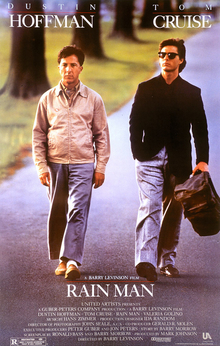
Rain Man (1988) Director: Barry Levinson
“Of course when they bring the pancakes after the maple syrup it’ll be too late…”
★★★☆☆
Rain Man is a bittersweet comedy/drama that occurs mainly on the open road. It is about the troubled relationship between two brothers, Raymond Babbitt (Dustin Hoffman) a high-functioning autistic savant who lives at the Wallbrook Mental Institution and whose life is timed by a rigid series of schedules in order to maintain psychological stability; and a slick Los Angeles hotshot named Charlie Babbitt (Tom Cruise) who is only interested in money. When Charlie Babbitt’s father dies he learns he has merely inherited a classic car and little else, and instead the bulk of his father’s fortune totaling $3M has been placed in a trust held by the Wallbrook Institution. Charlie travels across the country to the Wallbrook Institution where he discovers his previously unknown brother, Raymond.
When Charlie…
View original post 219 more words
Essential UCLA School of Economics: The Economics of Unintended Consequences
06 Oct 2021 Leave a comment
in applied price theory, applied welfare economics, Armen Alchian, comparative institutional analysis, economics of information, economics of regulation, Gary Becker, George Stigler, industrial organisation, law and economics, Ronald Coase, Sam Peltzman, survivor principle
Our electoral system is to be subjected to a sweeping review – but the Maori seats are in no danger of being brushed away
05 Oct 2021 Leave a comment

The Parliamentary seats put aside especially for Maori – they provided Labour with five MPs at the 2020 general election – are among the issues that are off limits during something described by RNZ as “a sweeping review of the country’s electoral laws”.
It will include voting age, the three-year term, party funding and the “coat-tailing” rule.
But the government has been careful to ensure the seven Maori electorates (although it lost two of them to the Maori Party at the last general election) aren’t swept away during this clean-up of our electoral system.
As Faafoi explained without the hint of a blush, the review will not consider changes to Māori seats, local elections, changing from the MMP system, or fundamental constitutional changes such as becoming a republic or having an upper house.
Moreover, he said some rule changes – he described these as “targeted” ones, such as changes to…
View original post 971 more words
David Friedman – The World From an Anarchist-Anachronist-Economist’s View
05 Oct 2021 Leave a comment
in applied price theory, applied welfare economics, comparative institutional analysis, constitutional political economy, David Friedman, economics of crime, labour economics, law and economics, property rights
The Greens may never have a better opportunity to tackle climate change
04 Oct 2021 Leave a comment

In Germany that is.
Age before beauty they say. But after last week’s inconclusive election in Germany it’s the forty-something leader of the Green party, Annalena Baerbock, and her generational compatriot, Christian Lindner of the market liberal Free Democrats (FDP), who are making the running in coalition negotiations, leaving the sexagenarians who head the Christian and Social Democrats out in the cold – for now.
View original post 580 more words


Recent Comments